I’ve been very much impressed by Pierre Mac Orlan painted by Henri Landier found on a Le copain de Doisneau, a blog dedicated to Robert Giraud.

Merryland (1740) – Thomas Stretzer

Merryland (1740) – Thomas Stretzer
Edition shown: NY: Robin Hood House (1932)
Her valleys are like Eden, her hills like Lebanon, she is a paradise of pleasure and a garden of delight
This poetic praise by the pseudonymous Thomas Stretzer may sound like any other earth-troping colonization of womanhood similar to John Donne’s well-known characterization of his mistress; Oh “my America, my new-found-land!” Those familiar with Merryland (published in 1740) and indeed, with a whole tradition of what Darby Lewes has dubbed somatopias (texts composed of, or designed for the body), will recognize in these words the embarrassingly facile puns of female landscaping metaphors that treat woman as so much ground to till, as so much earth to exploit. Certainly, Stretzer’s Merryland—both composed of and designed for bodies—offers up a fertile pornocopia for male corporeal pleasures based on exposed, accessible female body parts. —http://www.specmind.com/vixen/geography_of_desire.htm [Sept 2005]
Goodbye sweet dreams
https://www.youtube.com/watch?v=_c7Y1McdyaM
Schreber’s Fantastic Beasts
Schreber’s Fantastic Beasts:
“In 1774 Johann Christian Dan Schreber authored a multivolume set of books entitled Die Saugthiere in Abbildungen nach der Natur mit Beschreibungen. Focusing on mammals of the world, these books were lavishly illustrated with 755 hand-colored plates. There was a slight problem though: in most instances the artists had never seen the animals they were rendering onto paper. Explorers would return from their travels and describe the animals in question to the artists. The end result was that some of the drawings, though representing real animals, looked more like they had come from someone’s nightmares.” —http://www.nhm.org/research/libraries/beasts/index.html
Miscellaneity
[Youtube=http://www.youtube.com/watch?v=rUG80q-zNIs]
[Youtube=http://www.youtube.com/watch?v=_NZfTQECLH0]
[Youtube=http://www.youtube.com/watch?v=_N4xBts4ptA]
[Youtube=http://www.youtube.com/watch?v=f-QkDnx22ow ]
[Youtube=http://www.youtube.com/watch?v=LKql_sBQTM0&]
Jean-Pierre Bouyxou interviewed
Dailymotion has an interview by Stéphane du Mesnildot with Jean-Pierre Bouyxou –via I’m in a Jess Franco state of mind by
Summary:
Part 1: Il évoque la naissance de sa cinéphilie et l’importance de la revue Midi-Minuit Fantastique. Il nous parle aussi de Jean Boullet, de Kenneth Anger et de “l’adaptation” d’Histoire d’O par ce dernier.
Part 2: Jean-Pierre nous parle des années 60 et du caractère sulfureux du cinéma fantastique, mais aussi de Guy Debord.
Part 3: Jean-Pierre nous parle de cinéma expérimental, du cinéaste Etienne O’Leary et de la contestation dans les années 60.
Part 4: Jean-Pierre nous parle du peintre et photographe Pierre Molinier et de son film “Satan bouche un coin”. il évoque aussi Noël Godin et les attentats pâtissiers de Georges Le Gloupier.
Part 5: Jean-Pierre nous parle de son amitié avec Jean Rollin, le grand cinéaste de films de vampires français.
Part 7: Jean-Pierre nous parle de ses deux films pornos qu’il a réalisés dans les années 70 : “Entrez vite… vite je mouille” et “Amours collectives”.
Part 8: Jean-Pierre nous parle de la revue Fascination, la bible des amateurs d’érotisme « Belle Epoque ».
I’ve mentioned Bouyxou here.
Can’t say what they mean, don’t mean what they say
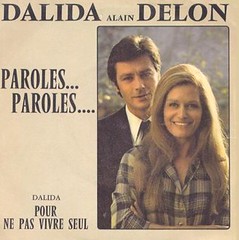
Paroles, by Dalida, words in romance and daily life
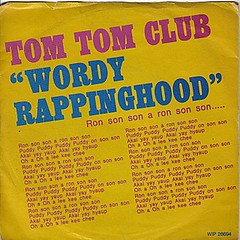
Wordy Rappinghood by Chicks on Speed, postmodern words
more on words
Nick Cave-esque
[Youtube=http://www.youtube.com/watch?v=uRu5sqaHLHQ]
Via DC’s.
In 1968, an abbreviated version of the film Haxan was released, entitled Witchcraft Through The Ages. This version featured an eclectic jazz score by Daniel Humair and dramatic narration by William S. Burroughs. The film was produced by Antony Balch.
My previous post on this subject.
John Zorn plays his favourite records
John Zorn plays his favourite records via dmtls
The thing I like to find out most about my favourite artists is who influenced them. Show me your bookcase/record case/video library and I’ll tell you who you are!
A bit about Zorn at Art and Popular Culture.
The originating broadcast is NYC FM, c. a. 1992.
The tracklisting is Mauricio Kagel, Napalm Death, James Blood Ulmer, Hasil Adkins, Juan Garcia Esquivel, Roland Kirk, Jazz Composer’s Orchestra, Husker Du, Die Kreuzen, Naked City, Indian Karnatic Jazz (directed by T.K. Ramamurthi), Funkadelic, Beach Boys, Ennio Morricone, John Zorn, Lenny Tristano, very similar to the one found here.
This is the hippest hour of music I’ve’ heard in a long time.
“These guys are supposed to be American? My ass!”
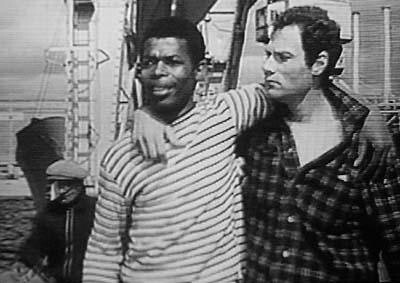
I Spit On Your Grave (1959) – Michel Gast
On the morning of this date in 1959, Boris Vian was at the Cinema Marbeuf in Paris for the screening of the film version (see picture above) of his controversial “Vernon Sullivan” novel, I Spit On Your Graves. He had already fought with the producers over their interpretation of his work and he publicly denounced the film stating that he wished to have his name removed from the credits. A few minutes after the film began, he reportedly blurted out: “These guys are supposed to be American? My ass!” He then collapsed into his seat and died of a heart attack en route to the hospital.
Background:
J’irai cracher sur vos tombes (Eng: I Spit On Your Graves) is a 1946 French language novel by Boris Vian written under the pseudonym Vernon Sullivan. It was adapted to film by Michel Gast in 1959. Radley Metzger bought the American the rights to this film and distributed it there from 1963 onwards. Miscegenation, murder and revenge are the themes of this French crime drama set in the American south.
Plot
The story, like the other stories that Vian wrote under the “Sullivan” moniker, is set in the American South and describes the difficulties African Americans face in their daily lives with “whites”. In this novel, Lee Anderson, a light-skinned African-American, leaves his native town after his brother was lynched and hanged because he was in love with a white woman. Once arrived in this other city, Lee becomes librarian and fraternizes with the local youngsters who crave for alcohol and sex. His goal is to avenge his brother.
Different in style from other Vian novels, this story is more violent, rawer and most representative of the “Sullivan” series, in which Vian denounces the atmosphere of racism and the precarious situation of African Americans’ living conditions in the American South.
Shortly after its publication (in 1949) the novel was banned because it was perceived as pornographic and immoral; Vian himself was convicted of “outrage aux bonnes mœurs” [2] a French phrase meaning outrage to public morality or “an insult to public decency. (see Censorship in France) There was a 1947 illustrated version by Jean Boullet. The novel also exists in a bowlderized version.
I’ve previously written about Vian here.