Noise rock pioneers Big Black covered ‘Das Model‘ on their 1987 album Songs About Fucking.
View the original by Kraftwerk (played live?) , which opens with footage from what I believe is an early Christian Dior’s New Look collection.
Noise rock pioneers Big Black covered ‘Das Model‘ on their 1987 album Songs About Fucking.
View the original by Kraftwerk (played live?) , which opens with footage from what I believe is an early Christian Dior’s New Look collection.
[Youtube=http://www.youtube.com/watch?v=oeeFKXnQST0]
Fuses (1967) by Carolee Schneemann
Carolee Schneemann (b. 1939) is an American performance artist, known for her discourses on the body, sexuality and gender. She received a B.A. from Bard College and an M.F.A. from the University of Illinois. A member of the Fluxus group, her work is primarily characterized by research into visual traditions, taboos, and the body of the individual in relationship to social bodies. Her most famous works include Eye Body: 36 Transformative Actions (1963), Meat Joy (1964), Fuses (1967), and Interior Scroll (1975)
She has published widely, producing works such as Cezanne, She Was a Great Painter (1976) [2] and More than Meat Joy: Performance Works and Selected Writings (1997) [3].
[Youtube=http://www.youtube.com/watch?v=7KC_5pnbsWU]
The Terror’s Advocate is new documentary film by Barbet Schroeder about terrorism in the last 50 years seen trough the eyes of a lawyer, Jacques Vergès, and his clients.
[Youtube=http://www.youtube.com/watch?v=6Q7amoKYFCc]
It’s been ages since I regularly listened to this Nick Cave classic. Cave’s more interesting songs are the biblical ones. I clearly remember the moment when I first heard about his novel “The Ass Saw the Angel.”
Nick Cave wrote the song The Mercy Seat for his 1988 Tender Prey album; his ‘signature tune’, it has been performed at nearly every concert since 1988. The song tells the story of a condemned man facing death on the electric chair seeking redemption in the afterlife. This song was later covered by Johnny Cash on his album, American III: Solitary Man.
[Youtube=http://www.youtube.com/watch?v=SEU-AZszsr0]
A Youtube remix of Titicut Follies, a 1967 American film on life in a mental institution for the criminally insane. The Youtube uploader added a Einstürzende Neubauten audio track to this originally scoreless film. Harsh.
[Youtube=http://www.youtube.com/watch?v=bBz4UJUjunk]
Que Tal America (1978) – Two Man Sound
Lou Deprijck, who was behind the above, also did Plastic Bertrand’s 1977 international hit single “Ça plane pour moi” :
[Youtube=http://www.youtube.com/watch?v=Km2qrc9nqCg]
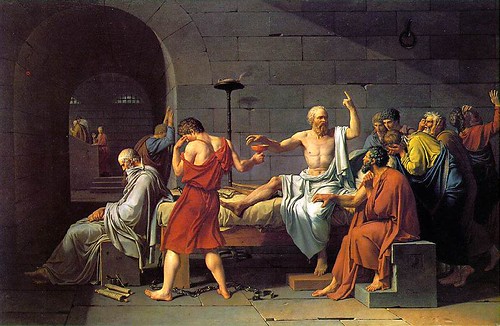
The Death of Socrates (1787) by Jacques-Louis David
I’ve started reading The Consolations of Philosophy by Alain de Botton and the book starts out with Socrates and his trial:
The trial and execution of Socrates was the climax of his career and the central event of the dialogues of Plato. According to Plato, both were unnecessary. Socrates admits in court that he could have avoided the trial by abandoning philosophy and going home to mind his own business. After his conviction, he could have avoided the death penalty by escaping with the help of his friends.
But he didn’t avoid the trial or flee. This makes him an icon of countercultural history.
[Youtube=http://www.youtube.com/watch?v=UN4Xkgm2a9c]
[Youtube=http://www.youtube.com/watch?v=r13RWKQ5DEc]
P. S.
[Youtube=http://www.youtube.com/watch?v=5_2kp6JtHAY]
Wonderland (1999) , also by Winterbottom, with a score by Michael Nyman.

Parc Monceau by Monet

Monceau Park (1878) – Claude Monet
In search of Borgesian elements in Story of O.
From the opening lines of Story of O:
Where did her lover take her? To the Monceau Park or the Montsouris Park? Or both?
I’ve written about O here.
Somewhat related linkcandy: sinnliches.ch and and accompanying Google gallery (nsfw).
![[2]](http://stephan.barron.free.fr/2/troupenat_schneeman/cezanne.jpg)
![[3]](https://www.mcphersonco.com/share/morethan.jpg)