Flaubert’s hatred for the bourgeois was at times almost maniacal

Yesterday I acquired Bohemian Versus Bourgeois at Demian bookstore, Antwerpen. It appears to be one of the earliest books on alienation in modern art, taking a sociological approach. Colin Wilson has done the same with a psychological approach in 1956 with The Outsider.

Bohemian Versus Bourgeois: French society and the French man of letters in the nineteenth century (1964) – César Graña [Amazon.com] [FR] [DE] [UK]

It’s in this book that one finds references to the group of French artists les bousingots, which is rendered bousignots in the index. Web references to this groups include: “Hugnet, Georges, 1906-1974. Bousignots, excentriques et isolés du romanisme, typed manuscript with handwritten corrections together with signed typed letter 1954 Oct. from L. Mollion of Radiodiffusion Français”. The book itself references Théophile Lavallée’s Histoire de Paris depuis le temps des Gaulois jusqu’en 1850 published by J. Hetzel, Paris, 1852. [Feb 2007]

César Graña bio

César Graña (1919 – 1986) was a Peruvian anthropologist who received his Ph.D. of sociology from the University of California. In 1942, he came to the United States.

César Graña’s best known work was based on the sociology of art. He wrote Bohemia vs. Bourgeois: French Society and the French Man of Letters in the Nineteenth Century, which was published in 1964, this work is also known as Modernity and its Discontents. In 1989, he released Meaning and Authenticity. On Bohemia: The Code of the Self Exiled was published in 1990. In 1994, Fact and Symbol was published and it was nominated for a National Book Award. Graña died on August 24, 1986 in a car crash. —[1]

An excerpt from cultural relativist Roger Sandall’s The Culture Cult:

In his 1964 study Bohemian Versus Bourgeois César Graña shows how [the bohemians] claimed a more natural sympathy with other cultures than the bourgeoisie could possibly possess. They regarded the lives of the French commercial and professional classes as utterly degrading. Graña describes Stendhal’s horror of the lowness and meanness of the middle-class, and how “anyone who acquired a routine social obligation or worked at a profession received from Flaubert either casual scorn or mocking sorrow”. This same contempt for the routine world of paid employment was pushed to an extreme by Baudelaire, whose attitude—“to be a useful person has always appeared to me to be something particularly horrible”—expressed pure aristocratic disdain.

Flaubert’s hatred for the bourgeois was at times almost maniacal. After completing his second novel Salammbo in 1862 he wrote that “It will: 1) annoy the bourgeois; 2) unnerve and shock sensitive people; 3) anger the archaeologists; 4) be unintelligible to the ladies; 5) earn me a reputation as a pederast and a cannibal. Let us hope so.” While research into sexual behavior is a normal part of anthropological inquiry, it was a personal interest in erotic experience—romantically justified as self-fulfilment—which drove literary bohemia on its escapades. — Roger Sandall via http://www.culturecult.com/culturecult/bohemia.htm [Jun 2006]

See also: FlaubertStendhalBaudelairebohemiabourgeoisgenre theory

Xkeban was sick with lust and gave her favors to every man who asked her

Yma Sumac at 83

Queen of Exotica (2005) – Yma Sumac [Amazon.com] [FR] [DE] [UK]

Fabulous documentary here provided by the ever reliable Ombres Blanches. Yma Súmac belongs to the intriguing exotica category. Yma is alive and will be 85 coming September. Here and here is some Yma at MySpace, the reliable source for instantaneous auditory gratification, just as is Youtube for the moving visuals gratification and Flickr for stills.

I quote Ombres Blanches’s post in full:

If someone always wanted to know what that Xtabay is that Yma Sumac sings of, here’s the answer:

Xtabay litterally means ‘Female Ensnarer’ and can refer to (1) a basically Mesoamerican demon who seduces and kills, and (2) a female deity of the hunt, on a par with the male Ah Tabay. The Xtabay is not to be confused with Ix-Tab, a 16th-century Yucatecan goddess of suicides.

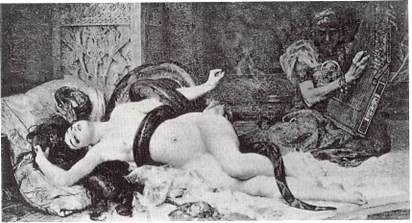
A legend of Xtabay (the female demon) tells us about two women who lived in a village in the Yucatán Peninsula. One was named Xtabay, but people called her Xkeban (which means prostitute, bad woman or who practices illicit love), the other was Utz-Colel (a good, decent woman).

People said Xkeban was sick with lust and gave her favors to every man who asked her. Utz-Colel was virtuous and honest…” more…

In another tale – incindentally to be found in Benjamin Péret’s retelling of American myths and legends – La Xtabay turns out to be a female demon consisting of nothing else but hair.

A french documentary about Yma Sumac with some beautiful stock footage can be found here.

A bone thrown from the void

I’ m completely smitten with Joanna Newsom’s late 2006 Ys album. Here is an early review by Woebot and here is the Wikipedia link.


Ys (2006) – Joanna Newsom

[Amazon.com] [FR] [DE] [UK]

Folk music and the new weird has been the hottest and hippest after replacing house, disco and electro on my musical diet. Best of 2006.

Incidentally, the vocals and harp were recorded by Steve ‘Big Black’ Albini.

From the song ‘Emily’:

That the meteorite is a source of the light
And the meteor’s just what we see
And the meteoroid is a stone that’s devoid of the fire that propelled it to thee

And the meteorite’s just what causes the light
And the meteor’s how it’s perceived
And the meteoroid’s a bone thrown from the void that lies quiet in offering to thee

It takes about a year and several hundred injections to make an addict

“You don’t wake up one morning and decide to be a drug addict. It takes at least three months’ shooting twice a day to get any habit at all. And you don’t really know what junk sickness is until you have had several habits. It took me almost six months to get my first habit, and then the withdrawal symptoms were mild. I think it no exaggeration to say it takes about a year and several hundred injections to make an addict.” —Junky (1953) – William S. Burroughs

His unpleasant relations with her so affected his health

And some Goltzius to bid you good night:

 Icarus, from The Disgracers, engraving, 1588

At the age of twenty-one Goltzius (1558 – 1617), Dutch painter and engraver, married a widow somewhat advanced in years, whose money enabled him to establish at Haarlem an independent business; but his unpleasant relations with her so affected his health that he found it advisable in 1590 to make a tour through Germany to Italy, where he acquired an intense admiration for the works of Michelangelo, which led him to surpass that master in the grotesqueness and extravagance of his designs. He returned to Haarlem considerably improved in health, and laboured there at his art till his death.

The monster appeared in Buenos Aires on August 26

Via Celeste comes this:

0

 Description of a Monster Born of a Ewe (Translation of August 1708 Work)


“The monster which is shown in the figure appeared in Buenos Aires on August 26. The contrast of three resemblances which it had, that of a child, a horse, and a calf, surprised all who saw it. I asked the person who showed it to me if I could examine it in order to describe it faithfully, but he never allowed me to do this. I examined it from quite close and drew its principal traits without his noticing. As soon as I returned to my room, having all the information about the monster vividly in my memory, it furnished what was missing from the drawing. I completed it and represented it in its natural color.”[2]

Louis Éconches Feuillée (sometimes spelled Feuillet) (1660-1732) was a French member of the Order of the Minims, explorer, astronomer, geographer, and botanist.

Limbo, weightlessness, and uncertainty

Have you ever reached out for something that was so tangible as to be almost in your grasp… that you realized you had to let go of what you were holding on to – to be able to reach even further out towards the object of your interest? The letting go is reminiscent of limbo, weightlessness, and uncertainty; that ‘far away, so close’ feeling.

Download the_one_moment.mp3 via Kierkegaardian

Oh how I love the plentiful emptiness of Michael Nyman.

Kierkegaardian and arcimboldesque

André Martins de Barros more here, Barros is also the artist who did the flyer I first encountered on Ian McCormick’s grotesque page.

Found when Googling for Arcimboldesque, this anomymous etching c.1700, mid-Italian map, sourced here

The Moviegoer is a 1961 Kierkegaardian philosophical novel by Walker Percy. The writer of this page holds that High Fidelity, Garden State, The Graduate, The Truman Show, American Beauty, Harold and Maude, Adaptation and Sideways are similarly themed.

I quote from The Moviegoer:

“Today is my thirtieth birthday and I sit on the ocean wave in the schoolyard and wait for Kate and think of nothing. Now in the thirty-first year of my dark pilgrimage on this earth and knowing less than I ever knew before, having learned only to recognize merde when I see it, having inherited no more from my father than a good nose for merde, for every species of shit that flies – my only talent – smelling merde from every quarter, living in fact in the very century of merde, the great shithouse of scientific humanism where needs are satisfied, everyone becomes an anyone, a warm and creative person, and prospers like a dung beetle, and one hundred percent of people are humanists and ninety-eight percent believe in God, and men are dead, dead, dead; and the malaise has settled like a fall-out and what people really fear is not that the bomb will fall but that the bomb will not fall – on this my thirtieth birthday, I know nothing and there is nothing to do but fall prey to desire.”

More info over at Kierkegaard and Arcimboldo.

The possibility of a literary canon

On the Possibility of Conservative Literary Criticism

via Acephalous by Scott Eric Kaufman on Feb 27, 2007

Actually, Scott’s post is more about the possibility of a literary canon tout court. He says: “few believe that Shakespeare, Tolstoy or Melville shouldn’t be taught—that’d they’re somehow inadequately “literary” in some regard—only that they should be taught alongside Behn [amatory fiction, women’s lit], (George) Eliot [women’s lit] and Stowe [Uncle Tom].” He recognizes place and time constraints: “Practical issues obviously abound. I’m talking about the hypothetical canon here, not what can be covered in a ten or eighteen-week survey.”

Shakespeare is universal because he embraced cultures and traditions outside his own—although his argument suffers here from being too quick on the triumphalism. …But then there’s the problem of what else should be included in the canon. We all agree that Shakespeare should, but what about all those books written by brown people who live on islands we’ve never even heard of. Can they possibly produce great literature. …

there’s absolutely no reason [Erna] Brodber‘s Jane and Louisa Will Soon Come Home couldn’t be a work of “universal” genius. Were someone to argue that “our” cultural tradition isn’t represented, the claim to universality could be wielded as a multicultural cudgel: It doesn’t matter, we could say, swinging, because it tells a universal story, as applicable to us and our lives as any native Jamaican.

….

none of the usual critics of academia have attempted to define the literary in such a way that Shakespeare and Dickens are in, but Brodber and the rest are out. Or, they could have the courage of their convictions and say that if Shakespeare and Dickens are in, so are Brodber and the rest …

In this respect, I think the multiculturalist have cornered the cultural traditionalists, forcing them into a position either visibly incoherent (the false universalism of Shakespeare) or spectacularly racist (Dead and White, That’s What’s Right! Dead and White, That’s What’s Right!). ….

To conclude Scott asks: Where do they go from here?

Essentially, Acephalous is in search of a postmodern canon. A canon that gives a place to the other; the queer, the postcolonial. He’s not denying the justifiability of the Western canon, but wonders how big a place should be reserved for the ‘other’ within that canon, without deviating too far from the what-is-ness of things. I look forward to reading more.