Awe of nature, taste for the bizarre, thirst for knowledge

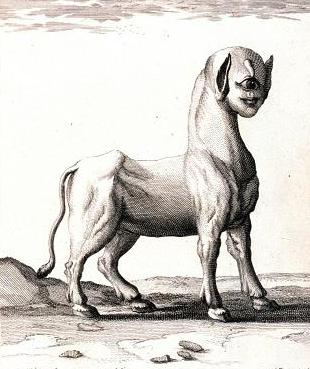
I found some excellent plates of the Monstrorum historia cum Paralipomenis historiae omnium animalium by the Italian naturalist Ulisse Aldrovandi (1522 – 1605) at the Universidade de Coimbra. You can view full sized versions by clicking the thumbnails. In the same collection are also plates by Ambroise Paré, Conrad Gessner, Bartolomeo Ambrosinus, Olaus Magnus, Giovanni Cavazzi da Montecuccolo.

Here are the Wikipedia links: Ambroise Paré, Ulisse Aldrovandi, Conrad Gessner, Bartolomeo Ambrosinus, Olaus Magnus, Giovanni Cavazzi da Montecuccolo.

Il Giornale Nuovo has two posts on Aldrovandi: Aldrovandi’s Watercolours and Aldrovandi’s Herbal. Mr. Aitch adds:

Plants, sea-creatures, serpents, birds, domestic beasts, exotic creatures, ‘monsters’ (deformed animals, freaks of nature, conjoined twins, etc.) are all depicted in these watercolours, as are fantastic fauna, such as dragons, whose existence one supposes had not yet been altogether disproved. Many of the paintings are very beautifully and vividly executed. I’m particularly impressed by the pair of entwined snakes which, whilst I can hardly vouch for their zoological verisimilitude, appear very much alive.

Aldrovandi Monstrorum Historia

Aldrovandi Monstrorum Historia3


Aldrovandi Monstrorum Historia8


Aldrovandi Monstrorum Historia9

Aldrovandi Monstrorum Historia6

Aldrovandi Monstrorum Historia7


Aldrovandi Monstrorum Historia4


Stuffed Animals & Pickled Heads: The Culture and Evolution of Natural History Museums (2001) Stephen T. Asma [Amazon.com] [FR] [DE] [UK]

The natural history museum was a place where the line between “high and low” culture effectively vanished–where our awe of nature, our taste for the bizarre, and our thirst for knowledge all blended happily together. The first natural history museums were little more than high-toned side shows, with such garish exhibits as the pickled head of Catherine the Great’s lover.

Eye candy

Various visuals, discovering the pleasures of Flickr

Work by Tivadar-Kosztka-Csontvary, sourced here, it reminds me of this painting.

Tivadar Kosztka Csontváry (1853-1919) was a Hungarian painter. He was one of the first Hungarian painters to become well-known in Europe.

Work by Ulisse Aldrovandi, sourced here.

Work by Ulisse Aldrovandi, sourced here.

Ulisse Aldrovandi (1522 – 1605)

Ulisse Aldrovandi (1522 – 1605) was an Italian naturalist, the moving force behind Bologna’s botanical garden, one of the first in Europe. Carolus Linnaeus and the comte de Buffon reckoned him the father of natural history studies. He is usually referred to, especially in older literature, as Aldrovandus.

Work by Jean-Louis Alibert. Ilness illustrated is Haematoncie framboisée, painted by Valville and engraved by Tresca.

Jean-Louis-Marc Alibert (1768 – 1837) was a French dermatologist.

Before (1736) – William Hogarth

After (1736) – William Hogarth

Inspired by Gershon Legman’s book Rationale of the Dirty Joke, in which Legman tells of a joke where a woman and a man are window shopping and the man promises the woman everything she likes. After having made love, the man refuses everything he’d promised saying: “When I am hard I am soft, when I am soft I am hard”. Like John Currin today, Hogarth was an excellent portraitist of the condition humaine.

Still-Life with Partridge and Iron Gloves (1504) – Jacopo de’ Barbari

Jacopo de’ Barbari, sometimes known or referred to as: de’Barbari, de Barberi, de Barbari, Barbaro, Barberino, Barbarigo or Barberigo etc., (c. 1440 – before 1516) was an Italian painter and printmaker with a highly individual style. He moved from Venice to Germany in 1500, making him the first Italian Renaissance artist of stature to work in Northern Europe. His few surviving paintings (about twelve) include the first known example of trompe l’oeil since antiquity. His twenty-nine engravings and three very large woodcuts had a considerable influence. —Wikipedia

Anna P., who lived for many years as a man in Germany, was photographed for Magnus Hirschfeld’s book Sexual Intermediates in 1922. Today, Anna would probably be considered to be transgender.

Surrealism avant la lettre

Bizzarie di varie figure

Bizzarie di varie figure (1624) – Giovanni Battista Bracelli

Bizzarie di varie figure (1624) – Giovanni Battista Bracelli

Bizzarie di varie figure (1624) – Giovanni Battista Bracelli

Bizzarie di varie figure (1624) – Giovanni Battista Bracelli


Bizzarie di varie figure (1624) – Giovanni Battista Bracelli

I quote the Giornale Nuovo:

I’ve mentioned Giovanni Battista Bracelli’s book Bizzarie di Varie Figure before. It was originally published in Livorno, in 1624. One would assume the book was not a success, as it exerted no influence, and attracted very little notice until its rediscovery in Paris ca. 1950. Its rediscoverer, Alain Brieux, published a limited facsimile edition of the book in 1963, with a preface by Tristan Tzara. –source

More on bizar here.


Monsters are not signs of God’s punishment

In search of Custos and Liceti and the representation of monstrosities in general.

A “colonel of the Tartars (des Turqs) and a soldier”, captured in 1595, drawn by Domenicus Custos [1]

Dominicus Custos (1550/60–1612) was a copper engraver in Antwerpen and Augsburg.

Don’t forget to check the rest of [this page].


De Monstrorum (1616) – Fortunio Liceti

For the Italian physician Fortunio Liceti, true monstrosity inspired wonder and not horror. He criticized the association of monsters with divine wrath, and pointed out that the word ‘monster’ came from the Latin verb ‘monstrare,’ meaning ‘to show.’ Hence, Liceti argued, monsters were not signs of God’s punishment, but rather, they were creatures to be displayed because of their rarity. —source

In 1616 Liceti published De Monstruorum Natura which marked the beginning of studies into malformations of the embryo. He described various monsters, both real and imaginary, and looks for reasons to explain their appearance. His approach differed from the common European viewpoint of the time, as he regarded monsters not as a divine punishment but rather a fantastical rarety. He also supported the idea of transmission of characteristics from father to son. —Wikipedia

Elephant-headed man from Fortunio Liceti’s De Monstris (1665).

Amorphous Monster (Fortunius Licetus, De Monstris, 1665).

Pope-ass and other monsters from Fortunio Liceti’s De Monstrorum causis natura (1665).


 These are some of the many oddities pictured in a treatise simply entitled De Monstris, by Fortunato (or Fortunio) Liceti (1577-1657), an Aristotelian scholar who also published works on hieroglyphics, spontaneous generation and astronomical controversies. —Il Giornale Nuovo


For those of you unfamiliar with this masterpiece of the genre:

Old Woman. (The Queen of Tunis). c. 1513. Oil on panel. National Gallery, London, UK

Old Woman. (The Queen of Tunis)., Quentin Matsys, c. 1513. Oil on panel. National Gallery, London, UK

To jump-start your thinking

I’ve been thinking about something meaningful to say about the negative stir caused by Camille Paglia’s return to on-line writing at Salon.com. Scott McLemee at Quick Study introduced her comeback with the lines “Is Anybody Out There Eagerly Waiting for Volume Two of “Sexual Personae”? No, I Didn’t Think So….” When I read the actual piece, I found more than 400 comments, more than 90% negative. Today, as I check the backward links to her, I see more than hundred blog entries mentioning her comeback. I haven’t checked the positive/negative in those yet.I was enormously intrigued when I read my first interview with Paglia in Belgian magazine HUMO; I was increasingly intrigued when I read her in techno-utopian Wired magazine; I was rewarded when I finally read Sexual Personae (1990); she introduced me to the Lovecraftian Chthonic, to the Nietzschean Dionysian and Apollonian, she said strange things on date rape, her quotes were funny, she compared Meryl Streep (who I disliked at the time, I’ve since seen Adaptation and changed my mind, which reminds me that I have to re-watch Sophie’s Choice.) to I believe a horse and mentioned her nasal tone. I liked it. I had been raised on a Freudo-Marxist diet and her biased politics were refreshing. In short, I loved her, and I still do; my page on her is even referenced at the Camille Paglia checklist:

Camille Paglia , another dictionary entry in a network of illustrated cultural references, with quotes illustrating various points Paglia is known to occasionally make.”

Over the last few years, I’ve come to understand what her limits are, that she is indeed often only a provocateur (but what a flattering ToA), this sentiment was best described by Lee Siegel who wrote two years ago:

To invoke two other writers from the past, Paglia used to come on like Byron; now she is like some cynical version of Dickens’s Oliver Twist, trampling on her very own standards, stooping as low as she can go in order to get a second helping of attention from the public that has forgotten her. But bullies always end up being reduced to their inner weakling. It’s called poetic justice. –Lee Siegel in Look at Me [June 13, 2005 ]

So there I was, trying to defend someone and not knowing how. Until today when Scott Mclemee, in a fascinating post paralleling Zizek and McLuhan, provides the vocabulary I was looking for: “to jump start your thinking”. According to the American Heritage Dictionary to jump-start means to “start or reinvigorate (an activity, system, or process).”

Jump-start my thinking is exactly what Paglia did. Philosophers who are quotable. Philosophers who read like poets. Philosophers who write prose poetry. Philosophy as eternal recurrence repackaged in beautiful words.

And now for the Marshall McLuhan / Slavoj Žižek parallel:

By coincidence, I see that Jonathan Goodwin has noticed an interesting parallel that certainly squares with my own impression:

Žižek reminds me much of McLuhan. Facts don’t matter for either. In the space of a few pages, Žižek has claimed that Martin Luther King made a radical anti-capitalist turn in the last few weeks before his death and that the Japanese Army relied on a Zen mantra similar to “the sword that kills is the sword that saves” to justify their actions in Korea and Manchuria. These are not even the kinds of claims that can be checked. As with McLuhan, Žižek just wants to make as many connective gestures as possible. That’s what make both, generally speaking, fun to read but dangerous to the untutored.

This is exactly right. McLuhan liked to refer to some of his writing as “probes” — a very space race-era locution (let’s not even get into the Legmanian implications) meaning, in effect, “I am totally making this up as I go along.” —Scott Mc Lemee via Legman and McLuhan With Zizek Along the Way.

Speaking of Adaptation and eternal return, I caught Eternal Sunshine on TV, and I was slightly amused but not impressed. In the category experiment in cinematic time it did not strike a chord as much La Jetée or Back to the Future. As Charlie Kaufman script I was more impressed with Adaptation and Being John Malkovitch.

One last word on film, I got to see Destricted, and was only slightly taken by Matthew Barney’s opening vignette, and found the rest of the film quite literally masturbatingly boring. I was especially bored with Noé’s ‘strobed’ entry. Larry Clark had put up an ad for young men to apply to perform with an adult actress. After Clark and his team had chosen the male candidate, the male candidate interviewed the actresses and made his pick. He then proceeded to ‘get it on’. Very sad, just as sad as the Lasse Braun documentary I watched a while back. Final verdict for Destricted: to be avoided, try catching the Matthew Barney ‘s Hoist (and here) at Youtube and you’ve had the best.

Elsewhere


For more of these delightful images, check Casey’s post referenced below, this image from here

  1. gmtPlus9 (-15)
  2. Dennis Cooper has a William Gaddis special, I picked this profile of his novel The Recognitions of which Dennis says: “Though neglected for many years, this monumental, eclectic, and intertextually dense masterpiece is now regarded as one of the foundation stones upon which American literary postmodernism is built. ” Also note this beautiful cover image — which has the feel of a Northern Renaissance piece — anyone by whom the painting is?
  3. S. Casey reports on one of his books called Diableries, see image here, here and here. I am very much intrigued by S. Casey, and his C. V. adds to my curiosity.
  4. Both the music blogosphere and the literary blogosphere have articles about ‘the conventional press’ ridiculing bloggers.
    1. Woebot reports on “Paul Morley [who] is almost guaranteed to be having a pop at music bloggers. … The latest piece is almost entirely about online music criticism. It’s quite hilarious really.”
    2. Conversational Reading quotes Sam Tanenhaus, who says “I find [litblogs] write about us, but I don’t find they write about authors and have that many interesting things to say about literature. Maybe I’m missing them?”

Our society allows infinite aggressions

I am sort of reviewing my newly arrived copy of Legman’s Rationale of the Dirty Joke, but thought I’d share the opening lines of the book with you:

“Under the mask of humor, our society allows infinite aggressions, by everyone and against everyone. In the culminating laugh by the listener or observer–whose position is really that of the victim or butt–the teller of the joke betrays his hidden hostility and signals his victory by being, theoretically at least, the one person present who does not laugh. Compulsive storytellers and joke-tellers express almost openly the hostile components of their need, by forcing their jokes upon frankly unwilling audiences among their friends and loved ones, and upon every new person they meet. Often they proffer this openly as their only social grace. the listener’s expected laughter is, therefore, in a most important but unspoken way, a shriving of the teller, a reassurance that he has not been caught, that the listener has partaken with him, willy-nilly, in the hostility or sexuality of the joke, or has even acceded in being its victim or butt.” (Rationale, 1st Series, first page.)

I’ve finished my analysis of the introduction here.

No index

Report obscene mail to your postmaster[1].

To Gershon Legman, what would his blog have been like?

Rationale of the dirty joke: An analysis of sexual humor (1968) – G Legman
[Amazon.com]
[FR] [DE] [UK]

My copy of Gershon Legman’s Rationale of the Dirty Joke arrived in the mail today, I had ordered it somewhat “by accident” after finding out about Neurotica magazine (a magazine Legman was involved with in the 1950s) via Scott McLemee’s new blog Quick Study. My first impressions are: no index (I have a British edition of 1969, but I do not believe it is present in the American edition either) but also no bibliography, of which my version says it is available in the American edition.

One of the first things I check in a non-fiction book is the TOC — I’m always interested in a good ontology — Legman in this case confirms that he essentially relied on the ontological model Freud first set forth in Jokes and their Relation to the Unconscious(1905).

I read about 13 pages in this 700+ page book and found it clear and amusing. There were favorable references to Games People Play , Children’s Humor : a Psychological Analysis (1954) by Martha Wolfenstein (who was analyzed by the art historian and lay analyst Ernst Kris) and The Mask of Sanity (1941) by Hervey Cleckley.

Only now do I find out that Taschen and Simon & Schuster have reprinted Rationale. Maybe they have an index?


Simon & Schuster reprint

[Amazon.com] [FR] [DE] [UK]

Links: Freud’s Legacy by Richard Webster.

See also: Our society allows infinite aggressions

Easy access to id material without being overwhelmed by it …

‘Groovy Age of Horror Curt”s third post in a series Horror, High and Low on the merits and theory of genre fiction comes just in time as he is about to delve into the depths of Nazi exploitation fiction in a series he announces as The Nazis Are Coming. Needless to say, I am a bit of a fan of this guilty pleasure genre myself and I am happy that he introduces this chapter (other chapters have included vampires, werewolves, Frankenstein, nurses) with the cautionary words: as long as it firmly remains fantasy.

“I hope this goes without saying, but I’ll say it anyway: I, a hardcore liberal, no more endorse Nazism politically than I, a hardcore atheist/naturalist, endorse belief in the supernatural elements in the horror novels I review here. Nazis are bad for real life, but they obviously resonate powerfully in the imagination as embodiments of evil, sadism, and power. Like so much else, they’re good for fantasy–as long as it firmly remains fantasy. “

The emphasis on fantasy reminds me of the cathartic theories on gruesome fiction and the aestheticization of violence that were en vogue in the sixties and seventies.

Contrary to the cathartic theory, Curt’s current piece recognizes — by way of the theories of Ernst Kris, presumably from Psychoanalytic Explorations in Art (1952) — the possibility of being overwhelmed by id material, of not being able to distinguish the line between fact and fiction. This shines a particular light on media effects studies where for several decades, discussion of popular media was frequently dominated by the debate about ‘media effects’, in particular the link between mediated violence and real-life aggression.

An excerpt:

A more mature critical attitude, one that has made that reconnection, rather manifests a healthy flexibility described by Ernst Kris as,

The capacity of gaining easy access to id material without being overwhelmed by it, of retaining control over the primary process [i.e., while indulging it], and, perhaps specifically, the capability of making rapid or at least appropriately rapid shifts in levels of psychic function . . .

I think this truly positive account of genre fiction is what’s needed to put Jahsonic’s “nobrow” position on its firmest footing. I’m no more interested in Danielle Steele than Jan is, but now we’re in a position to say something about her–at least to the extent that we’re in a position to say something about genre fiction in general. Likewise, when Jan likens exclusively highbrow critics to someone who “only know[s] two colors, let’s say green and blue,” we’re now in a position to complete that metaphor by filling in the blanks of what the other colors represent that are missing from that palette–the warm colors, appropriately enough! —source

On a more personal note, Curt’s post above is the most articulate response so far since I started posting in the nobrow category. Curt’s blog Groovy Age has reinforced my position that one can only come to the nobrow if you know both ‘brows’.

Groovy Age is the only horror blog I read precisely because it knows its way around in ‘high theory’, referencing Freud and Ernst Kris. Fortunately Curt’s high theory does not detract from the sheer fun and excitement that oozes from its pages. I am already on the lookout for his 2008 nunsploitation chapter.

They show no empathy, remorse, anxiety or guilt …

In search of psychopaths

They are generally considered to be not only incurable but also untreatable. They show no empathy, remorse, anxiety or guilt in relation to their behavior, in short, they truly seem devoid of conscience.

It has been shown that punishment and behavior modification techniques do not improve the behavior of a psychopath. They have been regularly observed to respond to both by becoming more cunning and hiding their behavior better. It has been suggested that traditional therapeutic approaches actually make them, if not worse, then far more adept at manipulating others and concealing their behavior.

Charles Starkweather

Charles Starkweather (1938 – 1959) was a spree killer who murdered 11 victims in Nebraska and Wyoming during a road trip with his underage girlfriend Caril Ann Fugate. He became a national fascination, eventually inspiring the films The Sadist, Badlands and Natural Born Killers. Charles had an obsession with James Dean; he sympathized with Dean’s rebellion, believing that he had found a kindred spirit of sorts, someone who had suffered ostracization similar to his own.


The Sadist (1963) – James Landis [Amazon.com]

The Sadist is a 1963 black and white American exploitation film written and directed by James Landis, based on real life serial killers Charles Starkweather and Caril Fugate.


Peter Kürten

Peter Kürten (1883- 1932) was a German serial killer dubbed The Vampire of Düsseldorf by the contemporary media. He committed a series of sex crimes, assaults and murders against adults and children, most notoriously in the year1929 in Düsseldorf. As he was awaiting execution, he was often interviewed by Dr. Karl Berg. Later Berg’s book The Sadist (pictured above) was written on the account of Kürten’s murderous career. Kürten gave his primary motive to Berg as being one entirely of sexual pleasure. The number of stab wounds differed due to the simple fact it took longer to achieve climax. It was the sight of blood that was integral to his sexual ejaculation.

Peter Lorre in M (1931)

M – (1931) – Fritz Lang [Amazon.com] [FR] [DE] [UK]

In 1931, Fritz Lang’s movie M was released. It told a fictionalized story of a serial child killer. Some feel it was in part based on Peter Kürten’s crime spree, primarily concerning itself with the atmosphere of hysteria surrounding the case. Lang fervently denied that he drew from this case. The film could just as well have been based on the stories of Jack the Ripper.