Disco D commits suicide

Word has just got in that hip hop producer Disco D has taken his life at only 26. Always sad, this kind of news. Here is one of his productions for 50 Cent. Shayman fought manic-depression for much of his adult life.

Dave Shayman (aka Disco D) was found dead this morning of an apparent suicide. He was 26 years old.

The Michigan-bred, New York-based producer—who was best known for his work with 50 Cent — began his career at the age of 16 in the college town of Ann Arbor, MI. Having discovered the then unnamed Detroit ghettotech scene via artists such as DJ Assault and DJ Godfather, the still in high school Shayman dove head first into the music scene, scoring his first residency at age 17, at Ann Arbor’s The Blind Pig before he could even legally enter the venue. He began releasing music soon after signing his first record deal before graduation with Bad Boy Bill’s Muzik/Mixconnection label. —URB.com

That the eleven thousand virgins punish me if I lie

“If I had you in bed with me, twenty times in a row I would prove my passion to you. That the eleven thousand virgins punish me if I lie.”

The Eleven Thousand Rods (1907) – Guillaume Apollinaire
[Amazon.com]
[FR] [DE] [UK]

The Eleven Thousand Rods (French: Les Onze Milles Verges) is a 1907 erotic novel by Apollinaire. The title is a pun on the legend of Saint Ursula and her eleven thousand handmaidens. The pun works better in French where vierge means virgin and verge means rod. The painting on the cover of the French edition shown above looks like something by Ingres, but is it?

It is my honour to declare war on you

In search of the editors of surrealism

Eric Losfeld (photocredit unidentified)

Eric Losfeld gives a good indication of his surrealist approach to life early in his memoirs. When on his military service in the 1930’s, he writes to Adolf Hitler:

“Sir, I am a Belgian soldier who is bored in a garrison in a city called Namur. I hold you personally responsible for this. Subsequently it is my honour to declare war on you”. [translation mine]

There is no record of what reply, if any, was received from Berlin . –Patrick J. Kearney via here.

When Kearney refers to Losfeld’s memoirs, he must be quoting from Losfeld’s autobiography Endetté comme une mule: Ou, La Passion d’éditer (1979) which costs a prohibitive amount of money at Amazon.com, is unavailable at [FR],and costs even more at [UK], so if anyone knows how to read this cheaply, please let me know. BTW, the title roughly translates as — please correct me if I get this wrong: Indebted for life, or, the passion for publishing.

Entirely off-topic: this and this is dedicated to my girls.

The best library in the entire multiverse

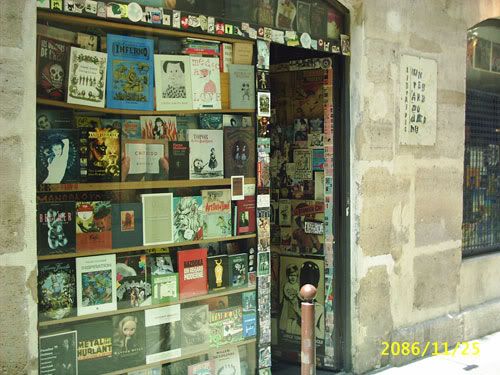
Excellent post by fellow Belgian Borsky and ‘pataphysician on his book shopping trip to Paris. He got to visit Un Regard Moderne, which was closed last time I was there.

I found the bookstore ‘Mona Lisait’ (Mona did read) at rue Danton #6. All old unraid books from stocks. I discovered a real treasure in the basement: two numbers of ‘Bizarre’ in minted condition. Some people would commit a murder for those, published by one of two revolutionary editors in the french language: Jean-Jacques Pauvert (the other one is Swiss Eric Losfeld). This legendary magazine from the fifties was the soil from which many pataphysicians realized their life purpose. Surrealism, dadaism and a thick layer of serious humor, with special issues about strange literature, naive art, literature studies etc. made Bizarre [1], [2] a holy grail to me. I only owned one copy for which I had paid a lot ten years ago. Now I tripled my collection for just a few euros (the poor librarian had no idea what she sold me).

Apparently Bizarre magazine was started by Losfeld and then taken over by Pauvert in 1955. From the French Wikipedia: “Il reprendra à son compte en 1955 la revue Bizarre crée par Éric Losfeld. ”

Losfeld had only edited two issues when Pauvert took over:

Revue BIZARRE N° 02- ( Seconde série )- Thomas Owen, Jean Ray, Jean Mayoux, Michel Carrouges, Jean-Hugues Sainmont, Camille Renault, Jacques B. Brunius, Paul Gibson, Jacques Yonnet, Michel Morphy, René de Obaldia, Philippe Soupault, Nick Carter, Claude Ernoult, R. Chomet, G. Klein, Mayo, Agnese, Henri Bouché, Michel Bonno, Guy Jumeau Revue BIZARRE N° 02- ( Seconde série )- Ed. J.J. Pauvert, Octobre 1955. In 4°, br, 95 pp.+ 6 feuillets gris-vert, Rédacteur en chef : Michel Laclos- Au sommaire : Thomas Owen, Jean Ray, L’ insaisissable- Jean Mayoux, Les machines célibataires de Michel Carrouges ( Fin )- Jean-Hugues Sainmont, Camille Renault, créateur du monde ( Photographies )- Jacques B. Brunius et Paul Gibson, Un peu moins de bruit- Jacques Yonnet, Univers virgule cinq- Michel Morphy, Canaille en soutane- René de Obaldia, L’ Heure qu’ il est- Philippe Soupault, Mort de Nick Carter- Claude Ernoult, Science-Fiction et réthorique des idées- R. Chomet et G. Klein, Bestiaire ” Digest ” de la S.F.- Illustrations de Mayo, Agnese, Henri Bouché, Michel Bonno, Guy Jumeau, J.-H. Sainmont- Annonce page 53: Bizarre publiera dans ses prochains numéros J.-L. Borges- ( Note personnelle: ?- )- Très bon état- Une première série a paru auparavant, édité par Losfeld, avec seulement 2 numéros : Gaston Leroux N° I – Granville N° II- La seconde série est éditée par J.J.Pauvert (46 numéros )- —source

More on the dis/similarities between Pauvert and Losfeld:

Eric Losfeld, the original publisher of the work translated here (THE NUN (Count D’Irancy)) for the first time, was a horse of a different colour altogether. It’s difficult to say whether Losfeld and Pauvert were rivals exactly, since despite their beginnings in clandestine publishing, their approach to it was quite dissimilar. Sarane Alexandrian,who does see the pair as rivals, summed up the differences rather well: “Jean-Jacques Pauvert. a eu une carriere bien differente, mais non moins interresante. Losfeld fut un surrealist editeur, Pauvert un editeur du surrealism; voila ce qui les distingue.”

Losfeld gives a good indication of his surrealist approach to life early in his memoirs. When on his military service in the 1930’s, he writes to Adolf Hitler:

“Monsieur, Je suis un soldat belge qui s’ennuie dans une ville de garnison qui s’appelle Namur . Je vous en rends personnallement responsible. En consequence, j’ai l’honneur de vous declarer la guerre.”

There is no record of what reply, if any, was received from Berlin . —Patrick J. Kearney via here.

To conclude, some additional info on Pauvert’s publishing and extra Bizarre covers here.

Il me semble avoir une dette personnelle à l’égard de Jean-Jacques Pauvert, comme tous ceux à qui ses livres apportèrent autant de bouffées d’air frais dans un monde trop policé. Le temps où l’on ne pouvait lire Sade, Pauline Réage ou Bataille semble bien éloigné. Mais je ne peux m’empêcher d’avoir une affection particulière pour certains livres de ma bibliothèque où son nom apparaît : Hollywood Babylone de Kenneth Anger, la revue Bizarre, la première monographie de Clovis Trouille, et beaucoup de titres de la « Bibliothèque Internationale d’Erotologie » qui n’ont pas tout à fait perdu leur goût sulfureux : Les « enfers », Le vampire, Métaphysique du strip-tease, Mythologie du sein, Eros du dimanche…

Borsky also informs us that Robert Anton Wilson has died.
Dream-like states in films

“We experience the cinema in a state of double consciousness, an astonishing phenomenon where the illusion of reality is inseparable from the awareness that it is really an illusion.” —Edgar Morin on the film experience.

New article at Wikipedia on oneiric film theory.

In a film theory context, the term oneiric (which means “pertaining to dream“) is used to refer the depiction of dream-like states in films, or to the use of the metaphor of a dream or the dream-state to analyze a film. The connection between dreams and films has been long established; “The dream factory” “…has become a household expression for the film industry”[1]. The dream metaphor for film viewing is “one of the most persistent metaphors in both classical and modern film theory”[2], and it is used by film theorists using Freudian, non-Freudian, and semiotic analytical frameworks.

Filmmakers noted for their use of oneiric or dreamlike elements in their films include Luis Buñuel [3], Wojciech Has [4], Andrei Tarkovsky [5] , Lars von Trier [6] Krzysztof Kieslowski (e.g., The Double Life of Véronique from 1991) [7]and David Lynch (e.g., Mulholland Drive)[8]. Film genres or styles noted for their use of oneiric elements include 1940s and 1950s film noir and surrealist films; moreover, oneiric elements have also been noted in musicals, thriller and horror films and in comic films such as Marx Brothers movies [9]. The French surrealist playwright and director Antonin Artaud argued that the American burlesque genre, with its bizarre, lush, costumes, and its mixture of dancing girls, comedians, mime artists and striptease artists, has oneiric qualities[10]. —Source

I was very fond of the Ado Kyrou books

Eros in the Cinema (1966) – Raymond Durgnat [Amazon.com] [FR] [DE] [UK]

In a 1977 interview Durgnat said about Kyrou: “I didn’t read very much film criticism until I started teaching film regularly around 1964! There wasn’t much to read. I was very fond of the Ado Kyrou books.” If Raymond Durgnat can be compared to some of the more exciting French film critics such as Ado Kyrou, his publishing house Calder and Boyars can be compared to that of Eric Losfeld’s. [Jan 2007]

Influences: There are various people whom I read with interest because, whether I agree with them or not, there’s a genuine person speaking from a calibre of experience, not an automatic scanning mechanism. I’m thinking of Pauline Kael, who I rarely agree with; of Robin Wood, who I sometimes agree with; of Manny Farber. And Parker Tyler. At the other extreme, I’m very interested in certain theorists, particularly Jean Mitry and Edgar Morin. –Raymond Durgnat in a 1977 interview.

Music is the essence of Romanticism

“Music is the essence of Romanticism,” says Colin Wilson in Private Passions interviewed by Michael Berkeley on BBC Radio 3’s about his taste in music. He adds that Nietzsche wanted to be a musician but then decided against it because it would have been too dangerous for him.

Via Stephen’s This Space who admits being a bit ashamed embarrassed of having read so much Wilson.

Some more quotes from this programme:

“You can’t put philosophical ideas into music, the only thing that interests me.”

“Ritual in the Dark is a novel about a sadist, and I used Prokofiev as a leitmotif because it was a dark piece of music.”

Some seventies films

El Topo (1970) – Alexandro Jodorowsky [Amazon.com]

Performance (1970) – Nicolas Roeg, Donald Cammell [Amazon.com]

A Clockwork Orange (1971) – Stanley Kubrick

Deep Throat (1972) – Gerard Damiano [Amazon.uk]

Last Tango in Paris (1972) – Bernardo Bertolucci [Amazon.com]

La Grande Bouffe (1973) – Marco Ferreri [Amazon.com]

Bruce Lee in Enter the Dragon (1973) [Amazon.com]

The Night Porter (1974) – Liliana Cavani

The Texas Chainsaw Massacre (1974) – Tobe Hooper [Amazon.com] [FR] [DE] [UK]

Les Valseuses/Going Places (1974) Bertrand Blier [Amazon.com]

Jaws (1975) – Steven Spielberg [Amazon.com]

Je t’aime, moi non plus (1976) – Serge Gainsbourg

Ai No Corrida/In the Realm of the Senses (1976) – Nagisa Oshima [Amazon.com]

Taxi Driver (1976) – Martin Scorsese [Amazon.com]

Isabelle Adjani and Roman Polanski watching a kung fu film in Le Locataire
Le Locataire/The Tenant (1976) – Roman Polanski [Amazon.com] [FR] [DE] [UK]

Eraserhead (1977) – David Lynch [Amazon UK]

Una Giornata particolare/A Special Day (1977) – Ettore Scola [Amazon.com]

John Travolta in Saturday Night Fever (1977) [Amazon.com]

Interiors (1978) – Woody Allen [Amazon.com]

Donald Sutherland in Invasion of the Body Snatchers (1978) [Amazon.com]

The Brood (1979)- David Cronenberg [Amazon.com]

Buffet Froid (1979) – Bertrand Blier [Amazon.com]

By year: 1970 film1971 film1972 film1973 film1974 film1975 film1976 film1977 film1978 film1979 film

Title pages: Performance (1970)Women In Love (1970)El Topo (1970)Five Easy Pieces (1970)Zabriskie Point (1970)A Clockwork Orange (1971)Straw Dogs (1971) – Last Tango in Paris (1972)Deep Throat (1972) La Grande Bouffe (1973) La Maîtresse (1973)The Night Porter (1974)Ilsa – She Wolf of the SS (1974)The Texas Chainsaw Massacre (1974)Les Valseuses (1974)Jaws (1975)The Story of O (1975)The Rocky Horror Picture Show (1975)In the Realm of the Senses (1976)Taxi Driver (1976)Eraserhead (1977)Pretty Baby (1978)Caligula (1979)The Brood (1979)