Yearly Archives: 2008

Solstice and WMC #50

Solstice

Round about this time tomorrow, I mean somewhere around an hour and a half before midnight tomorrow, or 23 hours from now, it will be solstice, the longest day of the year.

Aristotle quotes the solstice as a moment of self-reflection:

For all men begin, as we said, by wondering that things are as they are, as they do about self-moving marionettes, or about the solstices or the incommensurability of the diagonal of a square with the side.Aristotle

The music I will be remembering this solstice is American jazz singer Andy Bey‘s “Round Midnight”[1], which some of you may know in Amy Winehouse‘s version [2]. The song, in Bey’s version is WMC #50. “River Man” of my previous post reminded me of Andy Bey, who did his own interpretation of “River Man,”

video

Andy Bey‘s “Round Midnight”[1]

video
Amy Winehouse‘s version [2]
But it really gets bad,
’round midnight.

Incidentally, here is Bey’s version of “River Man” mentioned in my previous post.

Nick Drake @ 60

video

“River Man” from Nick Drake‘s 1969 album Five Leaves Left

Nicholas Rodney Drake (June 19, 1948November 25, 1974) was an English singer-songwriter and musician best known for his acoustic, autumnal songs. Although he failed to find a wide audience during his lifetime, Drake’s work has since grown steadily in stature, to the extent that he is now widely considered one of the most influential English singer-songwriters of the last 50 years. He commited suicide aged 27.

“River Man” is World Music Classic #49. The track is also featured on the 2005 compilation album Late Night Tales: The Flaming Lips.

Introducing Kati Heck

In Belgian magazine Focus Knack June 2008, Els Fiers reviews German-born contemporary Belgian artist Kati HeckGoogle gallery at the occasion of Heck’s first museum expostion. Fiers likens her to Eija-Liisa Ahtila“Dog Bites”, Sam Taylor-Wood “A Little Death,” [YouTube] and Léopold Rabus Two girls and a mushroom.

Wood’s work I’ve learned to appreciate via dmtls a month or two ago, Ahtila and Rabus are so-so on first impression, and Heck, I’ve been a bit of a fan for some time. If placement she deserves, I will locate her in the tradition of the German Comic Grotesque, a category which Pamela Kort recently examined in her eponymous book and of which the earliest practitioners are Lovis Corinth, Paul Klee, Max Klinger, Otto Dix, Alfred Kubin, Kurt Schwitters, Emil Nolde, and the greatest of them all (and with Klinger and Corinth, the only ones in the beloved public domain), Arnold –“Isle of the Dead” —Böcklin.

Please notice the word comic in Comic Grotesque. If Heck is a great painter or not is not for me but for the market to decide, but I can say this: she has a sense of humor, and it’s a rosy kind of insouciance, of a cynical variety perhaps, but nevertheless one which invites genuine (as opposed to ironic) laughter.

Speaking of comic, I would like to offer you this piece of eye candy:

Sly as a fox, or, picaros avant la lettre

One more film for Paul Rumsey’s cinematheque: Le Roman de Renard.

The Tale of the Fox, as the film is known in English, was stop-motion animation pioneer Ladislas Starevich‘s first fully-animated feature film. It is based on the tales of Flemish picaro avant-la-lettre Renard the Fox.

[Youtube=http://www.youtube.com/watch?v=gcznvlBTQFk]

Le Roman de Renard

Lords, you have heard many tales,
That many tellers have told to you.
How Paris took Helen,
The evil and the pain he felt
Of Tristan that la Chevre
Wrote rather beautifully about;
And fabliaux and epics;
Of the Romance of Yvain and his beast
And many others told in this land
But never have you heard about the war
That was difficult and lengthy
Beween Renart and Ysengrin

Jeffrey Lee Pierce @50 and WMC #48

Jeffrey Lee Pierce (June 27, 1958March 31, 1996) was an American singer, songwriter and guitarist. He was one of the founding members of the 1980s punk band The Gun Club. He would have turned 50 today if he hadn’t exchanged the temporary for the eternal in his late thirties.

The Gun Club injected punk rock with doses of blues and country music. Pierce’s wailing vocals were an ideal delivery for his songs, which generally had a spooky, haunted quality.

Fire of Love was their debut album from whence came “Sex Beat,” released in 1981 on Ruby Records. “Sex Beat” is World Music Classic #48.

[Youtube=http://www.youtube.com/watch?v=CMdYi8pWPiw]
“Sex Beat” by The Gun Club

Choreography by Dipsetmuthafucka.

I’ve mentioned “Sex Beats” before here and the most memorable line of the song is: “We can f*** forever but you will never get my soul.”

Jello Biafra @50

Happy birthday Jello Biafra, former lead singer of the Dead Kennedys. In the late 1980s, the band was embroiled in an obscenity trial in the US over the 1985 Frankenchrist album, which included a “biomannerist” poster with art that depicted penises, “Penis Landscape[1] by H. R. Giger, a work in the same vein as jahsonic fave Yoshifumi Hayashi.

Interviewed by Jools Holland:

[Youtube=http://www.youtube.com/watch?v=iVrTW7AUkoM]

Go ask the physiognomists, phrenologists, pathognomists and characterologists

“I love this word decadence, all shimmering in purple and gold. It suggests the subtle thoughts of ultimate civilization, a high literary culture, a soul capable of intense pleasures. It throws off bursts of fire and the sparkle of precious stones. It is redolent of the rouge of courtesans, the games of the circus, the panting of the gladiators, the spring of wild beasts, the consuming in flames of races exhausted by their capacity for sensation, as the tramp of an invading army sounds.” — Paul Verlaine, Les Poètes maudits (1884)
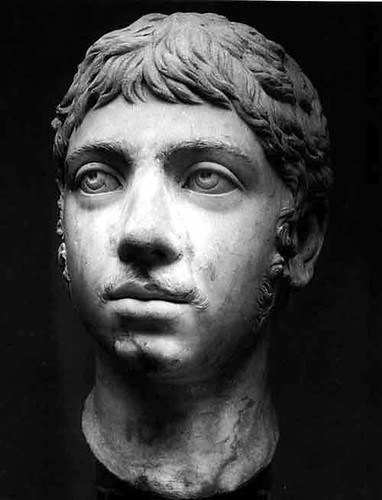
Elagabalus

Heliogabalus or Elagabalus

Heliogabalus was a remarkable example of psychopathia sexualis; but in his age there were no Krafft-Ebings to submit his case to scientific observation,” said John Stuart Hay in 1911 in The Amazing Emperor Heliogabalus. Heliogabalus, or Elagabalus as he is also called, is indeed a prime example in the category of Roman decadence, along with other notorious emperors such as Tiberius, Caligula, Claudius and Nero.

Keywords in the history of Roman decadence are inbreeding, bacchanalia, orgies, vomitoria, Great Fire of Rome, gladiators and pederasty.

The classic account of Roman decadence is Edward Gibbon‘s The History of the Decline and Fall of the Roman Empire, published in six volumes between 1776 and 1788, a book that was instantly put on the Index Librorum Prohibitorum. The history of Roman decadence is a necessarily a hybrid mix of truth and fact, but is interesting to note that the view Europe had of Roman antiquity during the Renaissance was that of an highbrow ideal. It wasn’t perhaps — although the existence of Latin profanity was already known to Antiquity scholars – until the excavations of Pompeii and we found the erotic art in Pompeii and Herculaneum in the second half of the 18th century that our view of the Romans started to change. This gave rise to the very first secret museum, the Secret Museum of Naples.

Back to Heliogabalus.

Two years ago in Amsterdam, I saw a pleasant man who served us in a bar while we were having dinner. His face struck me as perverse. How can someone have a perverse face? Is the nature of your character readable on your face? Go ask the physiognomists, phrenologists, pathognomists and characterologists and they will answer “yes“. Their sciences are long out of fashion and definitely politically incorrect, but I concur, without of course, casting a judgment. You need only look at the face of Heliogabalus.

Walking on water

[Youtube=http://www.youtube.com/watch?v=fagd2mC6RAQ]

Bridge by Michael Cross

Bridge is an installation by British contemporary artist Michael Cross currently hosted in Hasselt, Belgium. It gives the impression that one is walking on water.

Every step you makes a floater appear and disappear. It feels like hovering over an abyss. It is mechanically powered. One of the best things I’ve seen in a while.