Bosch, Breugel, Dutch or German?
Some eye candy by Bosch:
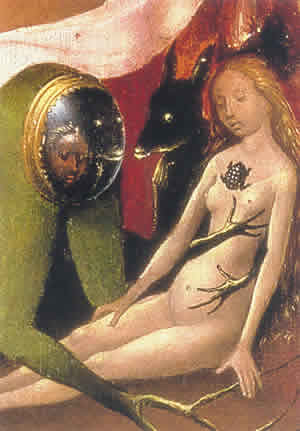
The Garden of Earthly Delights (detail)
[Youtube=http://www.youtube.com/watch?v=YauhheIq3Tk]
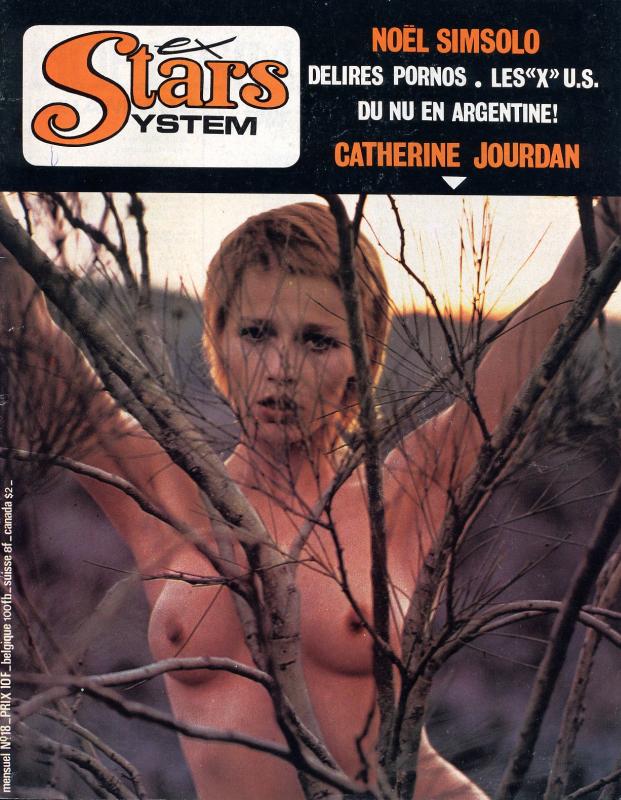
Eden and Afterwards (1970) – Alain Robbe-Grillet
Via sedmikrasky.
More Catherine Jourdan. Grillet’s (who turned 85 last Saturday) new novel Un roman sentimental will be published next month.
Yesterday as I went for a quick book shopping trip to the city, I glimpsed a detail of the The Temptation of St. Anthony painting by Patinir and Matsys on the cover of a Dutch language book on the history of witchcraft in the Low Countries.
That Northern Renaissance gets my vote over Italian Renaissance any day was confirmed once more.
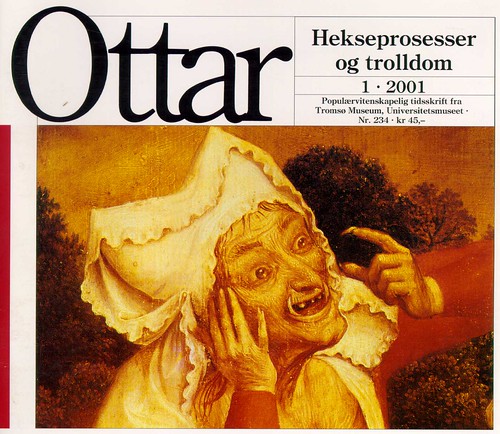
Temptation of Saint Anthony by Patinir and Metsys (detail)
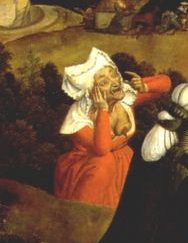
Temptation of Saint Anthony by Patinir and Metsys (detail)
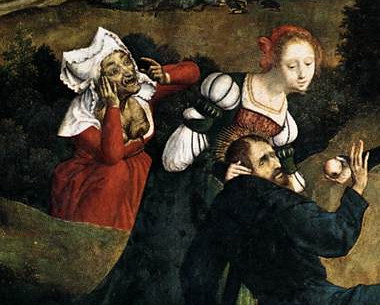
Temptation of Saint Anthony by Patinir and Metsys (detail)
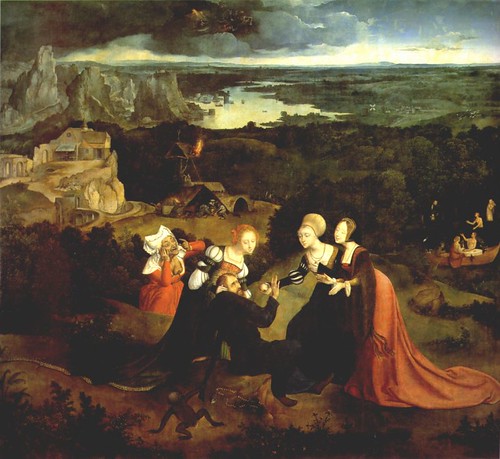
Temptation of Saint Anthony by Patinir and Metsys (detail)
Please excuse the poor quality of the scans compared to the image I saw on the cover of that book. I would need a photographic cliché to reproduce the details well enough.
Thanks La boîte à images.
I acquired a copy of Marvellous Méliès. More on The Temptation of St. Anthony and the allure of Northern Renaissance later.
[Youtube=http://www.youtube.com/watch?v=Kuo-GlLttwI]
If it’s any reassurance, the film is much better than the trailer.

click to enlarge
A classic example of nunsploitation by Johann Nepomuk Geiger, as I’ve alluded to in this post when I showed you this painting, I am a fan of the genre which can be traced backwards from the 1970s exploitation films to Renaissance anticlericalism. Another particularly good example is this one by Clovis Trouille.
I’ve posted on the surrealist film Un chien andalou which Luis Buñuel calls A desperate and passionate call to murder but want to pick up on it again to share some macabre and other details.
[Youtube=http://www.youtube.com/watch?v=9mBU4KQEWcw]
A ‘seduction’ scene
In this ‘seduction’ scene we see a man going after a woman, she recoils, he finally catches up with her and gropes for her breasts, she pushes him a way, but finally gives in overcome with desire, while he is stroking her breasts her dress disappears to reveal her naked body, causing him to gaze with pleasure into the void, she pushes him away a second time.
Imagine the scene: somewhere in 1929 Luis Buñuel is on set directing Simone Mareuil and Pierre Batcheff in the clip above. He has on a phonograph a recording of Richard Wagner‘s Liebestod which he plays on the background. Little did he know that both protagonists, in a bizarre twist of fate would later commit suicide. Pierre in 1932, Simone in 1954. Not an actual Liebestod, but macabre enough.
[Youtube=http://www.youtube.com/watch?v=uNC4kF1e470&NR=1]
Full clip with music by Mogwai
There is so much to be said of this film, watch it for the ‘razor slits the eyeball scene‘ or for some of the early uses of the jarring jump cut. Enjoy.
[Youtube=http://www.youtube.com/watch?v=4NkLUh_zMP8]
Blue Moon by Elvis
Elvis would have been 72 yesterday had he not died 30 years ago. Yesterday evening European artist Gottfried Helnwein (see here) commented in a TV show that in twentieth century mythology Elvis equals Mary. Helnwein looked like the ghost of Herman Brood .
It is not four years ago,
I offered forty crowns
To lie with her a night or so:
She answered me in frowns.
Not two years since, she meeting me
Did whisper in my ear,
That she would at my service be,
If I contented were.
I told her I was cold as snow,
And had no great desire;
But should be well content to go
To twenty, but no higher.
Some three months since or thereabout,
She that so coy had been,
Bethought herself and found me out,
And was content to sin.
I smiled at that, and told her I
Did think it something late,
And that I’d not repentance buy
At above half the rate.
This present morning early she
Forsooth came to my bed,
And gratis there she offered me
Her high-prized maidenhead.
I told her that I thought it then
Far dearer than I did,
When I at first the forty crowns
For one night’s lodging bid.
It is not four years ago is a poem by John Suckling reminiscent of a scene in the 1969 film Coming Apart. The scene where a young pregnant mother visits the protagonist psychiatrist and offers herself. She asks “Is it worth fifty dollars to you?” And Rip Torn answers: “Baby, you’re worth a million dollars to me”. They then proceed without monetary exchange. Loved the film. The poem came by way of the Kronhausens book Pornography and the law: The psychology of erotic realism and pornography.
[Youtube=http://www.youtube.com/watch?v=ou-P16a8o7w]
‘Gypped in Egypt’ – (1930) Van Beuren Studios‘ Aesop’s Film Fables