Poster for Micheaux’s film The Exile (1931)
See also: Spike Lee and African American cinema
The Black Dahlia is a neo-noir novel by James Ellroy based on true events. It is considered the book that elevated Ellroy out of typical genre writer status and with which he started to garner critical attention as a serious writer of literature. One of the first essays to come to the defense of crime fiction as a serious form of literature was Leslie Fiedler’s 1969 Cross the Border — Close the Gap.
Jill Greenberg… Apocalypse Now. From the exhibition End Times – photography by Jill Greenberg at Paul Kopeikin Gallery in Los Angeles, CA. “. via gmtPlus9 (-15)
See also this Google gallery.
The critic truffle-snuffing for trends might call it the New French Extremity, this recent tendency to the willfully transgressive by directors like François Ozon, Gaspar Noé, Catherine Breillat, Philippe Grandrieux—and now, alas, Dumont. Bava as much as Bataille, Salò no less than Sade seem the determinants of a cinema suddenly determined to break every taboo, to wade in rivers of viscera and spumes of sperm, to fill each frame with flesh, nubile or gnarled, and subject it to all manner of penetration, mutilation, and defilement. Images and subjects once the provenance of splatter films, exploitation flicks, and porn—gang rapes, bashings and slashings and blindings, hard-ons and vulvas, cannibalism, sadomasochism and incest, fucking and fisting, sluices of cum and gore—proliferate in the high-art environs of a national cinema whose provocations have historically been formal, political, or philosophical (Godard, Clouzot, Debord) or, at their most immoderate (Franju, Buñuel, Walerian Borowczyk, Andrzej Zulawski), at least assimilable as emanations of an artistic movement (Surrealism mostly). Does a kind of irredentist spirit of incitement and confrontation, reviving the hallowed Gallic traditions of the film maudit, of épater les bourgeois and amour fou, account for the shock tactics employed in recent French cinema? Or do they bespeak a cultural crisis, forcing French filmmakers to respond to the death of the ineluctable (French identity, language, ideology, aesthetic forms) with desperate measures? –James Quandt, Flesh & Blood: Sex and Violence in Recent French Cinema (2004) via artforum
James Quandt is a Canadian film critic associated with the Cinematheque of Ontario. He is a connoisseur of French director Robert Bresson.
Digression: I recently viewed Bresson’s Pickpocket and Au hasard Balthazar and although I really wanted to, I could not get into them. The reason I viewed these films is that a number of people who’s opinions/films I respect (Austrian director Michael Haneke, American director Paul Schrader, film critic Girish Shambu and American writer Dennis Cooper) are self-proclaimed fans of Bresson. There is no accounting for taste and I only do appreciative criticism, but a reason for my not really liking Bresson is that the two films I’ve seen lack a certain sensationalism that I appreciate in the films of – for example – Haneke. To conclude this post, I’d like to quote French film critic Ado Kyrou:
They can keep their Bressons and their Cocteaus. The cinematic, modern marvelous is popular, and the best and most exciting films are, beginning with Méliès and Fantômas, the films shown in local fleapits, films which seem to have no place in the history of cinema.
The two novels listed are supposed to be the foreign equivalents to Proust’s epic . (source: 1001 Books)
Can anyone think of other epic novels from different countries that are considered ‘foreign’ answers to In Search of Lost Time? Criteria are length, level of introspection and lack of plot. Would Robert Musil‘s The Man Without Qualities (1921-1942) count?
See also: modernist literature

George Barrington robs Prince Orlov.
George Barrington (May 14, 1755 – 1804) was an Irish pickpocket. A book on him was mentioned in the 1959 film Pickpocket by Robert Bresson. —http://en.wikipedia.org/wiki/George_Barrington
At one point in the film, Jeanne asks Michel if he “believes in nothing” and he replies, “I believed in God, Jeanne, for three minutes.” — Culture?Ugh!
The absences and overall minimalism in Bresson are accentuated by repetitions. (In Pickpocket: repeated scenes in Michel’s room, the Metro, the racetrack, of staircases, writing in his journal etc. ) Paradoxically, this combination creates a sort of hollowed-out, emptied-out vessel into which we pour….our own projections, ideas, feelings, and (very important) spiritual yearnings. But we don’t see the spiritual in his films; we see the material. Concrete surfaces are paramount here; and yet they are the portal to the spiritual. We intuit an inner life, a metaphysical life, via our immersion in the material. Quandt has called Bresson’s cinema both minimalist and maximalist for this reason. —Girish Shambu
One of the advantages of having children is that you get to live twice. I get to hear music, see films, read books that I would never see at my age, if it were not for my daughters.
So it came to pass that I saw White Chicks (Google gallery), the 2000s version of Some Like it Hot. Both films are examples of cross-dressing in film (my favourite in this genre still being Ed Wood’s 1953 Glen or Glenda?). White Chicks differs from these films in that it adds a racial dimension (whiteface/blackface, see Spike Lee’s Bamboozled and minstrel shows).
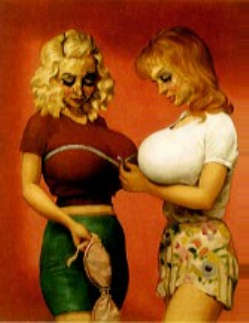
Enter John Currin; proving that high art and low art often make use of the same tropes. Currin’s grotesque portrayal of the ‘white chicks’-stereotype reminded me of this 2004 film. See this John Currin Google gallery, and especially this, this, this, this and this.
Take one look at John Currin’s paintings and you could assume he likes stupid women with big tits. Pouting, wide-eyed ingénues look vacantly out of his canvases while ladies in mini-skirts measure each other’s immense breasts. There is nothing politically correct here. –Francesca Gavin 05 September 2003 via http://www.bbc.co.uk/dna/collective/A1164971
Psychological realism 6/10 (reflects the zeitgeist), feelgood factor (I laughed out loud) 7/10, oddity value 6/10.

The Comfort of Strangers (1990) – Paul Schrader
[Amazon.com] [FR] [DE] [UK]
Saw The Comfort of Strangers (1990) on VHS; at the same time I went to the Fnac and read bits of this 100-page novella. With a runtime of 107 minutes it is probably a better idea (quicker and better) to read this story than see it.
Nevertheless: What will you miss when you read instead of see:
Notes:
Most memorable moments:
Rating (film): Psychological realism 4/10, feelgood factor: 3/10, Oddity value 5/10.
K punk has an analysis of an interview with Iain Sinclair by Tim Chapman which touches upon psychogeography, the art of the 20th century flâneur.
Of all the intriguing moments in Tim Chapman’s fascinating interview with Iain Sinclair over at the ever-excellent Ballardian (Sinclair so much more arresting and engaging as a commentator and critic than as a novelist, where writerly obsurantism fogs over all his insights and sharpness), this is one of the most telling: —k punk