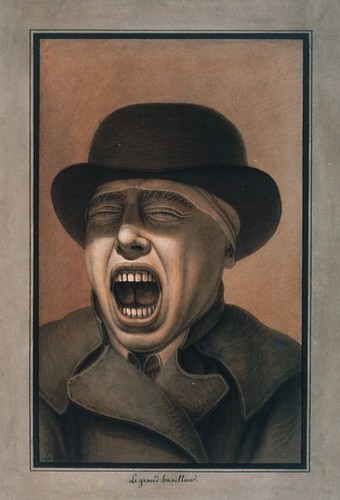
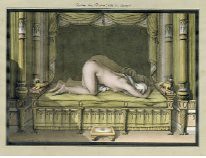
Broken Projector is holding a double bill blogathon. Being more of an archivist than a writer, I am not sure if I will write my entry for Liquid Sky /Café Flesh, especially considering that I have not seen either in its entirety. In an admitted extremely oblique way, Liquid Sky has already had its double bill on this blog: with a work by Eugène Atget.
The second significant artwork of the 20th century
The Fourth Estate, Il Quarto Stato (1901) – Giuseppe Pellizza da Volpedo
The second significant artwork of the 20th century is The Fourth Estate, a 1901 painting by Giuseppe Pellizza that depicts in – “MGM grandeur” – sepia-toned rows of handsome Italian workers marching toward a new dawn behind two men and a woman holding a baby.
This entry is part of a new series: “100 artworks that set the world on fire (while no one was watching)”, inspired by Wire’s 100 records that set the world on fire (while no one was listening).
See the previous entries here.
Informe, abjection and Robert Gober
Happy birthday Robert Gober. Google gallery.
I have found 35 useful sources for the informe, the abject, and religious purity, which tend to be related in current discourse. These terms are often seen as variations on a theme but should be considered as quite separate according to Rosalind Krauss (see October Winter 1993 and Krauss, 1997).
Three theorists appear in this discourse: Georges Bataile, Julia Kristeva, and Judith Butler.
The artists that have been associated with the informe, the abject, and the grotesque include Fontana, Joel-Peter Witkin, Robert Gober, John Miller, David Hammons, Cindy Sherman, Kiki Smith, Paul McCarthy, Mike Kelley and David Lynch. [1]
Elsewhere
It’s been a while since I reported on my befriended blogs’ activities. That’s because I forgot to use del.icio.us, with del.icio.us installed, you just bookmark all the worthwile posts you read, and after a while you copy-past the entries in your WordPress (or other blog).
Some recent favorites:
-
DC’s on Thurston Moore
Actually lots op posts on Moore, click on from this one
-
DC’s: ‘Here Lies Pierre Molinier. This was a man without morality.’ *
Dennis Cooper on Molinier
-
The Laughing Bone: Dust is the signature of lost time.
-
The Laughing Bone: Lachenden Knochen
-
The Laughing Bone: Information Policy for the Library of Babel: One or More of Its Secret Tongues Does Not Hide a Terrible Significance
-
Marcel Duchamp « >dmtls Merzbau
Clip from Dadascope (1961), directed by Hans Richter, contains two poems by Marcel Duchamp. “Carte Postale” and “Puns”.
Duchamp vs Venetian Snares (Szamar Madar). Duchamp’s cinema and mr. Funk’s breakbeats.
-
Giornale Nuovo: Alberto Savinio
Introducing Rachel Stone
“Neptune Here She Comes” (2005) Rachel Stone
Rachel Stone’s gallery here.
Uncanny – Bellmeresque – Bourdinesque
Tip of the hat to The Enigma of Hitler, Google gallery here.
Tell me lies about Vietnam
[Youtube=http://www.youtube.com/watch?v=FmMCObgu_jc]
Citizendium: improvements and bowlderizations
Last October I reported on Citizendium as the first Wikipedia fork, today we are seeing the first results of this fork. My feelings are mixed. Take for example the Pierre Molinier entry at Wikipedia and its sister article at Citizendium. While the Citizendium “sister” is more elaborate and in depth (thanks to the contributions of one Pierre Petit who also contributes a nice photo) than the Wikipedia entry, it is also a bowlderized version. Compare the entry on the death of his sister.
Wikipedia:
“Molinier began to take photographs at the age of 18. When Molinier’s sister died in 1918, he had sex with her corpse when he was left alone to photograph it. “‘Even dead, she was beautiful. I shot sperm on her stomach and legs, and onto the First Communion dress she was wearing. She took with her into death the best of me.” [1]”
Citizendium:
“Having been in love with his younger sister for a long time, he took a photograph of her on her deathbed, in 1918, thus starting his quest for androgyny identity, which would be a recurring theme throughout his life and work. “
The first significant artwork of the 20th century
The first significant artwork of the 20th century is The Road to Hell, a 1900 drawing by Alfred Kubin that depicts a tunnel, at the end of the tunnel is a woman, between this woman’s legs disappear rectangular boxes speeding towards her.
This entry is part of a new series: “100 artworks that set the world on fire (while no one was watching)”, inspired by Wire’s 100 records that set the world on fire (while no one was listening).
I take it to the edge of its collapse
[Youtube=http://www.youtube.com/watch?v=3TWBSMc47bw]
Introducing Jarosław Kukowski
There are a 1001 reasons not to like Jarosław Kukowski , the first one probably that his art is kitsch. But so is Odd Nerdrum‘s, John Currin‘s, Hajime Sorayama‘s and most other new figurative artists of the post-war era. There is only one reason not not to like Kukowski, and that is this Venus.