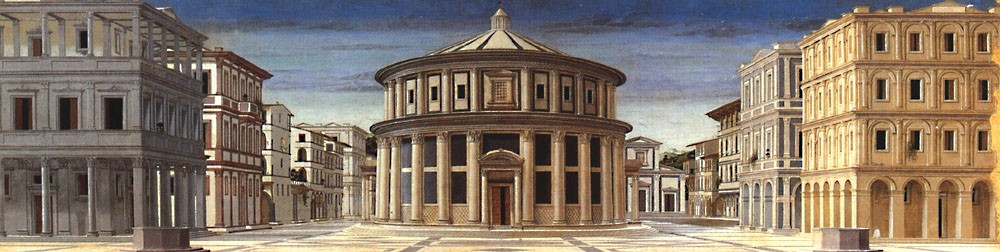
Apparently, Michel Houellebecq is to be found behind the camera these days. He is busy with the film adaptation of Platform (or is it Possiblity of an Island?). Some stills can be found on the website of Fernando Arrabal. Scarcely clad body-painted carnivalesque damsels draw the immediate attention. It has been rumored that Rem Koolhaas would design the decors. Fernando Arrabal is prominently present. –via De Papieren Man
A phantasmal group of huntsmen
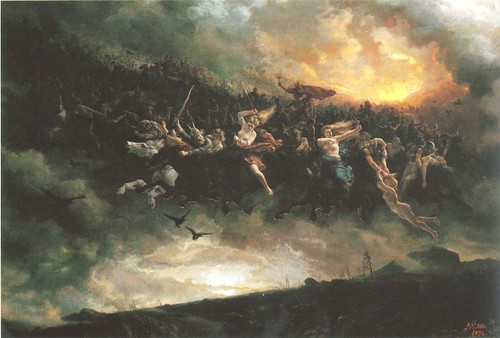
The wild hunt (1872) by Peter Nicolai Arbo
The Wild Hunt was a folk myth prevalent in former times across Northern, Western and Central Europe. The fundamental premise in all instances is the same: a phantasmal group of huntsmen with the accoutrements of hunting, horses, hounds, etc., in mad pursuit across the skies or along the ground, or just above it. It is often a way to explain thunderstorms.
The devil destroyed all young baobabs

Baobab is the common name of a tree, native to Madagascar, mainland Africa and Australia. The baobab is occasionally known as the devil tree, from African folklore which has it that the devil was mad at the tree because he got stuck in its branches, pulled it out and planted it upside down, making the branches the roots and vice versa. To make sure no future baobab trees would grow, the devil destroyed all young baobabs, that is why there are only fully grown baobabs. The Devil Tree is also the name of a novel by Jerzy Kosinski which I just finished reading and liked a lot. It’s the story of a ‘poor little rich kid’ who travels, goes in group therapy, is initiated into ‘the concern’ (its mysticism reminded me of Iain Banks‘ The Business). This revenge tale is the male equivalent of Fear of Flying (without the literary references). Both were published in 1973 and reflect the American zeitgeist. There is a fine review by Mary Ellin Barrett, Cosmopolitan.
Also, don’t miss Her Private Devil, the tale of the love affair between Kosinski and Laurie Steiber as told by Steiber over at nymag.
The power to unlock any door
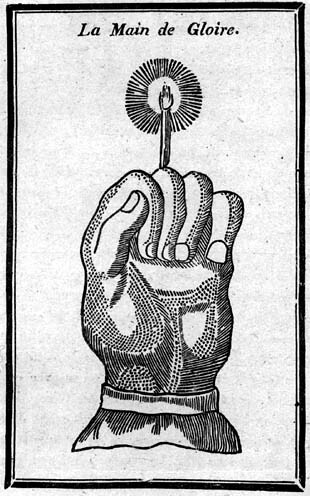
Hand of Glory, image sourced here
The Hand of Glory is the dried and pickled hand of a man who has been hanged, often specified as being the left (Latin: sinister) hand, or else, if the man were hanged for murder, the hand that “did the deed.”
According to old European beliefs, a candle made of the fat from a malefactor who died on the gallows, virgin wax, and Lapland sesame oil (the candle could only be put out with milk), and the hand having come from the said hanged criminal, lighted and placed in the Hand of Glory (as in a candlestick) would have rendered motionless all persons to whom it was presented. The Hand of Glory also purportedly had the power to unlock any door it came across.
The legend is traceable to about 1440, but the name only dates from 1707. It was originally a name for the mandrake root (via French “mandragore” and thus “hand of glory”) that became conflated with the earlier legend. The confusion may have occurred because mandrakes are said to grow beneath the bodies of hanged criminals.
Liquid Sky and Eugène Atget
[Youtube=http://www.youtube.com/watch?v=S9-n9gpFVpk]
Liquid Sky trailer via Dennis Cooper‘s today’s Video Nasties special .
Liquid Sky is a 1982 science fiction film produced and directed by Slava Tsukerman that has become a cult classic on the midnight movie circuit and to electroclash afficionados. The film would make an ideal double bill with Café Flesh.
Also, GmtPlus9 (-15) has a post on perennial favorite French photographer Eugène Atget, whose work can be compared to E. O. Hoppé‘s cityscapes of London.

Rue de la Colonie (1900) – Eugène Atget
Image sourced here.
Jules Janin presents the roman frénétique
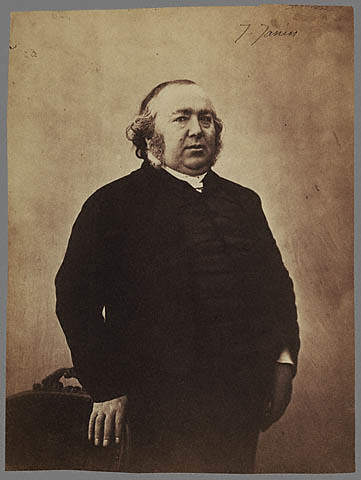
Jules Janin
“The frenetique school is a school of literature in 19th century France. The term frénétique is French for frenetic and means fast, frantic, harried, or frenzied. The term was coined by Charles Nodier.
In the category of “la littérature frénétique”, most frequently cited are Jules Janin (The Dead Donkey and the Guillotined Woman), Charles Lassailly, Xavier Forneret (Un pauvre honteux), Arlincourt (Le Solitaire) Charles Nodier (Smarra, or The Demons of the Night, 1821), Frédéric Soulié (Les Mémoires du diable, 1838) and Petrus Borel (Champavert, contes immoraux, 1833). Its peak was the late 1820s and early 1830s.
Its wider context is gothic literature. Every European country had its own terminology to denote the sensibility of the gothic novel. In France it was called the roman noir (“black novel”, now primarily used to denote the hardboiled detective genre) and in Germany it was called the Schauerroman (“shudder novel”). Italy and Spain must have had their own, but I am unaware of their names as of yet.
Their is some overlap with the Bouzingos.”
I’ve posted about this before here.
I, Galileo, kneeling before you

On June 22, 1633 – a memorable date in the history of counterculture – Galileo was forced to recant his scientific theory that the earth moves around the sun. The Inquisition had threatened the astronomer and mathematician with torture on the rack if he did not retract his “heretical” ideas. Torn between wanting to fight for the truth and not wanting to offend the Church, Galileo recants:
I, Galileo, son of the late Vincenzo Galilei, Florentine, aged seventy years, arraigned personally before this tribunal, and kneeling before you, Most Eminent and Reverend Lord Cardinals, Inquisitors-General against heretical depravity throughout the entire Christian commonwealth, having before my eyes and touching with my hands, the Holy Gospels, swear that I have always believed, do believe, and by God’s help will in the future believe, all that is held, preached, and taught by the Holy Catholic and Apostolic Church. But whereas — after an injunction had been judicially intimated to me by this Holy Office, to the effect that I must altogether abandon the false opinion that the sun is the center of the world and immovable, and that the earth is not the center of the world, and moves, and that I must not hold, defend, or teach in any way whatsoever, verbally or in writing, the said false doctrine.
After the trial, Galileo is sent to his villa outside Florence, where he will be confined for the remaining 9 years of his life, supposedly frequently muttering “e pur si muove!“
What a humiliation!
Fill the rest up with feelings
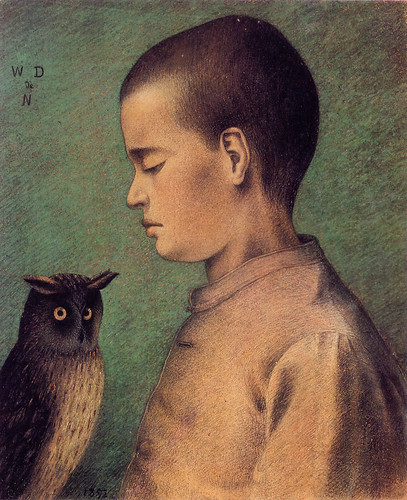
Enfant au hibou (1892)
Pastel by William Degouve de Nuncques via Il Giornale Nuovo.
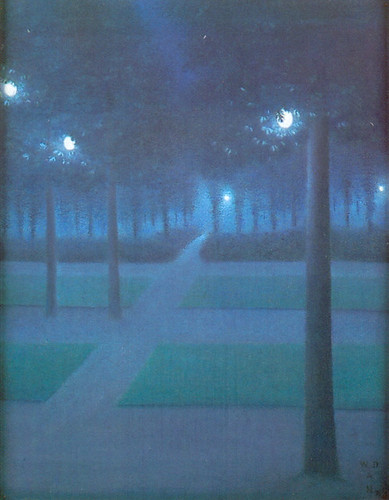
Nocturne au Parc Royal de Bruxelles (1897)
Notice the similarities between Degouve’s (1867 – 1935) Rainbow (pictured below) with some of the landscapes by American regionalist Grant Wood (1891 – 1942) who is much better known for his iconic 1930 painting American Gothic.

See also this Google gallery.
Destruction and delight in the same pair of eyes
[Youtube=http://www.youtube.com/watch?v=vryyDAj2EbA]
Clive Barker, Roger Corman, Joe Dante and Tim Burton on Barbara Steele in Clive Barker’s A to Z of Horror.
More Steele:

Barbara Steele, photocredit unidentified

Barbara Steele in bed
image sourced here.


Maschera del demonio, La/Black Sunday (1960) – Mario Bava [Amazon.com]
image sourced here.

Maschera del demonio, La/Black Sunday (1960) – Mario Bava [Amazon.com]
image sourced here.

Midi-Minuit Fantastique no. 17 (1967)
“Midi Minuit Fantastique” #17 devoted to Barbara Steele – 145 Pages – Dated of 1967

Barbara Steele in The Horrible Dr. Hichcock (1962) – Riccardo Freda
image sourced here. [Aug 2005]

Barbara Steele

images sourced here, from, Curse of the Crimson Altar (1968);
an adaptation of Lovecraft’s Dreams in the Witch House

Caged Heat (1974) – Jonathan Demme [Amazon.com] [FR] [DE] [UK]

Der Junge Törless/Young Toerless (1966) – Volker Schlöndorff [Amazon.com] [FR] [DE] [UK]
A wild-eyed, sex-crazed maniac
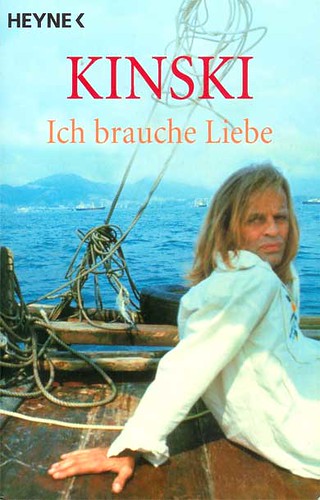
Off-screen, Kinski often appeared as a wild-eyed, sex-crazed maniac. He chronicled his exploits in an autobiography—Kinski: All I Need Is Love or Kinski Uncut, which, according to Werner Herzog’s My Best Fiend, a documentary about the pair’s experiences working together, was largely fabricated to generate sales. (A libel suit from Marlene Dietrich due to Kinski depicting her as a lesbian resulted in the book being withdrawn from circulation until her death). Throughout the memoir we witness encounters with young actresses, hookers, chambermaids and, in two memorable scenes, Alberto Moravia‘s wife and Idi Amin‘s daughter. He was married three times and had (according to his autobiography) at least five children, three of whom he regarded as such: two daughters (Nastassja Kinski and Pola Kinski), and a son (Nikolai Kinski), all of them actors. His brother Arne lives in Berlin, still bitter about the way Klaus portrayed him in his autobiography. He alienated his family with claims of incest with his sister and his mother.
Image via The Devil’s Honey