Kafkaesque, Orwellian, Joycean, Ballardian, …

Unfutz on Auctorial descriptives

Kafkaesque, Phildickian, Hemingwayesque, Orwellian, Joycean, Shavian, Ballardian, Shakespearean, Dickensian, Jamesian, Faulknerian, Brechtian, Pinteresque, Mametesque, Lovecraftian, Tolkienesque (or Tolkienian), Proustian, Seussian.

Any others?

Yes, there is Bataillean and Bretonian, Pirandellian, Beatlesque, Sadean (not to mention sadistic), Borgesian, Bellmeresque, Byronic (an interesting one because of its -ic-suffix), Freudian and platonic.

Once an author has been ‘adjectivized’ he has become a stereotype. Nevertheless, it is the ultimate compliment and the surest sign of longevity.

Wikipedia has:

Auctorial descriptives are a series of adjectives based on authors’ names, such as Kafkaesque, Brechtian, Joycean, Orwellian, Pinteresque, Sadistic/Sadism, Machiavellian, and Draconian.

More?

Knots of indecision

In search of the roots of counterculture

Frontispiece to William Blake‘s Visions of the Daughters of Albion (1793), which contains Blake’s critique of Judeo-Christian values of marriage. Oothoon (centre) and Bromion (left), are chained together, as Bromion has raped Oothoon and she now carries his baby. Theotormon (right) and Oothoon are in love, but Theotormon is unable to act, considering her polluted, and ties himself into knots of indecision.

While the phrase “free love” is often associated with promiscuity in the popular imagination, especially in reference to the counterculture of the 1960s and 1970s, there are plenty of historical antecedents.

In 1789, radical Swedenborgians published the Plan for a Free Community, in which they proposed the establishment of a society of sexual liberty, where slavery was abolished and the “European” and the “Negro” lived together in harmony. In the treatise, marriage is criticised as a form of political repression. The challenges to traditional morality and religion brought by the Age of Enlightenment and the emancipatory politics of the French Revolution created an environment where such ideas could flourish. A group of radical intellectuals in England (sometimes known as the English Jacobins) supported the French Revolution, abolitionism, feminism, and free love. Among them was William Blake, who explicitly compares the sexual oppression of marriage to slavery in works such as Visions of the Daughters of Albion (1793).

Another member of the circle was pioneering English feminist Mary Wollstonecraft. Wollstonecraft felt that women should not give up freedom and control of their sexuality, and thus didn’t marry partner Gilbert Imlay, despite the two having a child together. Though the relationship ended badly, due in part to the discovery of Imlay’s infidelity, Wollstonecraft’s belief in free love survived. She developed a relationship with early English anarchist William Godwin, who shared her free love ideals, and published on the subject throughout his life. However, the two did decide to marry. Their child, Mary took up with the English romantic poet Percy Bysshe Shelley at a young age. Percy also wrote in defence of free love (and vegetarianism) in the prose notes of Queen Mab (1813), in his essay On Love (c1815) and in the poem Epipsychidion (1821).

Sharing the free love ideals of the earlier social movements, as well as their feminism, pacifism and simple communal life, were the utopian socialist communities of early 19th century France and Britain, associated with writers and thinkers such as Henri de Saint-Simon and Charles Fourier in France and Robert Owen in England. Fourier, who coined the term feminism, argued that true freedom could only occur without masters, without the ethos of work, and without suppressing passions; the suppression of passions is not only destructive to the individual, but to society as a whole. He argued that all sexual expressions should be enjoyed as long as people are not abused, and that “affirming one’s difference” can actually enhance social integration. The Saint-Simonian feminist Pauline Roland took a free love stance against marriage, having four children in the 1830s, all of whom bore her name. —Wikipedia

Pure examples of ‘high’ or ‘low’ art

Litlove at Tales from the Reading Room on one of my favourite subjects, by way of John Carey, one of my favourite nobrow art and literature critics whose The Intellectuals and the Masses was one of the more enlightening reads of 2006:


I’m currently reading John Carey’s What Good Are The Arts?, a book designed to provoke all art-lovers into a steaming maelstrom of outrage. …

Carey will ultimately dismiss the distinction between high and low art as impossible to maintain, but I think we can do something better than that with it. First of all we have to stop seeing the categories of high and low as being mutually exclusive. Quite a lot of operas, for instance, will include elements of farce, or romance, or pantomime, just as a television cartoon ostensibly for children, like The Simpsons, is a fantastic example of relentlessly subversive, parodic, allusive elements disguised under a sugary outer coating. So it’s incredibly rare, in my opinion, to come across a pure example of ‘high’ or ‘low’ art. What we get is far more complex and mixed up than that. The way I would distinguish between those high and low elements, is to see ‘low’ or commercial or mass media art as being formulated in order to satisfy the desires and expectations of its audience. Take Mills and Boon/Harlequin romance books, for instance. … The whole point of these books is that they comfort and reassure readers by providing them with exactly what they want. By comparison, we might define those ‘high’ elements of art as the ones that challenge or question our expectations, whether they be about the world we live in, or the way that an artwork ‘ought’ to be put together […]

I like litlove’s analysis of what makes the difference between high and low culture:

  • Low art comforts, satisfies and reassures audiences’ expectations
  • High art challenges and questions audiences’ expectations

But I disagree with the statement “it’s incredibly rare to come across a pure example of ‘high’ or ‘low’ art.” I believe that the overwhelming majority of cultural artifacts lack this ambiguity, unresolvedness and ambivalence; this simultaneous jarring and soothing I desire so. Coming back to the proposed low art/high art definitions, the keywords are audience and expectations, but also — from the perspective of the author — demanding (of the audience), which reminds me somewhat of Walter Benjamin’s assessment:

The masses seek distraction whereas art demands concentration from the spectator. –WAAMR, Walter Benjamin, 1936

The keyword in Benjamin’s quote is demanding:

As I wrote in the introduction of my Literature/literature page:

Literature is a term (­like taste, culture, quality and style) that carries its own value judgement: Literature (with capital L, also called literary fiction) is associated with serious, complex, difficult and demanding works like Modernist literature (e.g. James Joyce) and experimental novels (e.g. Nouveau Roman).

On the other side of the spectrum are popular fiction and genre fiction, which are perceived as easy, accessible and of low literary merit.

Jahsonic.com aims to show that good works can be found in high and low literary genres, and the more interesting works are to be found where high and low intersect (Cervantes, Stephen King, Simenon, Georges Bataille, …). [Oct 2005]


Litlove’s invoking of romantic fiction also reminds me of a recent post by TeachMeTonight who is teaching a romance fiction class and who demonstrates that there is still a divide between literary fiction and genre fiction and thus between low and high culture:

This quarter at DePaul I’m teaching a brand new class on popular romance fiction. … In a curiously appropriate twist, my course competes for students this quarter with another Senior Seminar for majors: a course on James Joyce’s Ulysses. It’s as though my colleague Jim and I had agreed to divide the literary world between us, with one course focused on what is perhaps the most highly-regarded novel of the 20th century (indeed, the book voted “best novel of the century” a few years back) and the other devoted to the most popular genre of the 20th century. By some odd coincidence, the students in my course are all women. I guess the boys have better things to do. […]

A final post by cultureby.com which divides cultural critics in those who defend and reject high/low culture:

Be it resolved:

that commercial culture is compromised culture

Pro:

F.R. and Q.D. Leavis
Robert and Helen Lynd
Richard Hoggart
Helmut Minow
John Berger
Christopher Lasch
Neil Postman
Noam Chomsky
Hilton Kramer
Stuart Ewen
Christopher Lasch
Thomas Frank
Benjamin Barber

Contra:

Lloyd Warner
Herbert Gans
John Carey
John Docker
Warren Susman
H.S. Bhabra
Robert Thompson
Tyler Cowen
Charles Paul Freund

See also: culture war‘high culture’‘low culture’


I was advised on all hands not to write this book

Oscar Wilde

I was advised on all hands not to write this book, and some English friends who have read it urge me not to publish it.

“You will be accused of selecting the subject,” they say, “because sexual viciousness appeals to you, and your method of treatment lays you open to attack.

“You criticise and condemn the English conception of justice, and English legal methods: you even question the impartiality of English judges, and throw an unpleasant light on English juries and the English public—all of which is not only unpopular but will convince the unthinking that you are a presumptuous, or at least an outlandish, person with too good a conceit of himself and altogether too free a tongue.”

I should be more than human or less if these arguments did not give me pause. I would do nothing willingly to alienate the few who are still friendly to me. But the motives driving me are too strong for such personal considerations. — from the introduction to Oscar Wilde, His Life and Confessions (1916) – Frank Harris

The publishing houses of Western counterculture

Last August I asked whether anyone knew of the German and British equivalents of Eric Losfeld’s Éditions Le Terrain Vague, an editing house I admire for its readiness to publish works of ‘high art’, works of political subversion and the works of erotic avant-garde which accompanied the post-war European sexual revolution. Thanks to the comments by Andrej Maltar I have been able to fill in these gaps. If anyone else knows of other publishing houses that played this role in the rest of Europe (Spain, Italy, the former Eastern Bloc or the Scandinavian countries), please let me know. Below is a little write-up on Jörg Schröder:

Typical cover of März-Verlag with their distinctive look – yellow with thick black and red types. März-Verlag is the German equivalent of similar Western publishing houses such as Eric Losfeld’s Éditions Le Terrain Vague, American Grove Press and Great Britain’s John Calder’s various publishing houses. März-Verlag was run by Jörg Schröder, who published Rolf Dieter Brinkmann, Castaneda, Leonard Cohen, Robert Crumb, Fassbinder, John Giorno, Gerhard Malanga, Kenneth Patchen and J. G. Ballard. Jörg Schröder was also the german publisher of Histoire d’O and he ran the German branch of Girodias’s Olympia Press.

More publishers of interest:
Dalkey Archive PressAtlas PressSylvia BeachCreation BooksEdmund CurllLawrence FerlinghettiMaurice GirodiasGlittering ImagesGrove PressEric LosfeldHeadpressNew DirectionsObelisk PressOlympia PressJean-Jacques PauvertRE/Search publications (V.Vale and A. Juno)Barney RossetTaschen

The art of stalking

In search of Sophie Calle, Vito Acconci and Christopher Nolan

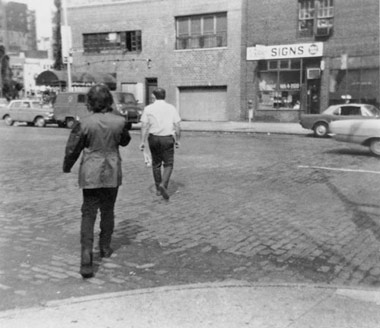
Films such as Following by Christopher Nolan (whose 2006 film The Prestige is out now in Europe) and artworks such as Sophie Calle’s and Vito Acconci’s are about following perfect strangers for the kick of it. The art of stalking comes to mind.

The comparison of Calle with Acconci is inevitable:

The cultural and social question of who is using whom is always at issue in artwork that gives others a voice (Krzysztof Wodiczko’s enlistment of people with stories of cultural dislocation is one relevant example) or relies on their presence in some other way (the inevitable comparison, to Calle’s early work in particular, is Vito Acconci’s 1969 Following Piece) —Art in America, Sept, 2005 by Nancy Princenthal

For a picture of the Following Piece click here.

On Sophie Calle’s Address Book (1983):

One of Calle’s first projects to generate public controversy was Address Book (1983). The French daily newspaper Libération invited her to publish a series of 28 articles. Having recently found an address book on the street (which she photocopied and returned to its owner), she decided to call some of the telephone numbers in the book and speak with the people about its owner. To the transcripts of these conversations, Calle added photographs of the man’s favorite activities, creating a portrait of a man she never met, by way of his acquaintances. The articles were published, but upon discovering them, the owner of the address book, a documentary filmmaker named Pierre Baudry, threatened to sue the artist for invasion of privacy. As Calle reports, the owner discovered a nude photograph of her, and demanded the newspaper publish it, in retaliation for what he perceived to be an unwelcome intrusion into his private life.

On Following:

Following (1998) – Christopher Nolan
[Amazon.com]
[FR] [DE] [UK]

Bill is a young, jobless aspiring writer. He tells a story about himself to a man, explaining how he began to follow random people on the street in an attempt to understand them. He sets up a number of rules to separate himself from the people he follows, but breaks them when he begins following a specific man, Cobb, day after day. Cobb wears a suit and leaves several different apartment buildings carrying a bag. He eventually confronts Bill at a diner and reveals that he is a burglar. Cobb invites Bill to accompany him on his next burglary.

On Following piece (1969) – Vito Acconci:

Following Piece is one of Vito Acconci’s early works. The underlying idea was to select a person from the passers-by who were by chance walking by and to follow the person until he or she disappeared into a private place where Acconci could not enter. The act of following could last a few minutes, if the person then got into a car, or four or five hours, if the person went to a cinema or restaurant. Acconci carried out this performance everyday for a month. And he typed up an account of each ‘pursuit’, sending it each time to a different member of the art community. —http://hosting.zkm.de/ctrlspace/d/texts/01?print-friendly=true [Mar 2005]

A fallacious catalogue

The visible work left by this novelist is easily and briefly enumerated. Impardonable, therefore, are the omissions and additions perpetrated by Madame Henri Bachelier in a fallacious catalogue which a certain daily, whose Protestant tendency is no secret, has had the inconsideration to inflict upon its deplorable readers–though these be few and Calvinist, if not Masonic and circumcised. The true friends of Menard have viewed this catalogue with alarm and even with a certain melancholy. One might say that only yesterday we gathered before his final monument, amidst the lugubrious cypresses, and already Error tries to tarnish his Memory . . . Decidedly, a brief rectification is unavoidable. —source

So begins Borges’s Pierre Menard, a fine piece of false document-based appropriative writing which I acquired at Antwerp book store Demian today, inbetween a haircut and a philharmonic concert (Wagner’s Tannhäuser and G. Holst’s The Planets (whose Mars theme was used in British cult tv series The Quatermass Experiment).

The keyword that I find in many works by Borges is fallacious which translates in my Dutch version as bedrieglijk. Fallacious are concepts which are based on fallacies.

More on fiction within fiction:

Fictional books and authors figure prominently in several short stories by the Argentine author Jorge Luis Borges. A few of Borges’s fictional creations include The Book of Sand, Herbert Quain (author of April March, The Secret Mirror, etc.), Ts’ui Pen (author of The Garden of Forking Paths), Mir Bahadur Ali (author of The Approach to Al-Mu’tasim), as well as the imaginary Encyclopædia Britannica of the story “Tlön, Uqbar, Orbis Tertius.” Borges’s most famous and beloved fictional book, however, is Don Quixote! This Don Quixote is written by the fictional symbolist poet Pierre Menard in Borges’s “Pierre Menard, Author of the Quixote.” In this story, Menard undertakes an independent word-by-word and line-by-line recreation of Cervantes‘s classic novel. The story itself takes the form of a review of Menard’s work for a literary journal; though Menard’s Quixote is still unfinished, the imaginary reviewer concludes that Menard’s circumstances and the intervening history between Cervantes’s 16th century Spain and Menard’s fictional present produce a Quixote that is more pleasurable to read and deeply richer in meaning: though Menard’s Quixote is identical on a word-for-word basis to Cervantes’s original, Menard’s is superior! This ironic conclusion is often read as a commentary on the nature of accurate translation, but more significantly as an illustration of the manner in which the meaning of a text is determined as much if not more by the reader than the author. –fictional books at Wikipedia

Of human hunting

The Most Dangerous Game (1932)

The French title to the film adaptation was Les Chasses du comte Zaroff , as depicted here on the cover of French magazine Midi- Minuit Fantastique, issue 6 of June 1963

Excerpt from the story, where the protagonist finds out what general Zaroff actually means:

“I wanted the ideal animal to hunt,” explained the general. “So I said, `What are the attributes of an ideal quarry?’ And the answer was, of course, `It must have courage, cunning, and, above all, it must be able to reason.”‘

“But no animal can reason,” objected Rainsford.

“My dear fellow,” said the general, “there is one that can.”

“But you can’t mean–” gasped Rainsford.

“And why not?”

“I can’t believe you are serious, General Zaroff. This is a grisly joke.”

“Why should I not be serious? I am speaking of hunting.”

  —The Most Dangerous Game (1924) is a famous short story by Richard Connell


See also: human hunting

Stephen Fry: The Secret Life of the Manic Depressive

Stephen Fry: The Secret Life of the Manic Depressive (Youtube)

Bipolar(previously known as manic depression) (Jahsonic)

BBC entry

… following his highly publicised nervous breakdown in 1995, which was attributed at the time to bad reviews … Fry was suffering from serious clinical depression at the time as a result of his as-yet undiagnosed cyclothymia, a form of bipolar disorder (formerly known as manic depression). He subsequently walked out of the production, prompting its early closure … Fry subsequently was unaccounted for for several days, during which period he contemplated suicide.

Stephen Fry (V for Vendetta, 2006) has since spoken publicly about living with a bipolar disorder, and in 2006 made a two-part documentary about his experiences, Stephen Fry: The Secret Life of the Manic-Depressive. In it, he interviews celebrities (such as Robbie Williams, Rick Stein, Carrie Fisher, Richard Dreyfuss (Inserts, 1975) , and Tony Slattery) and non-famous persons, all of whom also suffer from the illness. The programme was broadcast BBC Two on September 19 and September 26, 2006.