Introducing the Opinionated Diner

Simon Grigg has The Opinionated Diner, a music blog with good taste.

Silent Introduction (1997) – Kenny Dixon Jr
[Amazon.com]
[FR] [DE] [UK]

….enigmatic, even in his most open moments, Kenny Dixon Jr remains both one of America’s great musical secrets, almost unknown outside electronic circles, and a massive influence across the pond in Europe and America (try and imagine Henrik Schwarz’s wonderful DJ Kicks mix without Kenny’s influence). And completely addictive…once you buy in you come back again and again (and indeed, find yourself paying silly money for those rare 12”s). His rhythms, grooves…call them what you will…are often ridiculously understated in their subtly but their ability of snare you…as he says: I Can’t Kick This Feeling When It Hits —The Opinionated Diner

A bit more on Henrik Schwarz:

DJ-Kicks (2006) – Henrik Schwarz
[Amazon.com]
[FR] [DE] [UK]

It features tracks by personal favourites, Moondog, James Brown, Cymande, Drexciya, Coldcut, Robert Hood, Pharoah Sanders, Arthur Russell and Rhythm & Sound.

Other releases in 2006 that seem good:

Sunday Afternoon at Dingwalls (2006) – Gilles Peterson, Patrick Forge
[Amazon.com]
[FR] [DE] [UK]

Related: Patrick ForgeGilles PetersonAcid Jazz Dingwalls

And finally K Punk’s 2006 rewind:

Momus argues that ‘if music didn’t exactly die in 2006, it certainly felt sidelined, jilted, demoted, decentred, dethroned as the exemplary creative activity, the most vibrant subculture.’ That is one reason why Burial has to be the album of 2006, and hauntology the year’s dominant theme. K Punk’s 2006 rewind

Burial (2006) – Burial
[Amazon.com]
[FR] [DE] [UK]


Burial’s self-titled LP on Hyperdub is one of our albums of the year. It’s a remarkable debut, built from damaged beats and distant, hiss-smothered vocal samples: a haunted pirate station broadcasting forgotten rave anthems from the afterlife. —factmagazine

Listen to a track by Burial here. The genre is called dubstep, and it has been championed by Simon Reynolds and K-Punk since more than two years, I’m not sure I’m too keen on it. I have the same feeling as when the British music press was raving about The Streets.

Best of 2006 in music:

I’m afraid I’m not very good at year end lists, but everyone seemed to like Ys by Joanna Newsom. She belongs to that elusive category New Weird America, my brother bought a lot of that stuff last year, and his musical taste is impeccable.

Toilet philosophy

Human waste has been of interest to a number of philosophers and I call them — and I do not mean this in a derogatory way — toilet philosophers.

Fountain by Duchamp

Among them are Georges Bataille, who André Breton called “excremental philosopher” and Peter Sloterdijk, famous for his remarks on the role of the arse in his book Critique of Cynical Reason.

Then there was Slavoj Žižek in a review of a book of Timothy Garton Arsh who connected toilets to Buñuel to Lévi-Strauss to Hegel to Erica Jong.

Underground canon

Underground U.S.A. (2002) – Xavier Mendik, Steven Jay Schneider
[Amazon.com]
[FR] [DE] [UK]

Whether defined by the carnivalesque excesses of Troma studios (The Toxic Avenger), the arthouse erotica of Radley Metzger and Doris Wishman, or the narrative experimentations of Abel Ferrara, Melvin Van Peebles, Jack Smith, or Harmony Korine, underground cinema has achieved an important position within American film culture. Often defined as “cult” and “exploitation” or “alternative” and “independent,” the American underground retains separate strategies of production and exhibition from the cinematic mainstream, while its sexual and cinematic representations differ from the traditionally conservative structures of the Hollywood system. Underground U.S.A. offers a fascinating overview of this area of maverick moviemaking by considering the links between the experimental and exploitative traditions of the American underground.

I would recommend readers to pay particular attention to those articles [in Underground U.SA. by Steven Jay Schneider] that take issue with the representation of sexuality and graphic nudity in the underground canon such as [Elena] Gorfinkel’s work on taste and aesthetic distinction, Sargeant’s research on voyeurism and sadistic transgression and Michael J. Bowen’s work on the violent eroticism of what he terms the ‘roughie’. The work on the sexploitation film is interesting in terms of a discussion of taste formations and cultural distinctions, but more importantly (in terms of the aim of this book), the sexploitation film is interesting due to the fact that such films provide a ‘shadow history to cultural and social events’ of particular historical periods. —Rebecca Feasey, Scope

And a Richard Armstrong review at Flickhead.

Things exist by mistake

Slavoj Žižek (1949 – ): I feel a kind of spontaneous affinity with quantum physics, where – you know, the idea there is that the universe is a void, but a kind of positively charged void, and then particular things appear when the balance of the void is disturbed. And i like this idea spontaneously very much. The fact that its not just nothing, things are out there, – it means something went terribly wrong. that, – what we call creation is a kind of cosmic imbalance, cosmic catastrophe. That things exist by mistake. And im even ready to go to the end, and to claim that the only way to counteract this is to assume the mistake and go to the end, and we have a name for this, its called love. Isn’t love precisely this kind of cosmic imbalance? I was always disgusted that with this notion of “I love the world, universal love”…I dont like the world, i dont know how..- Basically I’m somewhere inbetween, I hate the world or I’m indifferent towards it. But the whole of reality its just it, its stupid, it is out there, I dont care about it. Love for me is an extremely violent act, love is not;”I love you… all”. Love means i pick something out, and its again this structure of imbalance, even if this something is a small detail, a fragile individual, person, I say, “I love you more than anything else. In this quite formal sence, love is evil. — Youtube clip, transcription source

The Abduction of Europe (1993) – Cees Nooteboom

Illustration: Abduction of Europe (1908) by Félix Vallotton

I’m currently reading Cees Nooteboom’s 1993 essay bundle De Ontvoering van Europa (Eng: The Abduction of Europe), dedicated to the question of a European identity.

I read Nooteboom’s Rituelen while in my twenties and I had largely forgotten about him. It strikes me now how he is probably one of the foremost intellectual writers of Europe and also a true European in the sense that he divides his time between Amsterdam, Berlin, and the Spanish islands.

Here is my translation of an excerpt on France’s fear of American cultural imperialism (Coca-Cola, McDonald’s, Dallas and Dynasty):

… if we give Europe’s indigenous cable television moguls a chance, we will soon enough prove that we are capable of producing television series equally bad as those in America, and that the French secret weapon of MacBaudrillard and MacDerrida is wreaking just as much havoc at American universities as harmless McDonald’s in Europe.

P. S. : It’s interesting to note that the concept of abduction as it relates to the mythological figure of Europa is interchangeable with the terms rape and seduction. The Wikipedia article states that “the [latter] two being near-equivalent in Greek myth.” I had encountered this before when reading about Don Juan who is depicted as either a seducer, rapist or murderer, depending on who’s doing the analysis. The American Production code (the forerunner of the MPAA, the current American film rating system) said of the depiction of seduction and rape (intimately locating them in one entry): “They should never be more than suggested, and only when essential for the plot, and even then never shown by explicit method.”

Admittedly I may be influenced too much by 1990s feminist discourse in locating these similarities, but here is one more pointer: History of Rape, Abduction, and Seduction in European Art and Literature.

Update 24/11/2025. Wat een flauw blogpost. Ik schaam me. Maar goed, dat was ik ook ooit. Ooit stond dat schilderij van Vallotton wel bovenaan, dat gaf het nog enig bestaansrecht. Wat ik er geloof ik goed aan vond, is dat Nooteboom niet het typisch cultuurpessimistisch argument gebruikte dat Europa zoveel betere cultuur produceert dan haar bastaardkindje, maar dat wij allebei op onze eigen manier in staat zijn rommelentertainment te maken.

Hier het origineel van het bon mot van Nooteboom:

‘Ik herinner me nog dat ik gezegd heb dat als je Europa en de desbetreffende kabelkoningen de kans geeft , we snel genoeg zullen bewijzen dat we minstens even slechte televisieseries kunnen maken als de Amerikanen, en dat de Franse geheime wapens van MacDerrida en MacBaudrillard op de Amerikaanse universiteiten heel wat meer verwarring stichten dan die brave Mc Donald’s hier.’

What is realism in literature?

By definition, fiction is “untruth.” Since untruth is contrary to truth, and because truth is a virtue, does that not make untruth found in fiction a vice? –anonymous catholic quote

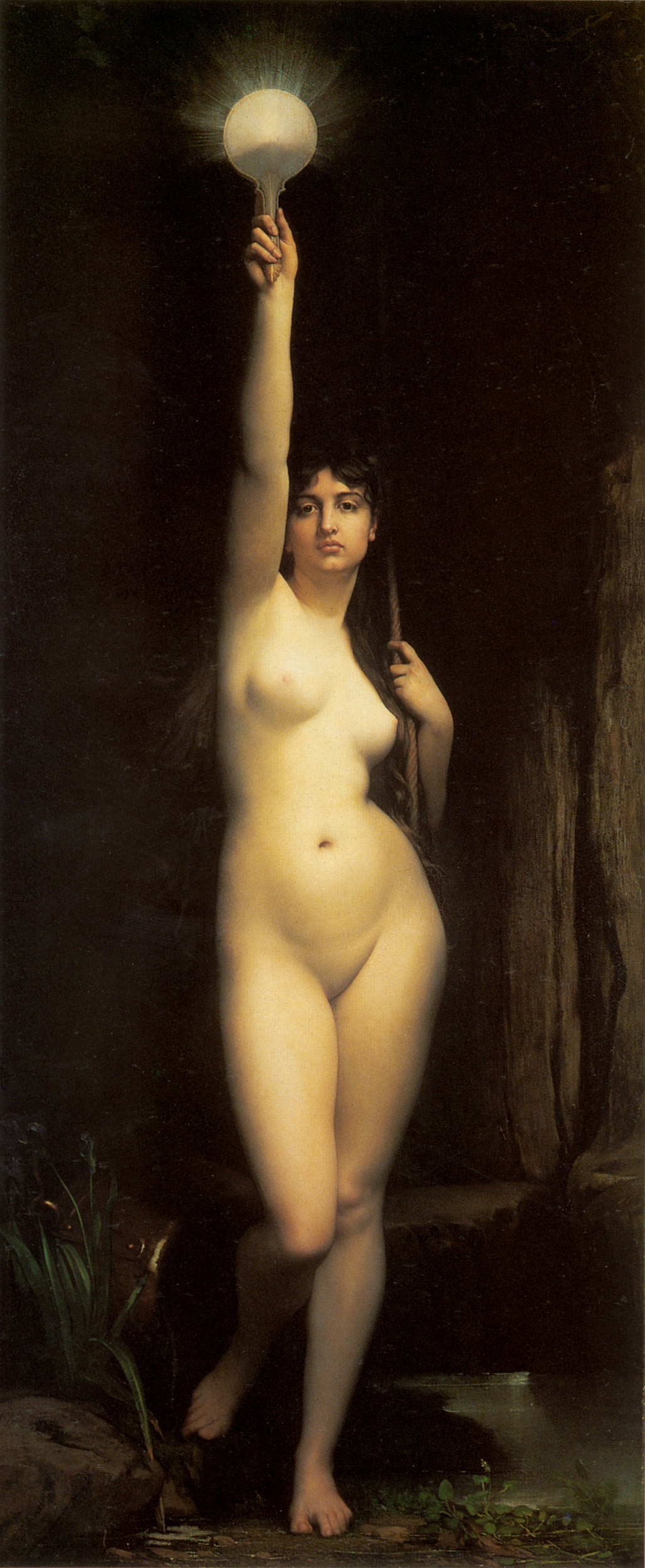
Truth (1870) – Jules Joseph Lefebvre

In literature realism refers to verisimilitude of narrative (whether or not a story is believable) or to verisimilitude of characterization (whether or not the characters are believable). Verisimilitude was introduced in literature when – in the latter half of the second millenium – the novel replaced the romance as primary literary genre.

The novel or the modern novel introduced realism in fiction, at a time when much fiction was marked by fantasy (romances such Amadís de Gaula, Le Morte d’Arthur). The devices used to introduce realism were the epistolary technique (Pamela), true adventure (Crusoe) and psychological development of the characters (Don Quixote, Madame Bovary, The Red and the Black). Literary realism as a full-fledged literary movement (first called realism and then naturalism) came into being in Europe in the 19th century. In France the movement’s main exponents were Honoré de Balzac and Émile Zola, in Scandinavia there was August Strindberg and Henrik Ibsen and in Russia Chekhov. The novelist George Eliot introduced realism into English fiction; as she declared in Adam Bede (1859), her purpose was to give a “faithful representation of commonplace things.” Mark Twain and William Dean Howells were the pioneers of realism in the United States.


“Will I disturb your writing if I vacuum?”

Woman: “Will I disturb your writing if I vacuum?”

Bukowski: “Nothing can disturb my writing, it’s a disease.”

Via The Rough Guide to Cult Fiction (2005) – which arrived in the mail yesterday. I don’t find it as enjoyable as 1001 Books I’ve been raving about but in contrast to the latter, it has more cross-media references to music and film. Notably absent are Ian McEwan and Iain Banks. Also, mostly 20th century literature.

The Rough Guide to Cult Fiction (2005) – Michaela Bushell, Helen Rodiss Paul Simpson [Amazon.com] [FR] [DE] [UK]

Renunciation of a vocation

Having read about Rimbaud’s life (and how he had stopped writing altogether) in Edmund Wilson’s Axel’s Castle, I re-read The Aesthetics of Silence by Susan Sontag. It’s incredible how Sontag – who was only 34 at the time this essay was published – reaches an impeccable style and an enormous lucidity. An excerpt:

The scene changes to an empty room.

Rimbaud has gone to Abyssinia to make his fortune in the slave trade. Wittgenstein, after a period as a village school-teacher, has chosen menial work as a hospital orderly. Duchamp has turned to chess. Accompanying these exemplary renunciations of a vocation, each man has declared that he regards his previous achievements in poetry, philosophy, or art as trifling, of no importance. —

The essay is published in the bundel Styles of Radical Will, which also features the seminal The Pornographic Imagination (1967).

L’Ultrameuble (1938) – Kurt Seligmann

L’Ultrameuble (Eng: Ultrafurniture) is a work of surrealist art by Kurt Seligmann. This 1938 sculpture is a three legged stool where the legs are quite literally women’s legs (stockinged mannikins’ legs in high-heel shoes.). It first came to my attention via the excellent German book Sade / Surreal.

Dismembered body parts such as dolls, living plants and speaking body parts belong to the category of the grotesque and the uncanny. Freud wrote an essay on the latter entitled The Uncanny in 1919:

Dismembered limbs, a severed head, a hand cut off at the wrist, as in a fairy tale of [Wilhelm] Hauff’s, feet which dance by themselves, as in the book by [Albrecht] Schaeffer which I mentioned above–all these have something peculiarly uncanny about them, especially when, as in the last instance, they prove capable of independent activity in addition. —The Uncanny (1919) – Sigmund Freud

A picture by Roger Schall of it here. It would make an ideal illustration for my page on independent body parts in fiction.

BTW, does anyone know the location of a the Legs video clip by ZZ Top?

P. S. I think I finally ‘ve been able to track the two writers Freud cites in his essay: Wilhelm Hauff and Albrecht Schaeffer.

Introducing Dr. Gaston Ferdière

Ferdière has been somewhat on my mind since a letter that Hans Bellmer wrote to him on his strange codependent relationship with Unica Zürn came to my attention. It appears that he was the psychiatrist of Unica Zürn, Antonin Artaud and Isidore Isou. Here is an excerpt from a 1995 article by British academic Stephen Barber:

“Under Ferdiere’s supervision, Artaud received 51 sessions of electroshock between June 1943 and December 1944. The treatment had been invented only five years earlier, by the Italian doctor Ugo Cerletti, who had observed the pacifying effect of electric shocks applied to the skulls of pigs in a Rome slaughterhouse and adapted the strategy for human application. The treatment was surrounded by an aura of discovery and excitement at the time Ferdiere began to use it, and he embraced it enthusiastically. Ferdiere’s assistant, Jacques Latremoliere, included an account of the treatment Artaud underwent in his doctoral thesis, Incidents and Accidents Observed in the Course of 1200 Electroshocks. He writes of the “theatrical reactions of the subject in the face of his hallucinations” and notes that one of Artaud’s vertebrae was shattered during the third of the unanesthetized sessions. Artaud himself would write of his having been taken for dead at the end of this same session, and of watching the orderlies prepare to take his “corpse” to the mortuary before he suddenly awakened after a coma of 90 minutes. Ferdiere, while not denying that such an incident took place, told me that, with such a volume of electroshocks being applied, it was difficult to remember this particular event. … Ferdiere, building on his reputation as the “rehabilitator” of Artaud, would subsequently become the psychiatrist of the Surrealist photographer Hans Bellmer and his companion, the poet Unica Zürn (who committed suicide in 1970 while under his care). He also treated the leader of the Lettrist art movement, Isidore Isou, during the events of May 1968 in Paris. Isou and his fellow Lettrist Maurice Lemaitre subsequently wrote an entire book of outrageous insults against Ferdiere, titled Antonin Artaud Tortured by the Psychiatrists. They asserted: “Dr Gaston Ferdiere is one of the greatest criminals in the entire history of humanity: a new Eichmann,” and demanded his immediate arrest …” —Art in America