Via research on the King Mob Echo magazine, which led me to Chris Gray which led me to Conrad Rooks which led me to Chappaqua (in which Rita had a part), it has come to my attention that Rita Renoir has died.
Rita Renoir was a French exotic dancer, sex symbol, nobrow figure and actress.
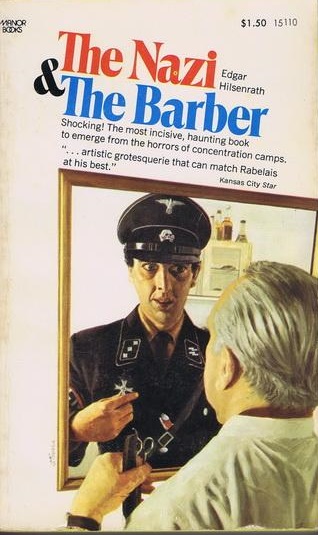
German writer Edgar Hilsenrath is best-known for his novel The Nazi and the Barber (1971), the story of a German SSmass murderer, who after the war assumes a Jewish identity and escapes to Israel and becomes a zionist. The story is told from his perspective and describes the atrocities he committed.
Today, it is exactly four years ago that Charlie Hebdo was massacred.
My father, who died in 2000, used to bring copies of Hara-Kiri home when I was a boy.
Charlie Hebdo was the new incarnation of Hara-Kiri, after it had been permanently banned by the French government.
I recently looked at ALL covers of Hara-Kiri, which you can find here.
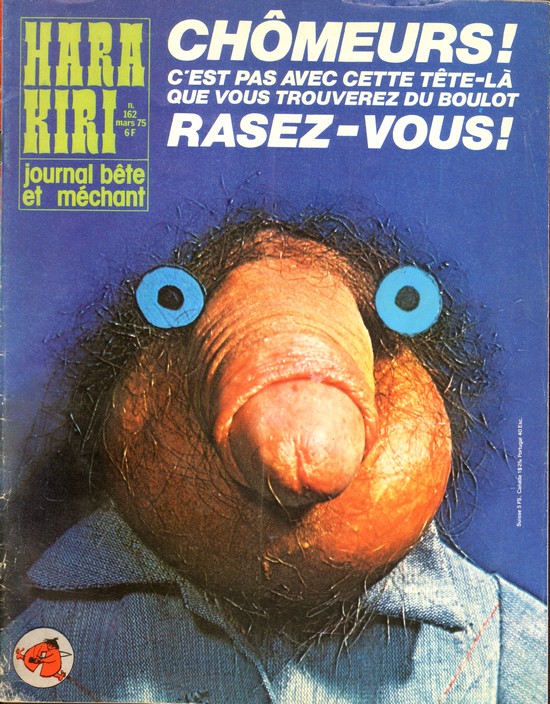
The funniest cover is perhaps Hara-kiri n°162 (March 1975) which depicts a frontal view of male genitals wearing a shirt along with the following accompanying text:
“Chômeurs ! c’est pas avec cette tête la que vous trouverez du boulot rasez-vous !”
English:”Unemployed! You won’t find a job with your face looking like this. Shave yourselves!”
I am, you might say, an unabashed fan of Charlie Hebdo. I am also a fan of the right to offend and insult, especially of fictional beings.
“I should like there to be perfect freedom to deride them all [all religions]; I should like men, gathered in no matter what temple to invoke the eternal who wears their image, to be seen as so many comics in a theater, at whose antics everyone may go to laugh.”
For those of you who think that Charlie Hebdo was obsessed with Islam. You are mistaken. It is simply not true and it has been proven.
Art critic Yve-Alain Bois in “Taken Liberties: Yve-Alain Bois on Charlie Hebdo”[1] has stated:
“A statistical analysis of Charlie Hebdo‘s content over the past ten years, particularly that of its front page, was published in Le Monde on February 25. It reveals not only that the publication was actually less obsessed with religion than is generally supposed, with only 7 percent of its front pages devoted to the subject, but also that the topic of Islam makes up less than a fifth of even these covers. When Charlie attacks religion–its contributors are particularly exercised by fundamentalism (of all stripes) and the hypocrisy of the clergy–Catholicism is most often the butt of its satire.”
So only seven percent is devoted to religion, and of that seven percent, only twenty percent to Islam. Which makes for 100*.07*.2 equals 1.4 percent. Yve-Alain Bois bases himself on research by Jean-François Mignot and Céline Goffette titled “Non, ‘Charlie Hebdo’ n’est pas obsédé par l’islam” [“No, ‘Charlie Hebdo’ is not obsessed with Islam”], published in Le Monde, February 24, 2015.
As we go forward, I’m rather pessimistic about freedom of speech , especially with regards to the global growth of religion. The question E. Kaufmann asks in 2010, Shall the Religious Inherit the Earth? is extremely relevant today.
Apart from a brief but ardent infatuation with Dutch schlager singer André Hazes in April (you don’t want to know 🙂 ), musically the best of 2018 was the discovery of the oeuvre of Hiroshi Yoshimura (1940 – 2003) who worked within Japanese ambient.
I discovered Hiroshi Yoshimura while listening to Birds of Venezuela (1973), an album of bird vocalizations which was re-released this year.
This whole Japanese ambient scene is most weird. There is the super sweet Jamaica ~ Waves And Light And Earth (1993) by Takashi Kokubo, which Discogs classifies as non-music.
In fact, many of these albums seem to have been made as pure background music. Kokubo’s album Get At The Wave (1987) was created for a new line of Sanyo air-conditioners.
Then there is the oddity Watering a Flower (1984) by Haruomi Hosono which was commissioned by Muji as in-store background music. And Hiroshi Yoshimura’s A・I・R (1984) was produced for the makeup and skincare company Shiseido; while his album Surround (1986) was made for playing at the model homes of the Misawa Home corporation.
But the best album is Green (1986) by Hiroshi Yoshimura. Someone remarked that this album is what green sounds like, what plant life sounds like. So soothing, full of natural sounds that have a very relaxing effect.
Ce magnifique gâteau ! (2018, This Magnificent Cake!) is written and directed by Marc James Roels and Emma de Swaef. It is cloth/fabric stop-motion film. The title is based on a dictum by Leopold II of Belgium recorded in a letter in which he remarked eagerly that he wanted his share of “this magnificent African cake”.
It is an anthology film set in colonial Africa in the late 19th century telling the stories of 5 different characters: a troubled king, a middle-aged Pygmy working in a luxury hotel as an ashtray, a failed businessman on an expedition who stole the fortune of his family which subsequently went bankrupt, a lost porter and a young army deserter. And a clarinetist who is forbidden by the king to play his cuckoo notes in “The Cuckoo in the Depths of the Woods”.
Cantudo sings “Desnudame”, in the background are excerpts from “La trastienda’
María José Cantudo was the actress who was first seen nude on Spanish cinema screens in La trastienda. While researching Grau, it also came to my attention that Cantudo recorded a song called “Desnuda me”, Spanish for “Unrobe me”.
In the part on Spanish horror of the documentary Eurotika!, Jorge Grau is featured on 18:50 [above].
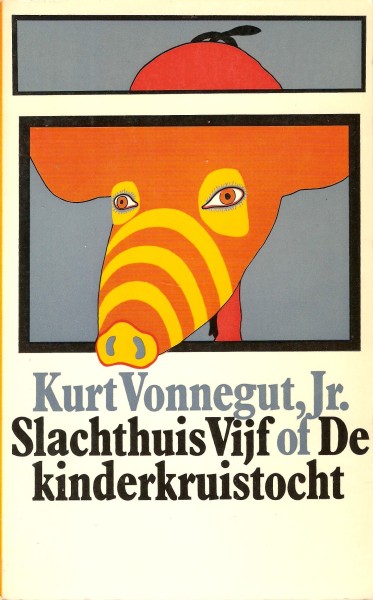
Dutch translation of 1970 of Slaughterhouse-Five (1969) translated by Else Hoog and with a cover by Ton Klop
It was not until I had read Galápagos (1985) in 2012 that I realized what a genius Vonnegut is. Last winter in China I read While Mortals Sleep (2011), a collection of short stories of which “The Humbugs” is absolutely gorgeous.
Back to Slaughterhouse-Five.
On page 21 (I’m reading the beautiful Dutch translation of 1970 translated by Else Hoog and with a cover by Ton Klop[above]), is the remark of Vonnegut on the fact that nothing intelligent can be said about a massacre, in this case the bombing of Dresden in World War II.
These are his words: “There is nothing intelligent to say about a massacre. Everybody is supposed to be dead, to never say anything or want anything ever again. Everything is supposed to be very quiet after a massacre, and it always is, except for the birds. And what do the birds say? All there is to say about a massacre, things like “Poo-tee-weet?“”
“Poo-tee-weet”, translated with an exclamation mark in Dutch au lieu of a question mark in the original English, is an onomatopoeia of a bird vocalization and in Vonnegut’s novel it stands for something meaningless (as Aristotle used it when he called the Platonic forms teretismata).
In reality of course, bird vocalizations are not meaningless (they are not blituri to use another ancient word), it is a form of animal communication that humans fail to understand.
Which brings us to the trope of meaningless violence, the Dutch notion of excessive and unnecessary violence. Here too, Vonnegut has something to say. When one character announces he is writing an anti-war book, someone retorts that writing and anti-war book is useless, because war is inevitable, you might as well write an “anti-glacier book”. Observations like this make Vonnegut not only a philosophical writer but also one of the great moralists of the 20th century.
Last Tango in Paris (1972) was the first of his films I saw. I’m sure if I would see it again, it would bore me to death. In contrast, Performance (1970) by Roeg (see prev. post) has aged better. Both films are a testament to the sexual revolution.
The last of Bertolucci’s film that I saw was The Dreamers (2003). I remember liking it and I guess that likely hasn’t changed.
Luck has it that YouTube has an entire copy of The Spider’s Stratagem (1970). Like Performance of Roeg, it is inspired by Jorge Luis Borges.
I’ve never seen it, I’ll watch it now.
Let me end (because I can) with this beautiful juxtaposition only marginally linked to Bertolucci: