Of a Fool, Who Thought His Wife Had Two Openings

Poggio

I have a definite fondness for crude humour of the Middle Ages. The history of the genre was first documented in Italian scholar Poggio‘s Facetiae, a collection of humorous and indecent tales.

There is a presumably American 1930 private edition titled Facetia Erotica. Its full text can be found here.

It features such stories as Of a Fool, Who Thought His Wife Had Two Openings.
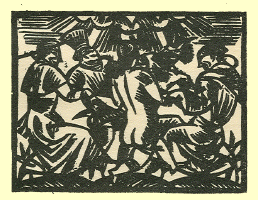
Poggio: Facetia Erotica, Title Page Poggio ‘s Facetiae, a collection of humorous and indecent tales is his best known work: it is available in several English translations. There is a public domain 1930 edition titled Facetia Erotica. It features such stories as Of a Fool, Who Thought His Wife Had Two Openings.

Facetiae, here published as Facetia Erotica. (source)

A peasant of our district, a stupid devil, who was utterly ignorant in matters of sex, got married. Thus it happened one night that his wife turned her back to him in bed, so that her buttocks rested in his lap. He had his weapon ready and landed by chance right in the goal. Marveling at his success, he inquired of his wife if she had two openings. And when she answered in the affirmative, he cried: “Hoho! I am content with but one; the second is entirely superfluous.” Upon which the sly woman, who was secretly consorting with the local priest, replied: “Then we can give the second away to charity. Let us grant it to the church and our priest.” The peasant, thinking to be relieved of an unnecessary burden, agreed [read the rest].

James Mason @100

James Mason @100

via img.youtube.com James Mason @100

James Mason (15 May 1909 – 27 July 1984) was an English actor who attained stardom in both British and American films. He acted in such films as Madame Bovary (1949), The Tell-Tale Heart[1] (1953) (animated short subject) (voice), 20,000 Leagues Under the Sea (1954), North by Northwest (1959), The Trials of Oscar Wilde (1960), Lolita (1962) and Mandingo (1975).

[Youtube=http://www.youtube.com/watch?v=W4s9V8aQu4c]

To me the man is remembered by his voice, there are even spoken word albums by him. Listen to it in the Youtube clip of The Tell-Tale Heart, the cinematic animated adaptation of Poe‘s story about the compulsion to confess, a psychological complex first described by Theodor Reik in The Compulsion to Confess in 1925.

La Merditude des choses (2009)

De helaasheid der dingen will premier at Cannes[1] this Saturday as La Merditude des choses.

[Youtube=http://www.youtube.com/watch?v=7FxKWAuf-4E]

The De helaasheid der dingen (French title: La Merditude des choses) is a 2009 film by Belgian director Felix van Groeningen (co-written by Christophe Dirickx), based on the eponymous novel by Dimitri Verhulst. The film stars Koen De Graeve, Johan Heldenbergh, Gilda De Bal, Pauline Grossen and Wouter Hendrickx.

Felix van Groeningen (1978) is a Belgian filmmaker. Van Groeningen came to the attention with his debut Steve + Sky which starred former model Delfine Bafort (his girlfriend at the time) and the Flemish actor Titus De Voogdt. He studied at the KASK in Gent and graduated in 2000. He also directed short subjects and theatrical work.  In 2007 he released Dagen Zonder Lief, with An Miller and a soundtrack by Jef Neve.

His latest project is De Helaasheid der dingen (2009), is a film adaptation of De helaasheid der dingen, a novel by Dimitri Verhulst.

The 2009 Cannes Film Festival opened yesterday

2009 Cannes Film Festival

The 2009 Cannes Film Festival opened yesterday

The 2009 Cannes Film Festival opened yesterday evening. On my list of faves there is Antichrist (by Lars von Trier), Bright Star (by Jane Campion), La Merditude des choses (by Felix van Groeningen), Les Herbes folles (by Alain Resnais), Los Abrazos Rotos (by Pedro Almodovar), Soudain le vide (by Gaspar Noe), Taking Woodstock (by Ang Lee), Thirst (by Park Chan-Wook), Vincere (by Marco Bellocchio) and The White Ribbon (by Michael Haneke).

Harvey Keitel @70

Harvey Keitel (born May 13, 1939) is an American actor best-known for the “tough-guy” characters he portrays and for his memorable roles from Quentin Tarantino’s Reservoir Dogs and Pulp Fiction, Martin Scorsese’s Mean Streets and Taxi Driver, Ridley Scott’s The Duellists and Thelma and Louise, Jane Campion’s The Piano and Abel Ferrara’s Bad Lieutenant.

Bad Lieutenant (1992) – Abel Ferrara [Amazon.com]

But surely, his most unsettling film is the Bad Lieutenant by bad boy of American cinema Abel Ferrara.

The film is squarely located in the oasis of American cinema known as the NC-17 pond. Its thematics are religion, rape revenge and general hardboiled existentialism. Its protagonist is Keitel who is tagged as Gambler. Thief. Junkie. Killer. Cop. Keitel’s nameless character is a corrupt police lieutenant who, throughout the movie, is spiralling rapidly into various drug addictions, including cocaine and heroin. His lack of success at gambling reflects his lack of faith. The turning point in the film arrives when the Lieutenant investigates the rape of a nun and uses this as a chance to confront his inner demons and perhaps achieve redemption.

The film features male frontal nudity of Keitel, a rarity in American cinema.

Most recently, erotic photographer Roy Stuart, in his Roy Stuart, vol. 5 reenacted the scene when Keitel stops two young girls in their car, discovers that they have no driver’s license and forces one to bare her behind and the other to simulate fellatio, while he masturbates.

Werner Herzog is to release a similarly titled film in 2009: Bad Lieutenant: Port of Call New Orleans starring Nicolas Cage and Val Kilmer. According to Herzog, the film is not a remake of the original. In fact, Herzog claims to have never seen Bad Lieutenant, nor to know who Abel Ferrara is.

Bad Lieutenant is World Cinema Classic #101.

RIP James Kirkup (1918 – 2009)

RIP James Kirkup

James Kirkup, FRSL (23 April 1918 – 10 May 2009) was a prolific English poet, translator and travel writer, best-known for his controversial poem The Love that Dares to Speak its Name, which describes a sexual fantasy of a homosexual soldier for the dead Christ.

The Dead Christ (1582) by Annibale Carracci

The Dead Christ (1582) by Annibale Carracci

The Love that Dares to Speak its Name is  written from the viewpoint of a Roman centurion who is graphically described having sex with Jesus after his crucifixion, and also claims that Jesus had had sex with numerous disciples, guards, and even Pontius Pilate. Its title The Love that Dares to Speak its Name was taken from a line in the poem “Two Loves” by Lord Alfred Douglas.

Lamentation over the Dead Christ (c. 1480) by Andrea Mantegna

Lamentation over the Dead Christ (c. 1480) by Andrea Mantegna

Dead Christ

In Western art, the death of Christ and its depiction is usually known by the term lamentation of Christ and it is a very common subject in Christian art from the High Middle Ages to the Baroque. After Jesus was crucified, his body was removed from the cross and his friends and family mourned over his body. This event has been depicted by many different artists.