[Youtube=http://www.youtube.com/watch?v=4pySXc-6GoU]
[Youtube=http://uk.youtube.com/watch?v=8GjjYHVj-mw]
From the director of Daft Punk’s ‘Around the World’ : The Science of Sleep

[Youtube=http://www.youtube.com/watch?v=4pySXc-6GoU]
[Youtube=http://uk.youtube.com/watch?v=8GjjYHVj-mw]
From the director of Daft Punk’s ‘Around the World’ : The Science of Sleep
[Youtube=http://youtube.com/watch?v=5AYnORotfq8]
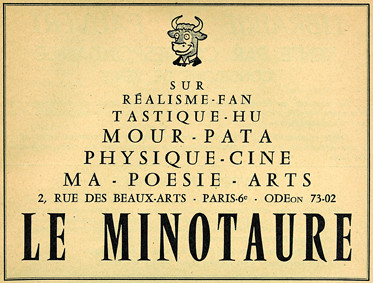
Le Minotaure was a Parisian bookstore founded by Roger Cornaille, located at number 2, rue des Beaux-Arts.
[Youtube=http://www.youtube.com/watch?v=pWL4C7JbOw8]
“Warm Leatherette” is a 1978 single by The Normal, based on J. G. Ballard’s novel Crash.
[Youtube=http://www.youtube.com/watch?v=_p7Ub1NDTVg]
Another Daniel Miller project: Silicon Teens – Memphis Tennessee
Inspiration: Music to read Crash by

Cover of Cannibale, issue 3
image sourced here.
Cannibale was an Italian underground comics magazine with humoristic and satirical overtones. Founded by Stefano Tamburini and Massimo Mattioli in the winter of 1977 and last published in July 1979. They were the first to publish Tanino Liberatore‘s RanXerox, who was later translated all over the world. The best known authors were Stefano Tamburini, Filippo Scozzari, Andrea Pazienza, Tanino Liberatore, Massimo Mattioli.
Liberatore was 25 when he started to publish his first episodes of Ranxerox in Cannibale. Here he is in a 2002 interview with Tanino by vakiltd for Greek national television. Italian text and Greek subtitles.
[Youtube=http://www.youtube.com/watch?v=13Aq5rog7Nk]
[Youtube=http://www.youtube.com/watch?v=zx8ohP7qro4]
[Youtube=http://www.youtube.com/watch?v=4lW0F1sccqk]
[Youtube=http://www.youtube.com/watch?v=3i3jT95NExE]
Sci-Fi noir is a term coined in the 2000s to denote a category of science-fiction films. Milestone films generally cited in this category are Jean-Luc Godard’s Alphaville (1965), Ridley Scott‘s Blade Runner (1982) and Ghost in the Shell (1995). As an aesthetic category, it is very near to cyberpunk and neo-noir. The work of Tanino Liberatore‘s RanXerox deserves mention here. One wonders how long this freshly-coined neologism will survive.
This collection of Youtube vids inspired by The Rise of Sci-Fi Noir by Broken Projector.
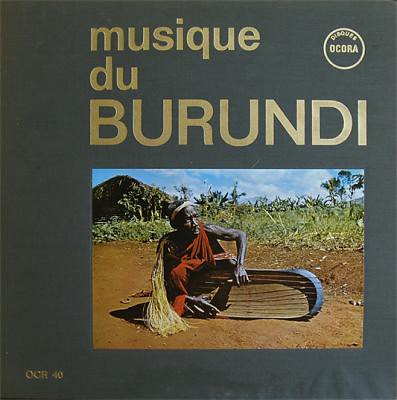
Musique du Burundi (1968)
Burundi beat is best known as an appropriated drum style of British New Romantics bands Bow Wow Wow and Adam and the Ants.
The original source of this tribal rhythm is a recording of 25 drummers of the Ingoma tribe, made in 1967 in a village in Burundi by Michel Vuylsteke and Charles Duvelle, a team of French anthropologists. The recording was included on an album, Musique du Burundi, issued by the French Ocora label in 1968. (pictured above)
In 1971 Mike Steiphenson grafted an arrangement for guitars and keyboards onto the Ocora recording for Barclay Records, and the result was Burundi Black, a seven inch that sold more than 125,000 copies and made the British best-seller charts. In 1978, Barclay released a twelve inch version.
In 1981, the track was re-released on Barclay and Cachalot records. This time, Rusty Egan, drummer with the new romantic band Visage, and a French record producer named Jean-Philippe Iliesco recorded a new pop arrangement over the Burundian drummers.
Mike Steiphenson holds the Burundi Black copyright. Adam and the Ants, Bow Wow Wow, and several other bands have made hits with the Burundi beat as a rhythmic foundation. The Burundian drummers who made the original recording are not sharing in the profits. In any case, as the Jamaican recording industry and the Amen break cases have shown, obtaining copyright for a rhythm is a difficult proposition.

Momus
“As a student of literature, something you find yourself doing a lot is reading books about books — narratives which tear through the plot outlines, critical receptions and choicest quotes of other books, giving you some kind of rapid gist or taste of hundreds of titles you’ll probably never read. What I’ve always liked about these books-about-books.”
He mentions
He also mentions the fact that the paratext is often better than the text itself
Example of the latter:
This post reminds me of the following quote of O. Wilde:
and my own recent research in thematic literary criticism and my earlier praise of secondary literature.
Via the comments to Momus’s post we come to reviews of books we’ve never read. Stanislaw Lem wrote a few sets of introductions to and reviews of fictional books here and Borges has An Examination of the Work of Herbert Quain
To top it off there is ‘How to Talk of Books We Haven’t Read?‘ by Pierre Bayard.
Inspired by The dream life of metabooks
[Youtube=http://www.youtube.com/watch?v=6p_WVUZvHLs]
Clear echoes of Faze Action on this Tellier disc, drums courtesy of Tony Allen.
Listen to the second track of the following clip for “Moving Cities” by Faze Action:
[Youtube=http://www.youtube.com/watch?v=fHt8In8CjbU]
If you like Faze Action and Tellier, you’ll like Renaud Paravel
[Youtube=http://www.youtube.com/watch?v=O3BvSRCfxog]
15 Again is the third album released by French electronic duo Cassius. This track “Eye Water” was written and produced by Cassius members Phillippe Zdar, Boom Bass and guest Pharrell Williams. It was recorded in just three weeks in Ibiza.
Original collage by Knalej
