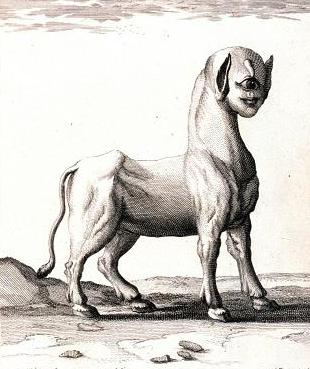
The monster appeared in Buenos Aires on August 26

Via Celeste comes this:

0

 Description of a Monster Born of a Ewe (Translation of August 1708 Work)


“The monster which is shown in the figure appeared in Buenos Aires on August 26. The contrast of three resemblances which it had, that of a child, a horse, and a calf, surprised all who saw it. I asked the person who showed it to me if I could examine it in order to describe it faithfully, but he never allowed me to do this. I examined it from quite close and drew its principal traits without his noticing. As soon as I returned to my room, having all the information about the monster vividly in my memory, it furnished what was missing from the drawing. I completed it and represented it in its natural color.”[2]

Louis Éconches Feuillée (sometimes spelled Feuillet) (1660-1732) was a French member of the Order of the Minims, explorer, astronomer, geographer, and botanist.

Limbo, weightlessness, and uncertainty

Have you ever reached out for something that was so tangible as to be almost in your grasp… that you realized you had to let go of what you were holding on to – to be able to reach even further out towards the object of your interest? The letting go is reminiscent of limbo, weightlessness, and uncertainty; that ‘far away, so close’ feeling.

Download the_one_moment.mp3 via Kierkegaardian

Oh how I love the plentiful emptiness of Michael Nyman.

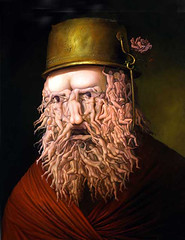
Kierkegaardian and arcimboldesque

André Martins de Barros more here, Barros is also the artist who did the flyer I first encountered on Ian McCormick’s grotesque page.

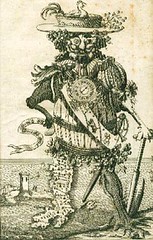
Found when Googling for Arcimboldesque, this anomymous etching c.1700, mid-Italian map, sourced here

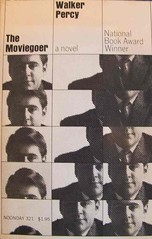
The Moviegoer is a 1961 Kierkegaardian philosophical novel by Walker Percy. The writer of this page holds that High Fidelity, Garden State, The Graduate, The Truman Show, American Beauty, Harold and Maude, Adaptation and Sideways are similarly themed.

I quote from The Moviegoer:

“Today is my thirtieth birthday and I sit on the ocean wave in the schoolyard and wait for Kate and think of nothing. Now in the thirty-first year of my dark pilgrimage on this earth and knowing less than I ever knew before, having learned only to recognize merde when I see it, having inherited no more from my father than a good nose for merde, for every species of shit that flies – my only talent – smelling merde from every quarter, living in fact in the very century of merde, the great shithouse of scientific humanism where needs are satisfied, everyone becomes an anyone, a warm and creative person, and prospers like a dung beetle, and one hundred percent of people are humanists and ninety-eight percent believe in God, and men are dead, dead, dead; and the malaise has settled like a fall-out and what people really fear is not that the bomb will fall but that the bomb will not fall – on this my thirtieth birthday, I know nothing and there is nothing to do but fall prey to desire.”

More info over at Kierkegaard and Arcimboldo.

The possibility of a literary canon

On the Possibility of Conservative Literary Criticism

via Acephalous by Scott Eric Kaufman on Feb 27, 2007

Actually, Scott’s post is more about the possibility of a literary canon tout court. He says: “few believe that Shakespeare, Tolstoy or Melville shouldn’t be taught—that’d they’re somehow inadequately “literary” in some regard—only that they should be taught alongside Behn [amatory fiction, women’s lit], (George) Eliot [women’s lit] and Stowe [Uncle Tom].” He recognizes place and time constraints: “Practical issues obviously abound. I’m talking about the hypothetical canon here, not what can be covered in a ten or eighteen-week survey.”

Shakespeare is universal because he embraced cultures and traditions outside his own—although his argument suffers here from being too quick on the triumphalism. …But then there’s the problem of what else should be included in the canon. We all agree that Shakespeare should, but what about all those books written by brown people who live on islands we’ve never even heard of. Can they possibly produce great literature. …

there’s absolutely no reason [Erna] Brodber‘s Jane and Louisa Will Soon Come Home couldn’t be a work of “universal” genius. Were someone to argue that “our” cultural tradition isn’t represented, the claim to universality could be wielded as a multicultural cudgel: It doesn’t matter, we could say, swinging, because it tells a universal story, as applicable to us and our lives as any native Jamaican.

….

none of the usual critics of academia have attempted to define the literary in such a way that Shakespeare and Dickens are in, but Brodber and the rest are out. Or, they could have the courage of their convictions and say that if Shakespeare and Dickens are in, so are Brodber and the rest …

In this respect, I think the multiculturalist have cornered the cultural traditionalists, forcing them into a position either visibly incoherent (the false universalism of Shakespeare) or spectacularly racist (Dead and White, That’s What’s Right! Dead and White, That’s What’s Right!). ….

To conclude Scott asks: Where do they go from here?

Essentially, Acephalous is in search of a postmodern canon. A canon that gives a place to the other; the queer, the postcolonial. He’s not denying the justifiability of the Western canon, but wonders how big a place should be reserved for the ‘other’ within that canon, without deviating too far from the what-is-ness of things. I look forward to reading more.

The artificiality of the image, its gloss rather than its reality

Via “Don’t you ever come down?” come The films of late Guy Bourdin on YouTube

Guy Bourdin (2006) – Alison M. Gingeras
[Amazon.com]
[FR] [DE] [UK]

Exhibit A: Guy Bourdin (2001) – Luc Sante
[Amazon.com]
[FR] [DE] [UK]

More text on Bourdin over at my page and pictures over at Flickr.

Also, this picture a very good illustration of Bourdin’s fascination with disembodied limbs, what I like to call independent body parts in fiction, of which I’ve blogged here.

Trivia: Madonna was sued in 2004 for using the copyrighted work of the late French fashion photographer Guy Bourdin in her music video for the American Life track “Hollywood”[YouTube]. It was claimed she reenacted poses from at least eleven of the late photographer’s erotically tinged photos. Madonna settled the copyright lawsuit out of court.[4]

François Houtin’s imaginary gardens

Imaginary gardens with real toads in them

The French printmaker François Houtin (1950- ) is an artist whose work has been devoted almost exclusively to the depiction of imaginary gardens.

See www.spamula.net/blog/2007/02/houtin.html

Also an interesting blog: bibliodyssey.blogspot.com, introduced by Mr Aitch of Il Giornale as:

I’m grateful to Peacay, of Bibliodyssey renown, for introducing me to the work of this artist, nicely described by his friend and collaborator Gilbert Lascault as ‘the printmaker-gardener, the draughtsman-nurseryman, the demanding dreamer, the landscape artist, and the arboriculturalist-etcher.’

Here is another superb post from Bibliodyssey:

German naturalist Johann Christian Daniel von Schreber (1739-1810) trained as a physician and went and studied botany in Sweden under the great Carolus Linneaus. He would eventually edit one of Linneaus’s publications and he also included the Linnean binomial species naming system for the first time for some of the animals depicted above.

And this one on cabinets of curiosities is a must.

Eye candy #1

Some recent Flickr uploads. Flickr is one of the most elegant content publishing platforms I’ve encountered in a long time. If you have a blog heavily involving pictures, it pays just to publish them there and write your blog entries over at Flickr, you can very easily include any kind of links to other pictures or outside of Flickr.

Click the pictures to find more info.

My mother’s favorite song

Steven Hall, whom I first met in 2000, is now on MySpace, under the moniker Buddhist Army. So am I, not as Jahsonic (somebody had beat me to it) but as MetaSoul. The similarities do not end there. We both feature his brilliant track — and also the favorite track of Steven’s mother — ‘Volleyball’. Click one of our spaces to listen.

One can easily recognize Steven’s guitar as the guitar on many a Arthur Russell track. Here is Steven Hall’s profile at Discogs.

‘Volley Ball’ sounds like nothing else I’ve heard in a while but to give you an idea it’s similar to:

  1. Padlock EP (1983) – Gwen Guthrie with Sly and Robbie, the ‘Padlock’ track can be heard here, unfortunately simultaneously with another choice Guthrie track: ‘Closer’, turn one off.
  2. Arthur Russell tracks, obviously, at MySpace here, here, and here are more.
  3. Josephine (La Version Francaise) by Chris Rea (here at Youtube, not the Version Francaise.), don’t be offended Steven, your song is way better.

Update: Steven notifies me that he doesn’t want to “take all the credit for the Volleyball song. Daniel Wang programmed and recorded the beat with that relentless bell–I used it readymade–I liked this beat so much I used it for another song that appears on the same live concert cd–“Go For The Night” which is one of only two songs that Arthur and I ever wrote together.”

The end of the sexual revolution

In the Cut (Unrated and Uncut Director’s Edition) (2003) – Jane Campion [Amazon.com] [FR] [DE] [UK]

In the Cut, of course, continues Campion’s career-long examination of female masochism.

In the Cut (1995) – Susanna Moore
[Amazon.com]
[FR] [DE] [UK]

I’m halfway through Susanna Moore’s 1995 novel In the Cut, the story of a thirty-something literature teacher in New York City with an interest in street slang who falls in love with a cop of whom she suspects he may also be a serial killer/psychopath. There are lots of similarities here with Erica Jong’s Fear of Flying, which I read last year. Can both be categorized as chick lit? If yes, this kind of chick lit takes it upon itself to study men’s (sexual) behavior in an almost anthropological way. Moore describes how a post-coital man, Erica Jong described one of her lover’s post-toilet behavior.

So far I liked Jane Campion’s film adaption of In the Cut better, Moore’s prose is kind of trite and Moore lacks the philosophical breadth I liked in Fear of Flying.

What In the Cut and Fear of Flying also share is the concept of women’s sexuality after the sexual revolution, a topic I’ve first mentioned in my profile of Looking for Mr. Goodbar (1977).

Speaking of the end of the sexual revolution which oficially arrived in 1984 (cfr. TIME cover) and which coincides with the arrival of AIDS (see Benetton AIDS ad) and of postmodernism: many writers of the pre- and sexual revolution era such as Gershon Legman, Wayland Young (Eros Denied), Gordon Rattray Taylor and Amos Vogel (Film as a Subversive Art) foreshadowed utopia as soon as we would get rid of our sexual inhibitions.

I quote from Jim Haynes’s website[1]:


Murder is a crime; describing murder is not. Sex is not a crime. Describing sex is. Why?” –Gershon Legman.

“If we were sexually liberated there’d be no president, no police force, no night sticks, no governments.” –Germaine Greer.

The utopia did not happen because of the aforementioned AIDS epidemic and what I suspect a whole range of reasons. Personally I like the concept of inhibitions, the concept of taboos, the concept of shame and guilt; not only are these inhibitions what makes sex exciting in the first place but I suspect that they are necessary to regulate a society. If these inhibitions would not be there life would be an eternal recurrence of the orgy in Perfume. Maybe I should read this?

The only writer that comes to mind who has dealt with this subject is Camille Paglia.

Well, um, what I’m saying is that I’m part of the sexual revolution, um, and I feel that the…in one of my most controversial sentences is “Everybody who preached free love in the 60’s is responsible for AIDS.” I mean by that the Mama’s and the Papa’s and all of us, so, the price of that revolution has been paid by gay men, primarily. I think that what we’re understanding is the enormous power of nature. Even Larry Kramer is starting to talk like this now: that nature apparently did not want us to be promiscuous and that it puts a thousand obstacles in our paths such as these diseases. OK. I feel that procreation is nature’s law, and that’s why I defy nature, I resist it, I oppose it. OK. I think that women certainly are in the..um, you know we were the first generation to have the birth control pill, OK, which frustrates nature. […] –Camille Paglia interviewed by Jack Nichols, 1997

But of course there must be other literature out there, and if you know of any, I’m looking forward to your recommendations.