Yearly Archives: 2008

Principles of an aesthetics of death

Principes d’une esthétique de la mort by Michel Guiomar

And just when you think you’ve seen everything, a book manages to come out of nowhere and amaze you. Today, at the Antwerp book store Demian, I bought Principes d’une esthétique de la mort, les modes de présences, les présences immédiates, le seuil de l’Au-delà, a book essay by French writer Michel Guiomar, published in 1967 by French cult publisher José Corti. The book has not been translated to English, a possible translation of the title is Principles of an aesthetics of death. The book extensively references jahsonic favourite Gaston Bachelard.

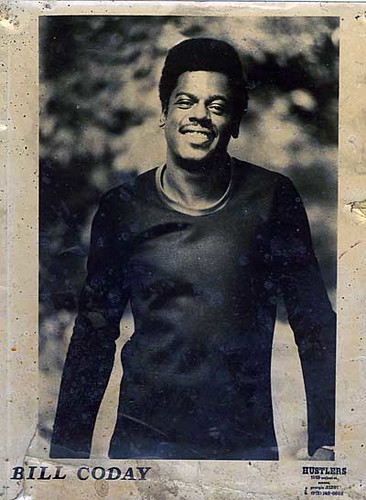
Bill Coday (1942 – 2008)

Photo unidentified of Bill Coday

Bill Coday (May 10, 1942 in Coldwater, Mississippi – June 8, 2008) was a blues and soul musician popular on the British Northern soul scene. As a young man he began singing in juke joints in and around Blytheville, Arkansas. Later, Coday travelled to Chicago, Illinois, and there one night he was “discovered” by Denise LaSalle. LaSalle signed Coday to her Crajon label, and introduced Coday to Willie Mitchell of Memphis, Tennessee. Mitchell’s reputation in the soul and soul blues music industry includes producing such artists as Al Green and Ann Peebles. Mitchell agreed to work with Coday, and a result of this relationship, the team of Mitchell and Coday produced songs that included “Sixty Minute Teaser,” “I Get High on Your Love,” “You’re Gonna Want Me,” and “Get you Lies Straight.”

[Youtube=http://www.youtube.com/watch?v=PCle3p43m3I]

“Sixty Minute Teaser”

The flower of the swamp, a head. Human and sad.

La Fleur du marécage (1885) by Odilon Redon

La Fleur du marécage (1885) by Odilon Redon

In 1885, Odilon Redon depicts a Pierrot entitled La Fleur du marécage and commented with “La fleur du marécage, une tête. humaine et triste.” The engraving is is reminiscent of the fantastic plants of Edward Lear. Marécage is French for swamp, so the title translates as The flower of the swamp, a head. Human and sad.

The Sob of the Earth

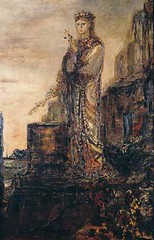
Helen by Moreau

Helen by Gustave Moreau

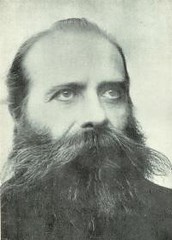
Eduard_von_Hartmann

Edward von Hartmann

Yes, this world is indeed flat, while the other nonsense.
I am resigned, without hope, in my fate,
And to kill time until death,
I smoke by the noses of the gods thin cigarettes.

Go, live, strive, poor future skeletons,
I, the blue meander which toward the blue sky twists,
plunge into an infinite ecstasy and end up sleeping
As a perfume dying of a thousand dishes.

And I enter paradise, filled with flowery yet clear dreams
Where seen mingling in waltzes fantastic
Elephants in choirs of mosquitoes.

And then, when I wake dreaming of my verse,
I contemplate the heart full of a sweet joy,
My dear thumb roasted as a goose’s thigh.

See Le sanglot de la terre, a poem that evinces the influence of Arthur Schopenhauer‘s pessimistic philosophy and Edward von Hartmann‘s concept of the unconscious mind.

On caricatures and character

One could easily be tempted to attribute common etymological roots to the words caricature and character. In fact their etymologies are not connected but that does not stop us from associating the two concepts.

Yesterday, I stumbled upon an epigraph by Poe: “Ce grand malheur, de ne pouvoir être seul,” which translates to Such a great misfortune, not to be able to be alone. It is from Poe’s short story “The Man of the Crowd,” but Poe had quoted it before, in his earliest tale, “Metzengerstein.”

Poe attributes it to Jean de La Bruyère, who wrote the Caractères (Eng: The Characters of Jean de La Bruyère). Bruyère’s book is an “augmented” translation of Theophrastus‘s (371 – c. 287 BC) The Characters which contains thirty brief, vigorous and trenchant outlines of moral types, which form a valuable picture of the life of his time, and in fact of human nature in general.

The genre of the “character sketch” is generally cited as originating in Theophrastus’s typology. One of the thirty sketches of Theophrastus reads thus:

Of Obscenity, or Ribaldry “Impurity or beastliness is not hard to be defined. It is a licentious lewd jest. He is impure or flagitious, who meeting with modest women, sheweth that which taketh his name of shame or secrecy. Being at a Play in the Theatre, when all are attentively silent, he in a cross conceit applauds, or claps his hands: and when the Spectators are exceedingly pleased, he hisseth: and when all the company is very attentive in hearing and beholding, he lying alone belcheth or breaketh wind, as if Æolus were bustling in his Cave; forcing the Spectators to look another way …”, translation by Joseph Healey

More recent writing inspired by Theophrastus includes George Eliot‘s 1879 book of character sketches, Impressions of Theophrastus Such.

What I particularly like about these character sketches are their plotlessness, their roots as inspiration for the psychological novel, there generalizations into stereotypes and stock characters, and finally, their link to caricatures and physiognomy.

This post was illustrated by Characters Caricaturas (1743) by William Hogarth.
Henry Scott Tuke @150

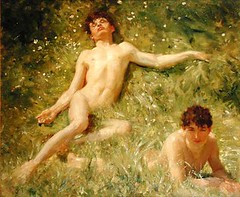
Sunbathers by Henry Scott Tuke

Sunbathers by Tuke

Today would have been Henry Scott Tuke‘s 150th birthday. Tuke, (12 June 185813 March 1929), a British painter and photographer, is best remembered for his homoerotic paintings of naked boys and young men, which have earned him a status as a pioneer of gay male culture. His nude adolescent boys were depicted doing everyday activities; his images were not overtly erotic, nor did they usually show their genitals.

Introducing Stan Vanderbeek

[Youtube=http://www.youtube.com/watch?v=1si3JxfYuBA]

Symmetrics (music credits anyone? Possibly Ravi Shankar?)

I don’t think I’ve mentioned American experimental filmmaker Stan Vanderbeek (1927 – 1984) on this blog. Today, I found his Symmetrics[1] of 1972 on YouTube. Vanderbeek is one of those artists I discovered in the post-internet days. Before the advent of YouTube this usually meant reading about him only, apart from the occasional still one might find on the net, such as this[2] very nice one.

Actually seeing Vanderbeek’s output on YouTube has proven to be very rewarding, especially after my disappointment in seeing much-read-about works Wavelength[3] by Michael Snow (born 1929) and that other overrated “structural filmSerene Velocity[4] by Ernie Gehr (born 1943).

These two last ones are deadly serious and devoid of any sense of humor; works such as Achooo Mr. Kerrooschev (1960) [5] by Vanderbeek are anything but that.

Click the numbers to see, hear.

If you like the work of Vanderbeek, you may also enjoy Len Lye.

Snuff (2008) Chuck Palahniuk

My first exposure to Chuck Palahniuk was the film Fight Club. My second was picking up the novel Haunted and reading the epigraph “There was much of the beautiful, much of the wanton, much of the bizarre, something of the terrible, and not a little of that which might have excited disgust,” a quotation from Edgar Allan Poe‘s “The Masque of the Red Death.” My third exposure was Diary, a novel I started to read and stopped reading around page 30 for reasons I forget.

The first and second exposures were enough to canonize Chuck.


[Amazon.com]
[FR] [DE] [UK]

Today, I present you Chuck’s latest novel Snuff, about a porn star on sabbatical, her attempt to break the world record of serial fornication and a portrait of three of the men obliging her in her attempt.

I was a huge Stephen King fan between my twenties and my thirties but if I still would be such an avid reader today, Chuck would replace Stephen. Stephen is a mere horror author while Chuck belongs in the tradition of the fantastique and the grotesque, genres which overlap with horror but which are more of a celebration of the ambiguity and ambivalence of expierence.

Back to the novel.

Since the book industry misses something akin to IMDb.com (although LibraryThing[1] comes close), which allows viewers to rate films, we resort to a randomly picked review [2] by minor writer Lucy Ellmann for the The New York Times who does not like the novel:

“What the hell is going on? The country that produced Melville, Twain and James now venerates King, Crichton, Grisham, Sebold and Palahniuk. Their subjects? Porn, crime, pop culture and an endless parade of out-of-body experiences. Their methods? Cliché, caricature and proto-Christian morality. Props? Corn chips, corpses, crucifixes. The agenda? Deceit: a dishonest throwing of the reader to the wolves. And the result? Readymade Hollywood scripts.”

Don’t you just love this? Negative criticism which makes you feel like reading the books involved. Lucy Ellman conveniently forgets all of the sensationalist writers from the past.

Barry Lederer (1944 – 2008)

I seem to have become somewhat of an obituarist.

The pantheon of disco DJs lost one of its demigods when Barry Lederer (September 9 1944May 31 2008) died earlier this week. Now you may ask, if Lederer was a demigod, who were the true gods in disco-DJ-mythology? Most commonly cited in this category are David Mancuso, François Kevorkian, Larry Levan, Walter Gibbons, Francis Grasso, Nicky Siano, Tom Moulton and Tee Scott.

In a 2000s interview[1] with disco-disco.com, Lederer noted that his favorite records included:

Click the footnotes to hear the music.