Yearly Archives: 2008

Hurry, before it’s gone

[Youtube=http://www.youtube.com/watch?v=PcNG4_Z2h5k]

From “The Incredibly Strange Film Show” (1988-89) Ross, Clarke

Apparently, so I found today, the book RE/Search No. 10: Incredibly Strange Films spawned a television documentary series hosted by Jonathan Ross. see the Doris Wishman entry on a YouTube clip here. Hurry, before it’s gone. Someone is going to object soon, be it copyright- or censorship wise.

Other parts of the series are online too.

Cult fiction #3

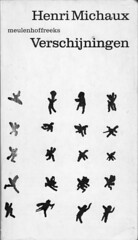
Verschijningen van Henri Michaux
Verschijningen

I started reading Verschijningen today, a Dutch translation of a selection of texts by Henri Michaux, published by Meulenhoff in 1972.

My first conscious exposure to the thought of Michaux was by way of David Toop‘s Ocean of Sound, in which Toop describes Michaux as an armchair traveler.

The collection comprises Les poètes voyagent (1946); Un certain Plume (1930); Apparitions (1946); Ici Poddema (1946); texts from Façons d’endormi, facons d’eveille; followed by a short essay by the translator Laurens Vancrevel.

My first impressions are based on reading Les poètes voyagent; Un certain Plume and Apparitions, Plume providing the most satisfying reading experience: the whole of Plume breathes Edgar Allan Poe and especially Poe’s incomparable short story Loss of Breath.

Keywords of Michaux’s writing are viscerality; the tropes of the macabre, fantastique, rocambolesque and grotesque; petrifaction, death, the void, lightness and emptiness, “everything-you-know-is-wrong” feelings, disintegration, decapitation and dismemberment, walls (and especially ceilings). All things considered, this is a very eerie collection told in a matter of fact voice.

If the content and tone are definitely Poe, the form of this collection’s most likely sibling is the writing of Baudelaire, and especially Baudelaire’s prose poetry.

The “liner notes” to this collection also alerted me to Images du monde visionnaire, a film by Eric Duvivier and Henri Michaux, an educational film which was produced in 1963 by the film department of Swiss pharmaceutical company Sandoz (best known for synthesizing LSD in 1938) in order to demonstrate the hallucinogenic effects of mescaline and hashish. It is the only venture in film of notable French writer and painter Henri Michaux. See that film by following the Documents entry, read more at Ombres Blanches.

World music classics #28

100 percent pure poison
Coming Right at You (1974) by 100% Pure Poison

Youtube: 100% Pure Poison’s “Windy C”, St. Germain’s “Sure Thing” and, “Get Involved by Pete Rock

If a musical composition’s popularity and quality can be measured from the number of times it’s been sampled, “Windy C” has fine credentials.

Windy C is a musical composition from the 1974 “Coming Right at You” album by 100% Pure Poison. “Windy C” was sampled for Pete Rock‘s “Get Involved” and St. Germain‘s Sure Thing.

Continuing the musical connections:

Sure Thing is a musical composition by Ludovic Navarre published on Tourist, featuring samples from “Windy C” and the soundtrack of Dennis Hopper‘s film The Hot Spot (John Lee Hooker, Miles Davis and Taj Mahal).

Let me give that video (not sure if original or some Youtube bricolage, stylish nevertheless):

[Youtube=http://youtube.com/watch?v=FgUFZQ4-HcY&]

Tired/Wired #1

Since its inception in the early nineties of last century, Wired Magazine has run a series called Tired/Wired. It highlights what is hot and what is not in cyber culture.

Here is my first Tired/Wired entry backed (or fronted) by a song by my musical hero Gainsbourg:

[Youtube=http://www.youtube.com/watch?v=sieGXAP2dCg]

Qui est In Qui est Out” (1966) by Gainsbourg

(The above composition also counts as World Music Classic #28 )

Tired/Wired

Please excuse the inclusion of my project. It is more a question of ambition than of reality. MUSE and JSTOR feature the best academic info but they keep it behind a walled enclosure.
Further rationales:

  • Wikipedia feels bloated today, Wikisource is getting up to speed (great for contemporary historical info in the public domain)
  • Google books has been a reliable source for some time now and is only getting better, Google itself contains too many Wikipedia clones
  • Downloading: only did this once, and downloaded some 250 tracks during a two month period which I subsequently lost, so I never downloaded again, I’ve always been in favor of the server-centric model proposed by SUN Microsystems rather than the client-centered model of that bête noire of computing Microsoft
    • Youtube satisfies my every music and moving images whim
  • Wikicommons is featuring a better and better image database free for use for any writer and blogger

Icons of erotic art #22

Study of a Seated Nude Woman Wearing Mask (c. 186566) by Thomas Eakins

This drawing by American artist Eakins is a testament to the aphrodisian qualities of sensory deprivation. Central to this drawing are the breasts, ripe and heavy, surreal and unreal, proof that the most beautiful of women are not to be found in real life (except in brief photographic glimpses); but rather on paper.

Previous entries in Icons of Erotic Art here, and in a Wiki format here.

I urge you

[Youtube=http://www.youtube.com/watch?v=MbGUr97tIDs&]

Early animation by the Chiodo brothers (of Killer Klowns from Outer Space)

I urge you, learn to see ‘bad’ films; they are sometimes sublime”. —Ado Kyrou, Le Surréalisme au cinéma, p. 276

Bad films are not only sublime, they learn you about the techniques of filmmaking, all the things we take for granted, the inner workings of concepts such as credibility in acting, continuity editing are exposed in watching and studying bad films.

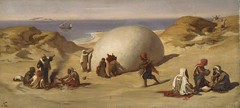
I found the clip above while researching Elihu Vedder‘s painting The Roc’s Egg (1868) which is said to have furnished Ray Harryhausen with inspiration for The Seventh Voyage of Sinbad.

The only version of the Roc’s Egg painting I found was this one, by Robert Swain Gifford

I couldn’t find Vedder’s painting.

Update: I found the Edder version, clearly inferior to Gifford’s. I’ll give you both so you be the judge.

The Roc's Egg by Vedder

Vedder’s version of the Roc’s egg

The Roc's Egg (1874) by Robert Swain Gifford
Gifford’s version of the Roc’s egg

World music classics #27

“California Soul”Youtube (1969) by Marlena Shaw

There are those records which invite you to perform grand gestures and theatrical movements on the dancefloor. This is one of them. A very spacious sound from the sunny side of the United States. Happy music.

My sensibilities in literature, film and the visual arts may sometimes be more to the gloomier side, in music I love bright, happy and danceable (exceptions notwithstanding).

Shaw is best-remembered for the use of her vocals in the 1996 “Remember Me” by Blue Boy Youtube.

Previous World Music Classics.

Quiddity and Derrick May

[Youtube=http://www.youtube.com/watch?v=FUWpSDtD9no&]

“It is what it is” (1988) – Derrick May

Prompted by a recent comment by Lichanos, here is a post on quiddity (the what-isness of things), Susan Sontag’s essay “The Aesthetics of Silence” and Derrick May.

Derrick May’s “It is what it is” is a composition first published in 1988 on Detroit recording label Transmat. Derrick May was my hero in the early 1990s but after his collaborations with System 7 (if you’d care to track down this material, only go for the Derrick May/Steve Hillage collaborations) he basically stopped making music.

“The scene changes to an empty room.”

The Aesthetics of Silence” is an essay by Susan Sontag first published in book form in Styles of Radical Will. She examines three 20th century intellectuals who – after having produced work in their younger years – stopped making anything as they grew older. Her case rests on Arthur Rimbaud, Ludwig Wittgenstein, and Marcel Duchamp.

The analogies with Derrick May are obvious, but does he deserve to be mentioned in the row of illustrious predecessors?

Back to the title of this post. The oblique link is the title of this musical composition “It is what it is” = quiddity.

Stunning work by Slavko Vorkapić

The Furies (1933)
music: Ludwig von Beethoven
score synchronized by Slavko Vorkapić

“Vorkapich hade complete creative freedom in writing, designing, directing and editing his montage sequences for feature films, his work was often reduced to its bones in the released productions. Here is the filmmaker’s original version of one of his outstanding efforts”

Thus reads the Youtube blurb to this wonderful clip; strange that I cannot find reference to this film over at IMDb.

Slavko Vorkapić (March 17 1894October 20 1976), was a SerbianAmerican film director and editor, university professor and painter, one of the most prominent figures of modern cinematography and film art, best-known for The Life and Death of 9413: a Hollywood Extra.

See surrealism and film