Category Archives: Uncategorized

Tying the loose ends of erotic history

Three years ago I find Le Bât[1], a painting by Pierre Subleyras of a man ostensibly painting on the private parts of a woman. While I knew that it was based on a tale by Jean de La Fontaine, I could not figure out which one.

Last week my friend Paul Rumsey brings the Renaissance print known by the mysterious name “Purinega tien duro” to my attention. It represents a phallic bird.

I start researching.

I find that uccello is Italian slang for phallus. The proof is the Decameron; in the tale of the nightingale (“he hath put the nightingale in his own cage and not in that of another”).

Via that episode I find an enumeration of the more bawdy episodes from the Decameron, being ‘Alibech and Rustico‘ (which I treated at length in my book De geschiedenis van de erotiek), ‘the priest metamorphosing a woman in a mare‘ and ‘Alatiel‘s revirgination‘.

While doing this, I stumble on another Pierre Subleyras painting, The Mare of Peasant Pierre (French: La Jument du compère Pierre), also apparently based on a tale by de La Fontaine, which is the equivalent of above-mentioned Decamerone’s “the priest metamorphosing a woman in a mare”.

The source of the La Fontaine tale is in his Contes et nouvelles en vers, a book I had short-changed in my own book: I only mentioned his rendition of Hans Carvel’s ring, failing to see that it is a compendium, a summary of a great many interesting stories, a  history of written erotica up until that age.

I find that “Le Bât” is translated as “The Pack Saddle.”
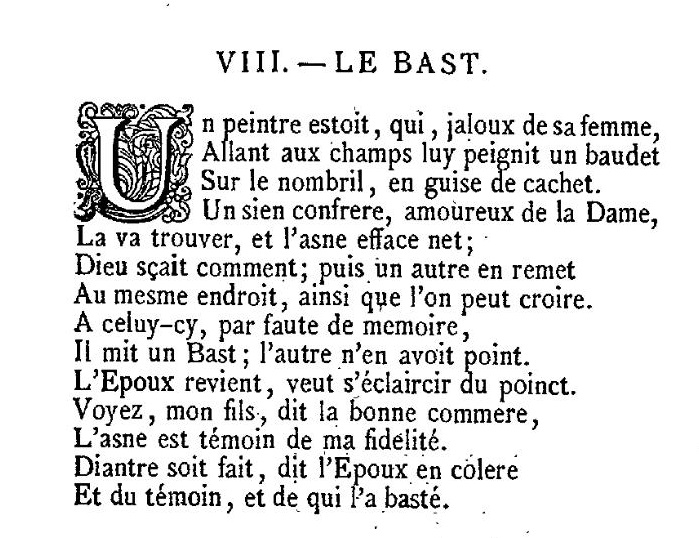
I go back to the Contes et nouvelles en vers and I find the text of “The Pack Saddle”. It is the story of a jealous husband who paints a seal (a painting of an ass) on his wife’s private parts, making her inaccessible to other men because the paint would wipe off during physical contact. The wife predictably does engage in amorous encounters, her lover decides to re-paint the wiped-off painting of the ass but he erroneously paints one detail too many. He paints a saddle where before there was none.

         A FAMOUS painter, jealous of his wife;
         Whose charms he valued more than fame or life,
         When going on a journey used his art,
         To paint an ASS upon a certain part,
         (Umbilical, 'tis said) and like a seal:
         Impressive token, nothing thence to steal.
         A BROTHER brush, enamoured of the dame;
         Now took advantage, and declared his flame:
         The Ass effaced, but God knows how 'twas done;
         Another soon howe'er he had begun,
         And finished well, upon the very spot;
         In painting, few more praises ever got;
         But want of recollection made him place
         A saddle, where before he none could trace.
         THE husband, when returned, desired to look
         At what he drew, when leave he lately took.
         Yes, see my dear, the wily wife replied,
         The Ass is witness, faithful I abide.
         Zounds! said the painter, when he got a sight,--
         What!--you'd persuade me ev'ry thing is right?
         I wish the witness you display so well,
         And him who saddled it, were both in Hell.

Case closed.

I feel like I am tying the last loose ends of erotic history.

RIP Benjamin Walker (1913 – 2013)


RIP Benjamin Walker (1913 – 2013)

In July 2011, Walker first came to my attention when I was researching “Della verga” by da Vinci.

Walker had researched “Della verga” in his book Body Magic which has the wonderful painting Potere cieco by Rudolf Schlichter on its cover (see above).

“Della verga” is a seminal text in the history of the unruly member (i. e. the genitals have a will of their own).

A double chin, disheveled hair and dirty boots

Napoléon Bonaparte abdicated in Fontainebleau (1845) by Paul Delaroche

Wham. What a painting.

Paul Delaroche often depicts his subject matter with an over-the-top sensationalism, think of his execution of Lady Jane Grey and the Christian female martyr floating down the river with tied hands.

The painting of a despondent Napoleon has a more subdued quality.

The high level of truthfulness does not arise from its photorealism but resides in the double chin, the disheveled hair and the dirty boots.

P.S. The painting is one of my WACs, that is, World Art Classics, an ongoing series of visual art and visual culture classics.

No American movie has ever found it “necessary” to show a toilet, let alone to flush it

I viewed the film Hitchcock last night. It features Geoffrey Shurlock as the censor of the Motion Picture Production Code, who says with regards to the production of the film Psycho:

“no American movie has ever found it “necessary” to show a toilet, let alone to flush it.”

Some thoughts:

I never knew that the American censor was involved during pre-production, i.e. before the shooting of the film.

It appears that the introduction of sound film coincides with the drafting of the Production Code. Did sound pose a threat more than imagery? Or was it the combination of sound and image that finally saw film evolving from a mere sideshow attraction to a genuine and ‘real’ mode of fiction consumption?

I remember a scene in Duck Soup where the Marx Brothers poke fun at the Production Code by showing a woman’s bedroom and then showing a woman’s shoes on the floor, a man’s shoes and horseshoes. Harpo is sleeping in the bed with a horse; the woman is in the twin bed next to them.

I remember extensive coverage of PsychoHitchcockianness and toilets in Enjoy Your Symptom! and The Pervert’s Guide to Cinema, both by Slavoj Žižek.

Above: “The Murder” by Bernard Herrmann used in the shower scene. “The Murder” is World Music Classic # 811.

RIP Prince Jazzbo (1951 – 2013)

Prince Jazzbo toasting on “Croaking Lizard

Linval Roy Carter (3 September 1951–11 September 2013), better known as Prince Jazzbo, was a Jamaican reggae and dancehall deejay and producer.

Croaking Lizard” is a musical composition by Lee Perry, published on the 1976 Super Ape album.

On this recording, Prince Jazzbo is heard chanting (toasting is what the Jamaicans call it) over the “Chase the Devil” riddim. The lyrics are largely nonsensical. Shards of texts I recognize are “on the river bank” and what I believe is “it’s slippery out there.”

Super Ape is a seminal recording in the history of 20th century music.

About bending, stooping and general prostration

Allegory of the World (1515) from the studio of Joachim Patinir

Allegory of the World (1515) is the title of an anonymous Flemish painting, attributed to the school of Joachim Patinir.

The work comes from the collection of the prince of Salm-Salm and is now in the collection of the Museum Wasserburg Anholt. It was first exhibited at the Meisterwerke westdeutscher Malerei in Düsseldorf in 1904.

On a globe of glass the artist has painted the joys and miseries of the world, with its gallows and torture wheels. The rocky and fantastic landscape is indeed reminiscent of Patinir. Through an opening on the left, a young man with a long stick tries to enter. A Flemish inscription tells us that he would like to cross the world without bending:

« Met recht soudic gerne doer de Werelt commen. »
« Upright I would like to cross the world. »

We see him coming out on the other side, middle aged and laughing, holding his long crooked stick. He has recognized the need to bend.

« ic bender doer maar ic moet crommen. »
« I crossed it but I had to bend. »

See also

They besieged it for three years

Alamut, vestiges of an impregnable castle

Alamut, vestiges of an impregnable castle (photo Payampak source).

“they besieged it for three years, but they could not take it, so strong was it. And indeed if they had had food within it never would have been taken. But after being besieged those three years they ran short of victual, and were taken. The Old Man was put to death with all his men [and the Castle with its Garden of Paradise was levelled with the ground].” [1]
The Travels of Marco Polo on Alamut Castle

In praise of land art


As I wrote in a post 10 months ago in a post over at Tumblr[1], there once was an artist who:

“had a garden. And every day, maybe several times a day, that artist walked a certain marked path in his garden, until the soles of his shoes had flattened the grass and eroded a path. I guess he then took a photo of his garden with its newly formed path. Maybe he sold the photos.”

Yesterday, I find out the name of this mysterious land artist, of which I had been ignorant for more than 20 years. It is a certain Richard Long (born 1945) and instead of my imagined curved geoglyph, he walked a straight line.

Richard Long first came to the attention of the art world with A Line Made by Walking in 1967 — three years before the iconic Spiral Jetty — and repeated the exercise in 1972 on a much larger scale and with more efficiency in Peru.

Where in Peru this was, I have been unable to find out, I wonder if it’s still there. Maybe it’s not far from When Faith Moves Mountains (2002) by Francis Alÿs.

Illustration: cover of a book on Richard Long‘s A Line Made by Walking by Dieter Roelstraete.