RIP Eartha Kitt (1927 – 2008)

RIP Eartha Kitt

That Bad Eartha by Eartha Kitt and Henri René and his Orchestra

Eartha Mae Kitt (19272008) was an American actress, singer, and cabaret star. She was perhaps best known for her 1953 Christmas song “Santa Baby“. Orson Welles once called her the “most exciting woman in the world”. She is internationally known for such songs as “I Want to Be Evil” (1957) and Where Is My Man (1983) (UK #36), the first a prime example of American cabaret, the second a gay anthem. She is an archetypical cat woman.

[Youtube=http://www.youtube.com/watch?v=tQ5VaBgXzuM&]

I Want to Be Evil

As for “I Want to Be Evil,” I just discovered the song today. The version on Youtube depicted was recorded for a Swedish television show called Kaskade or Kaskad, Swedish for waterfall.

The song was written by Lester Judson and Raymond Taylor, first recorded in 1953, taken from the album That Bad Eartha with  space-age pop musician Henri René and his Orchestra.

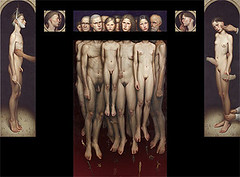
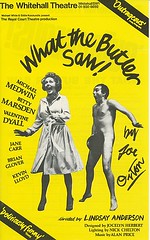
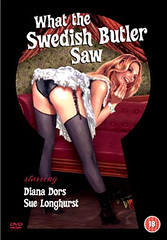
What the Butler Saw in Düsseldorf

The butler visited Diana und Actaeon – Der verbotene Blick auf die Nacktheit with a fellow butler and a maid.

He was thrilled to see Étant donnés[1] by Marcel Duchamp. And he did not realize it also looked like this[2]. He saw the famous metal doll sculpture[3] by Hans Bellmer and Bad Boy by Eric Fischl. He saw the most beautiful penis in post-war photography, yes he meant the Robert Mapplethorpe one[4].

He saw and liked photographs[5] of the Linley Sambourne collection, paintings by French figuratist Jean Rustin[6], paintings by Michael Kirkham[7], his first viewing of the fauvist Erich Heckel[8], Phryne[9] by French academic cult painter Jean-Léon Gérôme, waxworks by Belgian sculptor Berlinde De Bruyckere[10], and paintings by Roland Delcol[11].

The butler was also very much taken by Johannes Hüppi[12]; his first viewing of his fave John Currin[13]; his first real Félix Vallotton; and a Lisa Yuskavage[14]. But not that one.

Butler wants you to know that the works he pointed to are for reference only and may not correspond to the works at the exhibition. He also wants you to know that some of the links may be NSFW.

RIP Harold Pinter (1930 – 2008)

Harold Pinter is dead @78

Harold Pinter (1930 – 2008) is the man I know from his auctorial descriptive Pinteresque, his connection to the Theatre of the Absurd and his screenplay work on other writers’ novels, such as The Servant (1963), The Go-Between (1970), The French Lieutenant’s Woman (1980), and especially The Comfort of Strangers[1][2] (1990), one of the more devastating film experiences of the eighties.

[Youtube=http://www.youtube.com/watch?v=tjdKxVFd_K8]

The Comfort of Strangers

Outside of theatre, Pinter’s most popular lemma is the title of his play The Birthday Party, which survives to this day as Nick Cave‘s band The Birthday Party.

[Youtube=http://www.youtube.com/watch?v=l5I2vEcVC_I&]

“Nick The Stripper” (1981) by The Birthday Party

Theatre of the Absurd

Harold Pinter is a defining playwright of the 1962-coined Theatre of the Absurd theatrical movement along with French Eugène Ionesco, British Samuel Beckett, French Jean Genet, and Russian Arthur Adamov. The movement’s avant-la-lettre predecessors include Alfred Jarry, Luigi Pirandello, Stanislaw Ignacy Witkiewicz, Guillaume Apollinaire, and the Surrealists. Other playwrights associated are Tom Stoppard, Friedrich Dürrenmatt, Fernando Arrabal and Edward Albee.

Pinteresque

I don’t know what to think of Pinteresque. I feel as if Pinter and Buñuel share a set of the same sensibilities but I wonder. If one does a Celebrity Deathmatch between Pinteresque[3] and Buñuelian[4], Pinter wins with 19000+ vs 6000+ for Bunuel. Which is a pity, because I find Buñuelian absurdism a fuller experience than the Pinteresque, Buñuel manages to add spiritualism, humor and sensuality to his work whereas Pinter seems to bog down in kitchen-sink-naturalism. But Pinteresque is clearly the winner here, with Wikipedia defining Pinteresque in their separate article characteristics of Harold Pinter’s work and clearly no Buñuelian counterpart.

The Pinter pause

Another interesting aspect of Pinter’s work is his use of pauses, typographically represented by ellipses. Pinter uses it to such an extent that it has gained fame as the “Pinter pause“, a theatrical technique used for example to great effect in the water dripping faucet seduction scene in The Servant (1963).

The following exchange between Aston and Davies in The Caretaker is typical of the Pinter pause:

ASTON. More or less exactly what you…
DAVIES. That’s it … that’s what I’m getting at is … I mean, what sort of jobs … (Pause.)
ASTON. Well, there’s things like the stairs … and the … the bells …
DAVIES. But it’d be a matter … wouldn’t it … it’d be a matter of a broom … isn’t it?

Still, I prefer my ellipses by Céline (although he shares Pinter’s pessimism), who famously used them in Death on the Installment Plan in 1936, and which then became his trademark style, giving innovative, chaotic, and antiheroic visions of human suffering. In Death on the Installment Plan, he extensively uses ellipses scattered all throughout the text to enhance the rhythm and to emphasise the style of speech.

An example of Céline’s ellipses:

“So I start moseying down the Boulevard Sebastopol, then the rue de Rivoli . . . I’ve kind of lost track. It’s so stifling you can hardly move . . . I drag myself through the arcades . . . along the shop fronts . . . “How about the Bois de Boulogne!” I says to myself . . . I kept on walking quite a while . . . But it was getting to be unbearable . . . unbearable . . . When I see the gates of the Tuileries, I turn off … across the street and into the gardens . . . There was a hell of a crowd already.” —Death on the Installment Plan

RIP Adrian Mitchell (1932 – 2008)

RIP Adrian Mitchell

[Youtube=http://www.youtube.com/watch?v=FmMCObgu_jc]

To Whom It May Concern

Adrian Mitchell (24 October 193220 December 2008) was an English poet, novelist and playwright, best-known for his poem To Whom It May Concern[1].

Connecting lemmas for Mitchell include London Oz, Tom Phillips (artist), International Poetry Incarnation, SOMA Research Association, Wholly Communion, To Whom It May Concern (poem), Children of Albion: Poetry of the Underground in Britain and Penguin Modern Poets.

The poem To Whom It May Concern is known by its iconic phrase: “Tell me lies about Vietnam.” A piece of cult poetry if there ever was one.

“Women read fiction, men read non-fiction” revisited

Women read fiction, men read non-fiction[1], I wrote in 2006 and the subject has continued to intrigue me from three perspectives.

Lady Reading the Letters of Heloise and Abelard by you.

So what about the depiction of literature in painting? How about visual depictions of women reading? What about the female reader, the lectrice?.

Lady Reading the Letters of Heloise and Abelard (c.1780) is an oil painting measuring 81 x 65 cm .

It was painted by French painter Auguste Bernard d’Agesci and its subject was a female reader swooning over the star-crossed correspondence by Abelard and Heloise in the posthumously published Letters of Heloise and Abelard. The Letters of Heloise and Abelard are a series of letters between French priest Peter Abelard and his female student Héloïse after their separation and his castration.

Simonetti Redheaded woman tensely opens a love letter by you.

Love letters, it must be said, has been one of the most popular genres in the history of literature. Consider the aforementioned Letters of Heloise and Abelard, but also Letters of a Portuguese Nun and Love-Letters Between a Nobleman and His Sister. See also amatory fiction and the epistolary novel.

“Love letters, it must be said, has been one of the most popular genres in the history of literature.” Why? Because it reduces the reader to the part of eavesdropper or voyeur, it allows you to step out of yourself and live the life of another.

Abelard and his pupil, Heloise by Edmund Leighton. by you.

The passage you all want to read: the castration episode

“[Fulbert] bribed my servants; an assassin came into my bedchamber by night, with a razor in his hand, and found me in a deep sleep. I suffered the most shameful punishment that the revenge of an enemy could invent; in short, without losing my life, I lost my manhood. So cruel an action escaped not justice, the villain suffered the same mutilation, poor comfort for so irretrievable an evil. I confess to you that shame more than any sincere penitence made me resolve to hide myself from the sight of men, yet could I not separate myself from my Heloise.” in a translation/edition by John Hughes, Pierre Bayle

Introducing Coyle and Sharpe

[Youtube=http://www.youtube.com/watch?v=MFHxn_9aVq8]

The Warbler, 1963,  “man on the street” interview

Coyle and Sharpe was the name of American comic duo Jim Coyle and Mal Sharpe who appeared on television and radio during the early sixties, exhibiting their mastery of the “man on the street” interview, with humorous results.

Coyle and Sharpe began their comedy team in 1958 in a boarding house. In their official website Jim Coyle is described as a “benign conman who talked his way into 119 jobs by the time he was 25”. Mal Sharpe. At the time of their meeting, Mal Sharpe had just graduated college and was interested in the burgeoning scene that was happening in in the San Francisco area in that time.

In 1964, they were hired by radio station KGO in San Francisco to pull pranks, or as they jokingly referred to them, “Terrorizations”. The radio show was called “Coyle and Sharpe On The Loose”. Shortly after these broadcasts aired, they released two records: “The Absurd Imposters[1] and “The Insane Minds Of Coyle And Sharpe[2], which were released on the Warner Records.

The whereabouts of Jim Coyle are unkown, but in their website, a supposition is offered that he left the act to pursue a career in “tunneling” and that he died in 1993 burrowing under the city of Barcelona.

Mal Sharpe continued to do the “Man on the Street” interviews. In the year 2000, Sharpe hosted a centennial exhibit at the Whitney Museum, called “The American Century“. Coyle and Sharpe were featured in the Soundworks Exhibit for this presentation.

They have one record that re-presented their seminal comedy material in 2000 from Thirsty Ear, entitled Coyle And Sharpe-Audio Visionaries[3].

  • The Best of LCD: The Art and Writing of WFMU
  • RE/Search #11: Pranks!. RE/Search Publications, 1986.

De Daemonialitate et Incubis et Succubis

Pierre Antoine Baudouin by you.

La Dormeuse (1765) by Pierre Antoine Baudouin

Recent scholarship by Sholem Stein has revealed that the protagonist reader in this painting by French artist Pierre Antoine Baudouin had been reading either Sinistrari d’Ameno‘s Demoniality Or Incubi and Succubi or Claude Le Petit‘s “Apologie de Chausson.”

The woman reader was previously believed to have fallen asleep of boredom by reading Kant’s Observations on the Feeling of the Beautiful and Sublime, professor Stein now confirms that she probably died of excessive lasciviousness.

Introducing Alcide Bonneau ( 1836 – 1904)

Alcide Bonneau (Orléans, 1836, Paris, 1904) was a French intellectual, philologist, literary critic and translator of erotica and curiosa. He is also the author of Padlocks and Girdles of Chastity. In 1887, he collected a number of these essays and published them as Curiosa: essais critiques de littérature ancienne ignorée ou mal connue, it is said that the later bookselling category curiosa thanks its coinage to this collection.

The Love Academy by Vignale by you.

La Cazzaria by Antonio Vignali (a Latin novel by Antonio Vignale, written in the mid 1520s, first published in Napels in the 1530s. It was translated by Alcide Bonneau into French and as The Love Academy by Rudolph Schleifer (for Brandon House Library Editions)).

Alcide Bonneau followed in the footsteps of Antoine Galland and was a contemporary of British translator Richard Francis Burton.

Bonneau, like printer Isidore Liseux was an ex-priest, and they had known each other since seminary.

He was lexicographer at the Grand dictionnaire of Pierre Larousse (on Spanish and Italian literature), as well as the Nouveau Larousse illustré.

From 1876 to 1893, he was the principal collaborator of the editor Isidore Liseux (1835-1894), for whom he edited, translated and annotated some fifty works labelled as erotic or simply « curieux » : la On Civility in Children by Erasmus (1877); the Facetiae by Poggio Bracciolini (1878); the Raggionamenti by Aretino (1879-1880); the Dialogues de Luisa Sigea by Nicolas Chorier (1881); the Sonetti lussuriosi by Aretino (1882); the Apophoreta, or De Figuris Veneris, by German scholar Forberg, under the title Manuel d’érotologie classique (1882); La Cazzaria by Antonio Vignali (1882); Poésies complètes by Giorgio Baffo (1884); Raffaella by Piccolomini (1884); the Hecatelegium by Pacifico Massimi (1885); The Mandrake, a comedy by Machiavelli (1887); Portrait of Lozana: The Lusty Andalusian Woman by Delgado (1887); Hermaphroditus by Beccadelli (1892); etc. All translations were annotated, often running longer that the actual text.