[Youtube=http://www.youtube.com/watch?v=lWoE4J467lc]
Emak-Bakia (1926) Man Ray
Wonderful score, by whom?
[Youtube=http://www.youtube.com/watch?v=lWoE4J467lc]
Emak-Bakia (1926) Man Ray
Wonderful score, by whom?
[Youtube=http://www.youtube.com/watch?v=3wPCiyjtBfo]
Can dialectics break bricks? (1973) – René Viénet
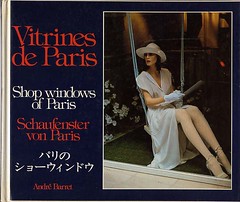
Shop windows of Paris (1980) – André Barret
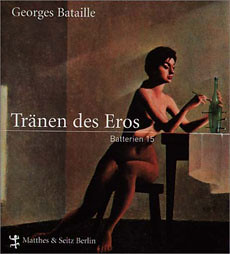
The Tears of Eros, in a German translation, with a cover by José Manuel Capuletti.
I’ve been re-reading Bataille’s last book The Tears of Eros, including the introduction by J. M. Lo Duca and their correspondence. I also found an online version (see above) of the cover picture as used in the German and Dutch translations. The painting is by José Manuel Capuletti, a now forgotten surrealist, here depicting yet another Danaide just as Rodin did in post #795.
This afternoon I acquired the excellent Quatre siècles de Surréalisme, L’Art fantastique dans la gravure.
“Maintenant je sais” (1954) by Jean Gabin
Jean Gabin sings that now he knows he’ll never know. Like in South Park episode 1101 (#154), the “With Apologies to Jesse Jackson” episode, popularly known as the “Nigger guy” episode to which the conclusion was “I don’t get it” and Luc Tuymans current photo exposition in Antwerp with the same title.
[Youtube=http://www.youtube.com/watch?v=doJ2uAPD3oc]
[Youtube=http://www.youtube.com/watch?v=-8n1kDrwneg]
Blood Simple (1985) Joel and Ethan Coen
Today is Ethan Coen’s fiftieth birthday.
Look out for the scene where the detective opens the window; the woman slams it on top of his wrist and drives a knife through his hand into the windowsill. The original soundtrack is by Carter Burwell, who has done the soundtracks to all of the Coens’ films.
Previous “World Cinema Classics“
In the history of co-dependent relationships there is Hans and Unica, there is Scott and Zelda.
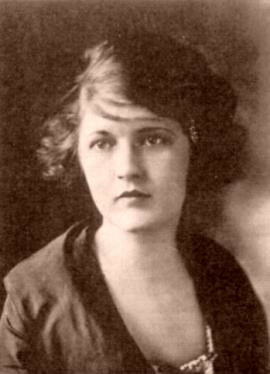
Zelda Fitzgerald
Of his relationship with Zelda, Scott says:
“Perhaps fifty percent of our friends and relations will tell you in good faith that it was my drinking that drove Zelda mad, and the other half would assure you that it was her madness that drove me to drink. Neither of these judgements means much of anything. These two groups of friends and relations would be unanimous in saying that each of us would have been much better off without the other. The irony is that we have never been more in love with each other in all our lives. She loves the alcohol on my lips. I cherish her most extravagant hallucinations. In the end, nothing really had much importance. We destroyed ourselves. But in all honesty, I never thought we destroyed each other.”
Inspired by the chapter “1874: Three Novellas, or “What Happened?”” in Gilles Deleuze Félix Guattari‘s A Thousand Plateaus (which begins with an illustration by Outcault). The chapter features the short stories/novellas “In the Cage” by Henry James, “The Crack-up” by F. Scott Fitzgerald and “The Story of the Abyss and the Spyglass” by Pierrette Fleutiaux and begins with an analysis of the difference between the short story (nouvelle in the original French version, rendered as novella in Brian Massumi‘s translation) and the tale:
[Youtube=http://www.youtube.com/watch?v=V1-tML8dtPc]