Introducing Gabriel von Max

Monkeys as Judges of Art, 1889

Monkeys as Judges of Art, 1889


Äffchen mit Zitrone Gabriel von Max Saure Erfahrung

Monkey with Lemon

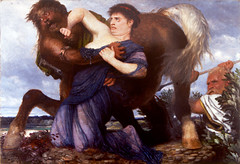
Die ekstatische Jungfrau Katharina Emmerich, 1885

Katharina Emmerich, 1885


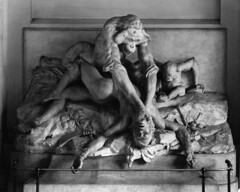
Der Anatom, 1869

The Anatomist, 1869

Gabriel Cornelius Ritter von Max (August 23, 1840, Prague – November 24, 1915, München) was a Prague-born Austrian painter. His themes were parapsychology and mysticism. He surrounded himself and with monkeys and painted them often, sometimes portraying them as human.

See also: Monkeys in art

It made me utter several moans

Bernini Saint Theresa

Ecstasy of St Theresa by Bernini

“In his hands I saw a long golden spear and at the end of the iron tip I seemed to see a point of fire. With this he seemed to pierce my heart several times so that it penetrated to my entrails. When he drew it out, I thought he was drawing them out with it and he left me completely afire with a great love for God. The pain was so sharp that it made me utter several moans; and so excessive was the sweetness caused me by the intense pain that one can never wish to lose it, nor will one’s soul be content with anything less than God.”


Lee Perry alert

Disco Devil by Perry

“Disco Devil revisited 2007 ” is a soon-to-be released new track and album by Lee Perry and Adrian Sherwood. It’s a radical but very relaxed re-interpretation of “Disco Devil” (the title of the twelve inch dub of “I Chase the Devil”) . Featuring the usual nonsense verse lyrics by Perry (“my wife is my knife”) and some wonderful Spanish horns, it shows Sherwood and Perry in excellent form. Out soon on On-U Sound Records. Key phrase is “Lucky Number.”

Tip of the hat to Freshly Squeezed, every Saturday from 16.00 to 18.00 PM.

For those of you who can’t wait to listen to this track, go to Steve Barker’s “On the Wire”, click on the Audio text link, it’s the third track.

Seduced at the Barbican

Fresco, 1st century AD, at the Villa dei Vetii, Pompeii
Not on show at the Barbican

Yesterday, “Seduced, Art and Sex from Antiquity to Now” opened at the Barbican Centre. Curated by Martin Kemp it features usual suspects Araki, Bacon, Bellmer, Boucher, Carracci, Fragonard, Goldin, Klimt, Koons, Mapplethorpe, Picasso, Rembrandt, Rodin, Schiele, Turner and Warhol.

You may want to pay it a visit for works by Marlene Dumas (X-posure, 1999) and Thomas Ruff (nudes ama14, 2000).

Dumas was new to me: here is her Google gallery.

Ruff I was familiar, but think I need to buy his book Nudes, a collaborative effort with Houellebecq. His Google gallery. And a Google gallery of the Nudes set.

Tip of the hat to John Coulthart

Happy birthday Pharoah and World Dance Music classic #8

Pharoah turns 67 today.

Thembi (1971) – Pharoah Sanders
(with on the cover I believe, Lonnie Liston Smith)

Pharoah Sanders (born October 13, 1940) is an American jazz saxophonist. Ornette Coleman once described him as “probably the best tenor player in the world.” Most of Sanders’ best-selling work was made in the late 1960s and early 1970s for Impulse Records, including the 30-minute wave-on-wave of free jazz “The Creator has a Master Plan” from the album Karma. Sanders’s works influenced a new generation when his music was a major influence on the British acid jazz scene from the late 1980s and 1990s. Most recently his work was compiled on You’ve Got to Have Freedom, which features my favorite and the most danceable and accessible track of Sanders: the 1980 You’ve Got to Have Freedom, which is number 8 in my World Dance Music Classic series.

[Youtube=http://www.youtube.com/watch?v=FdTgH1u7cmM]

World Dance Music Classic #8

Previous World Dance Music Classics

“I am a writer of tales of the uncanny”

[Youtube=http://www.youtube.com/watch?v=7jQtkGJMtH0]

Fake H. P. Lovecraft 1933 WPA Newsreel Interview via William Gibson

Today, William Gibson reported on the above footage. In a second post, Gibson admits having been fooled. As he writes in a second post:  “I guess I so wanted to believe that that was Lovecraft that I managed to ignore the actor’s complete lack of HPLoid bone-structure. (Lovecraft was one distinctively-jawed New Englander.)

Faking elder footage on YouTube, though, has great potential as a form.”

Italian white noise and avant-garde exploitation

“In 1951, the first electronic music studio was conceived from scratch at the WDR Radio of Cologne (Germany) to enable the composition of electronic music sounds. Briefly, the concept of studios evolved up to the 1955 design of the Phonology studio in Milan by Luciano Berio and Bruno Maderna. With nine oscillators, various filters and other sophisticated equipment , the presence of a technician/musician (Marino Zuccheri), the studio was the best equipped in the world at that time.” via usoproject

You may also know Bruno Maderna from his work on Death Laid an Egg.

Good night, sleep tight.

La morte ha fatto l’uovo (1968) – Giulio Questi

In praise of non-eventfulness

Tomorrow is Brigitte Lahaie 52nd birthday. While researching for this post I stumbled upon the following clip which is a perfect example of the non-eventfulness I appreciate in some films. The first time the concept of non-eventfulness took shape was when I saw the extended scene in La Maman et la putain where one of the female protagonists puts a record on and listens to it in real-time (I believe this actually happens twice in that same film).

[Youtube=http://www.youtube.com/watch?v=lZzV7HLSYpk]

Unidentified clip of early Lahaie (when she was still a brunette)

Please notice how the food Lahaie is about to eat, gazes back at her in the clumsy editing.

The most powerful image of Lahaie I know of is the one where she is photographed standing topless sort of straddling a Great Dane dog. Here.

And here is her Google gallery.

Happy birthday Brigitte.

I’m an eye. A mechanical eye.

Speaking of Ways of Seeing (see previous post).

[Youtube=http://www.youtube.com/watch?v=Qu1ejGmPk2w]

Beginning of the first of four Ways of Seeing at the BBC

This is a first for me, I’ve read the book, but had never seen the documentary film. Fascinating.

It starts with Berger cutting a piece out of a quattrocento painting in a museum, moves to showing a printing press printing the cut-out, switches then to fragments of Man with a Movie Camera accompanied by the text of the 1923 manifesto Kinoks Revolution, by Vertov (see below). Please also the checkbook lettering which were en vogue at the time.

Notes how Berger constistenly says “camewa” and “woom”.

An excerpt of Vertov’s manifesto:

“I’m an eye. A mechanical eye. I, the machine, show you a world the way only I can see it. I free myself for today and forever from human immobility. I’m in constant movement. I approach and pull away from objects. I creep under them. I move alongside a running horse’s mouth. I fall and rise with the falling and rising bodies. This is I, the machine, manoeuvring in the chaotic movements, recording one movement after another in the most complex combinations. Freed from the boundaries of time and space, I co-ordinate any and all points of the universe, wherever I want them to be. My way leads towards the creation of a fresh perception of the world. Thus I explain in a new way the world unkown to you.”

One just has to love Youtube for making all of this available. Filesharing has made music available (but not in real-time alas), Google books did the same for books, Youtube does it for the moving image. There is still a wealth of TV and radio documentaries waiting to be unearthed. I am particularly thinking of European state funded radio and television since the 1960s.