The capricious interference of the artist

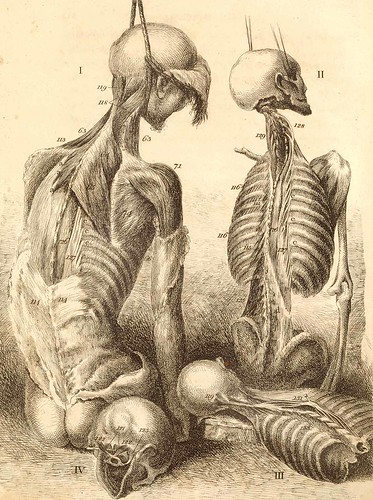
Etching of the bones, muscles, and joints, illustrating the first volume of the Anatomy of the Human Body. 2d ed. London, 1804. Etching. National Library of Medicine.

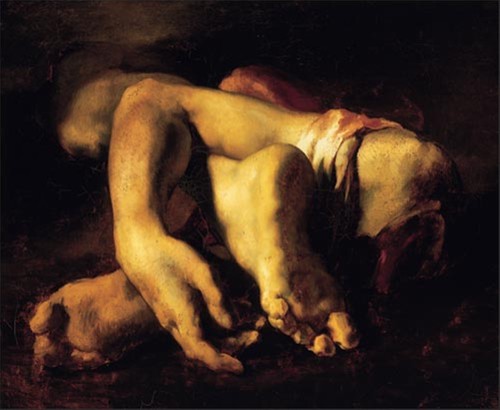
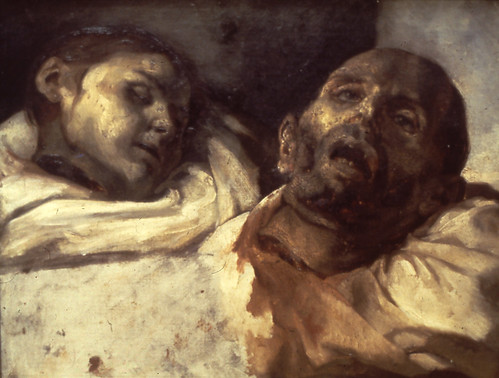
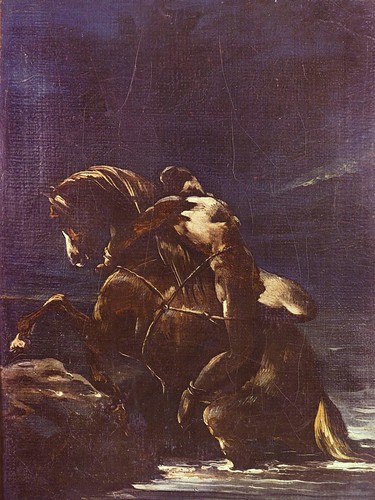
Further to my post More Géricault I tried to find the source of the Géricault Severed Heads painting and I found John Bell at the classic Dream Anatomy site. I couldn’t find the pictures I was looking for, that’s why I am giving you the above (there is one more over at my Flickr stream). I did find the story behind the Severed Heads painting of Géricault:

Théodore Géricault‘s painting Severed Heads (1818) [2] painting of two severed heads on a white cloth, turns out to be, not a painting of two heads fresh from the guillotine, but a painted elaboration of an illustration to a book on anatomy (Engravings, explaining the Anatomy of the Bones, Muscles and Joints ) by British surgeon John Bell. This site on France and Scotland in the Arts gives a detailed explanation how Délacroix’s Severed Heads is a painted elaboration of the work of John Bell, not an image of guillotined heads.

Also from dreamanatomy : “John Bell criticized “the subjection of true anatomical drawing to the capricious interference of the artist, whose rule it has too often been to make all beautiful and smooth, leaving no harshness….” His own drawings and etchings are notably harsh.”
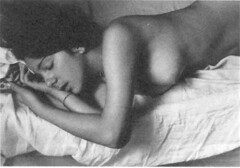
Brigitte Courme photographie


Brigitte Courme photographie

In 1969 Balthus starts to draw from photographs taken by himself and by Brigitte Courme (1934-1982) . Shown above is a picture by Brigitte Courme.

Balthus was a French artist of Polish origins whose work was figurative at a time when modern art was surrealist and abstract in nature, making him one of the first anti-modernists. His distinctive brand of nymphesque erotica (Thérèse rêvant, 1938) with lesbian overtones (The Guitar Lesson, 1934) has been influential to many present day erotomaniacs. Detractors accuse him of pedophilia and pornography but Balthus insisted that his work was not pornographic, but that it just recognized the discomforting facts of children’s sexuality.

Image sourced here

Géricault’s monomaniacs

La monomanie du vol des enfantsMonomanie du commandement militaireLa monomanie du volLa monomanie du jeuLa monomanie de l'envie


From left to right Monomanie du vol des enfants, Monomanie du commandement militaire, Monomanie du vol, La monomanie du jeu, Monomanie de l’envie.

The Monomanies is a series of ten paintings by Théodore Géricault produced between 1821 and 1824 of the patients of Étienne-Jean Georget, head physician at the Salpêtrière Parisian psychiatric ward. The paintings were commissioned by Georget so that his students could study the physical traits of these “monomaniacs“, in a sort of scientific realism that parallels the literary realism of that time.

Translation from left to right: a child kidnapper, a man obsessed with the military, a kleptomaniac, a gambling addict and a woman suffering from obsessive envy.

More on monomania.

He was always tinkering

[Youtube=http://www.youtube.com/watch?v=AAbo1uOuxG8&e]

Via >dmtls Merzbau

Active since April 2007, DMTLS is my kind of blog. His tags (upon tagging considered a fine art) tell much of the story:

20th century composer art avant-garde bizarre book cinema culture erotic-grotesque erotic art experimental fetish fluxus gothic grotesque Hermann Nitsch horror industrial jazz John Zorn John Zorn related modern classical music musick neofolk noise NYC photography surrealism video Vienna Aktionists

Already linked at another Jahsonic favourite Esotika Erotica Psychotica, >dmtls Merzbau is off for an promising start.

Death of the underground

After the death of the author and the death of the avant-garde comes, according to Simon Reynolds, the death of the underground:

“The web has extinguished the idea of a true underground. It’s too easy for anybody to find out anything now, especially as scene custodians tend to be curatorial, archivist types. And with all the mp3 and whole album blogs, it’s totally easy to hear anything you want to hear, in this risk-less, desultory way that has no cost, either financially or emotionally.” Simon Reynolds via woebot via factmagazine

Import Export

A film by Austrian director Ulrich Seidl (Hundstage, 2001) I’d like to see:

Two individual fates move in opposite directions. Olga, a nurse from the Ukraine, abandons her family to look for a better life in the West and ends up working as a cleaning woman in a geriatric ward in Austria. Paul, an unemployed security guard from Vienna, is looking a reason to get up in the mornings and heads East with his stepfather, ending up in the Ukraine. Two young people on the move, eager to start a new life, confronted with a rough reality. Two stories about the pursuit of happiness and material advantages, about the darker sides of sexuality and death, and about the difficulties of cleaning the teeth of a stuffed fox. —- festival-cannes.fr, still