A version of the apocalypse

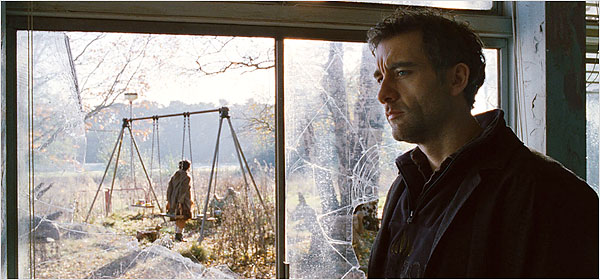
K-Punk and Richard on Children of Men, a new dystopian British film from the director of Y tu Mama Tambien (2001) . Screenshot here.

I’ve finally seen Children of Men, on DVD, after missing it at the cinema. Watching it last week I asked myself, why is its rendering of apocalypse so contemporary?

British cinema, for the last thirty years as chronically sterile as the issueless population in Children of Men, has not produced a version of the apocalypse that is even remotely as well realised as this. You would have to turn to television – to the last Quatermass serial or to Threads, almost certainly the most harrowing television programme ever broadcast on British TV – for a vision of British society in collapse that is as compelling. Yet the comparison between Children of Men and these two predecessors points to what is unique about the film; the final Quatermass serial and Threads still belonged to Nuttall’s bomb culture, but the anxieties with which Children of Men deals have nothing to do with nuclear war.

Kris Melis pointed out to me that the plot of Children of Men is similar to that of the 1982 pomo porn film Café Flesh in which humans are divided into Sex Negatives and Sex Positives. The negatives get sick if they have sex so they go to Café Flesh to see positives who are forced to perform on stage for the negatives. If the similarity is superficial, both films belong to the category infertility in fiction in a post-apocalyptic world.

How much death and terror

The Sight of Death: An Experiment in Art Writing (2006) – Timothy J. Clark [Amazon.com] [FR] [DE] [UK]

How much death and terror can nature contain and still be posited as a value — as a world that human beings reach for, steadying themselves. (p. 174)

Via a review of Bart Verschaffel in De Witte Raaf 125, see also this post at This Space. More on the art critic — and former member of the British SIhere, more on horror in the visual arts here.

Introducing French theory to America


A collection of Semiotext(e) titles that have been read.

In my previous post I wondered why Taschen does not publish on political counterculture since they have a penchant towards the realm where “high and low will no longer be perceived as contradictions”. Andrej Maltar answers in the comments section of that post that Taschen is not interested in subversion outside the aesthetic field and points us in the direction of publishers like Autonomedia [semiotext(e)] or the Pranks-issue of RE/Search. He asks “Aren’t these books very interesting in terms of contemporary political subversion?”


On Autonomedia and Semiotext(e):

Semiotext(e) is an American independent publisher. It is widely credited for having introduced French theory to America in the late 1970s via its magazine issues and Foreign Agents series. In 2000 the MIT Press began distributing Semiotext(e), taking it over from the anarchist publishing collective Autonomedia.

Without realizing it I already have two Semiotext(e) books in my library: Paul Virilio’s Pure War and his Aesthetics of Disappearance. I’ve read and very much enjoyed Pure War and started to tackle Disappearance. I bought Disappearance for its uncanny cover art.

Related: American academiacritical theorydeconstruction theoryPost-structuralismqueer theory


Off-topic, a dedication to all the girls [Youtube] I’ve loved before by way of Carole King’s ‘It’s Too Late’.

We want to declare on all forms of bad taste

Danae (1907-08) – Gustav Klimt

“We want to declare war on sterile routine, on rigid Byzantinism, on all forms of bad taste… Our Secession is not a fight of modern artists against old ones, but a fight for the advancement of artists as against hawkers who call themselves artists and yet have a commercial interest in hindering the flowering of art.”

This declaration by Hermann Bahr, the spiritual father of the Secessionists, may serve as the motto for the foundation in 1897 of the Vienna Secession, with Klimt as its leading spirit and president. The artists of the younger generation were no longer willing to accept the tutelage imposed by Academicism; they demanded to exhibit their work in a fitting place, free from “market forces”. They wanted to end the cultural isolation of Vienna, to invite artists from abroad to the city and to make the works of their own members known in other countries. The Secession’s programme was clearly not only an “aesthetic” contest, but also a fight for the “fight to artistic creativity”, for art itself; it was a matter of combatting the distinction between “great art” and “subordinate genres”, between “art for the rich and art for the poor” in brief, between “Venus” and “Nini”. In painting and in the applied arts, the Vienna Secession had a central role in developing and disseminating Art Nouveau as a counter-force to official Academicism and bourgeois conservatism. –Gilles Néret, 1993

P. S. The concept of “Venus” and “Nini” are the most intriguing part of these last posts on the book by Néret on Klimt I’ve been reading, and I want to add that it is unjust and unfair to direct the Nini page to “prostitution in art”. The woman who is impartial to casual sex and/or wants to lead an independent life is not a prostitute but is easily perceived as one. Most generally this dichotomy is labeled the mother/whore or Madonna/whore complex. If anyone knows of a very good exploration of this theme (apart from The Mother and the Whore (1973) – Jean Eustache and the work by Camille Paglia), please let me know.

Various artists

“Cold Me” is Reza Negarestani and he or she intrigues me. Here is his/her linklist (following the saying ‘show me your links and I will tell you who you are’). I found a list of Bellmer’s dolls photos.

Elsewhere and unrelated to ‘Cold Me’; Mike reviews The Fruits of Passion (Shuji Terayama, 1981), the follow-up film to Story of O. Mike says:

“Viewers expecting the same sort of story as told in The Story of O, or even viewers expecting that sort of soft-focus eroticism will be sorely disappointed, as Terayama elevates the story to an even higher level than the former film or novel. He also improves greatly on the source material; while The Story of O itself is a masterpiece of literature, erotic or otherwise, Return to the Chateau: The Story of O II is hardly up to par, being a lackluster imitation of the book it’s responding to.”

Elsewhere and unrelated to Fruits of Passion: electronic music at Youtube

Discovering Electronic Music (1983) pt 2, pt 3 (documentary film by Bernard Wilets 1983) via 1|2|3|4|5|6 selected by sonhors


Truth in nakedness

Nuda Veritas (1899) – Gustav Klimt

“Klimt certainly wasn’t the first to paint naked women,” Ruiz says. “But he also showed pubic hair, pregnant bellies, and old men and women with sagging flesh — nuda veritas! –Ruiz via [1]

..“What is interesting about Klimt (played here by John Malkovich) is that in the short space of a lifetime, he evolved from a Raphael to a Van Gogh. In Romania, where he got his first big job — and his first syphilis — he was a painter of the court, like Velazquez. Then he moved on to the painter of the Austrian Empire, paid by the state. Then he broke away and got commissions from Vienna’s Jewish bourgeoisie and became a painter of the wealthy. Toward the end, he just painted for himself. So he became rich, but he was also generous and died without money. Too many children to support!” –Ruiz via [1]

Apparently, what shocked the Viennese bourgeoisie in the 1899 oil painting Nuda Veritas is the depiction of pubic hair. Pubic hair marks the dividing line between a Venus and a Nini (see previous post), and continues to have the power to shock in the present age. I can’t be mournful about that because if there were a world where nothing were shocking, a world where a sense of the forbidden were gone, wouldn’t that be a bore?

Klimt vs. Loos

“All art is erotic”, declared Adolf Loos in “Ornament and Crime“. Long before Expressionism and Surrealism were credited with displaying sexuality openly in art, Klimt made it his creed, and it became the leitmotif of his work. –Gilles Néret, 1993

“”The first ornament that was ever born, the cross, was erotic in origin. The first work of art, the first artistic deed which the first artist smeared on the wall in order to work off his excess. A horizontal line: recumbent woman. A vertical line: man penetrating her … But man of our time, following an inner compulsion to smear the walls with erotic symbols, is criminal or degenerate … Since ornament is no longer a coherent organic part of our culture, it can no longer be an expression of our culture.” Thus wrote Adolf Loos in his article “Ornament and Crime”, which begins with the famous sentence: “All art is erotic”. The intention behind the article was to stigmatise the “erotic insalubrity” of Klimt and the other artists of the Wienner Werkstätten.” –Gilles Néret, 1993

Of niceness and nastiness

In search of Kant’s theory of taste, I bid you good night with this tune.

We can sum things up like this: judgments of taste occupy a mid-point between judgments of niceness and nastiness, and empirical judgments about the external world. Judgments of taste are like empirical judgments in that they have universal validity; but, they are unlike empirical judgment in that they are made on the basis of an inner response. Conversely, judgments of taste are like judgments of niceness or nastiness in that they are made on the basis of an inner subjective response or experience; but they are unlike judgments of niceness and nastiness which makess no claim to universal validity. To cut the distinctions the other way: in respect of normativity, judgments of taste are like empirical judgments and unlike judgments of niceness or nastiness; but in respect of subjectivity, judgments of taste are unlike empirical judgments and like judgments of niceness or nastiness. So we have three-fold division: empirical judgments, judgments of taste, and judgments of niceness or nastiness. And judgments of taste have the two points of similarity and dissimilarity on each side just noted.

However, our hope thus far has been merely to get a little clearer about what it is that is under scrutiny in this debate. Once we are armed with a modest account of what a judgment of taste is, we can then proceed to more ambitious questions about whether or not judgments of taste represent real properties of beauty and ugliness. We can even consider whether or not our whole practice of making judgments of taste is defective and should be jettisoned. But first things first. — Stanford Encyclopedia of Philosophy

Coolness and reserve mark this lady

Coolness and reserve mark this lady, while not yet a femme fatale, but as one of Freud’s castrating women. –Gilles Néret, 1993

Madame Heymann (c. 1894) – Gustav Klimt

Upon display Medicine was immediately attacked by critics who disagreed with the theme of the powerlessness of medicine in a time when Vienna was leading the world in medical research. The painting was also under the normal attack of pornography which Klimt often faced. A public prosecutor was called in and the issue even reached parliament, the first time that a cultural debate had ever been raised there, but in the end no action was taken. Only the education minister defended him, and when he was elected to be a professor at the academy in 1901 the government refused to ratify it. He was never offered another teaching position. [1]

Medicine (1907) – Gustav Klimt

I’ve been reading Gilles Néret’s 1993 Klimt study for Taschen. Since I am partial towards the human interest factor in art criticism I was a bit disappointed by the lack thereof. Otherwise the study is excellent.

Especially since his work is infused with the tropes of male castration anxiety and the femme fatale, I find it astonishing that little is mentioned on his personal life. Néret’s work reminds me of the shift in an erotic sensibility that Mario Praz describes in Romantic Agony, the shift from female masochism towards male masochism that occurred somewhere in mid-19th century.

In fact searching for Klimt’s personal life only brings up one page:

Though the book touches only lightly on Klimt’s personal life, the scandalous nature of his work, his illegitimate children and the haremlike working conditions of his studio, it provides a detailed portrait of the changes and inconsistencies that defined Vienna at the time, when Secessionist principles of freedom from artistic judgment met simultaneous demands for high standards and the “parallel pursuit of collectivity and individuality.” –quoted from a review of Rainer Metzger’s Gustav Klimt.

Perhaps the 2006 film Klimt starring John Malkovich would provide answers to my questions. This biopic was directed by Raoul Ruiz (Time Regained, 1999) .

Aha! Here is quite a bit on Klimt’s personal life:

He remained a bachelor and was being obviously terrified by the thought of entering into a permanent relationship; his attitude to women was highly ambivalent. For many years, Emilie Flöge (played here by Veronica Ferres), whose sister Helene had married Klimt’s brother Ernst, was his companion and he felt a deep affection for her; nevertheless the relationship is assumed to have been purely platonic. His desire was aroused by the sweet Viennese girls from the suburbs who were neither intelligent nor self-assured, by the many models who were his companions for short periods. The fact that he did not disdain sexual love is evidenced by the great number of his illegitimate children. There are records which establish that he had at least 14 children. It is true that he spent many summers with Emilie Flöge and her family in her house at Kammer on the Attersee, but she remained the woman he always worshipped from afar and only called to his deathbed.

On the Venus vs the Nini:

Néret’s book on the art of Gustav Klimt (1993) differentiates between two types of nudes and calls them Venus and Nini. His argument revolves around artistic pretexts:

In Plato’s “Symposium” one encounters two types of Venus, the celestial and the vulgar. Renoir makes the same distinction: “Naked woman rises either from the sea or from the bed; she is called Venus or Nini, there is no better name for her…” The academic, idealised nude is applauded by society, particularly when a historical message can be discerned, but an everyday naked woman ready for love causes a scandal. Before Klimt, Edouard Manet’s Olympia had aroused hatred and criticism. She likewise was a Nini — like the courtesan on the next street corner — rather than a Venus in the style of Titian’s idealised mistresses, disguised as mythical goddesses. Neither in Manet’s Olympia nor in Klimt’s Vienna was it permissible for such idols to be drawn from life.
Cavern MP3

Via Andrew at gmtPlus9 (-15) comes an MP3 of “Cavern” (from the Optimo EP, 99 Records 1983 .mp3 audio 05:20), a track by Liquid Liquid. See also here, where I explore the sample history of the track. Dennis Young recently sent me his latest CD Shadow, a radical break in style with his early eighties work with Liquid Liquid. Shadow has bits reminiscent of singer songwriter Tom Waits and post-punkers Echo and the Bunnymen. 

Dennis Young on Shadow:

“All of the songs were written around my acoustic guitar & vocals. Most of the songs have a dark rustic quality with the addition of violin, bowed dulcimer, accordion, electric & bass guitars, & various percussion instruments to enhance the mood of the songs. Special thanks to Tom DeStefano & Kevin Booth of “Firedog Studios” for the great job of mixing & production. Also, special thanks to the other thirteen musicians including David Axelrod, Jon Francis, Stephan Eicher, & Sal Principato to name a few. “

Coffeetablishness

GillesNeret

Gilles Néret (1933 – 2005)

In answer to my recently asked question regarding the publishers of 20th century counterculture Taschen came to mind, an international publishing powerhouse with its roots in 1980s Germany. Taschen started out by publishing Benedikt Taschen’s extensive comic book collection and then basically conquered the world with its ‘coffeetablishness’.

Taschen is the best alternative to countless hours of internet browsing and a much better reading experience than the web itself, but buying the books remains more expensive than the internet.

Taschen also illustrates the lack of political subversion in contemporary culture. Countercultural publishers such as Grove in the 1960s also published pamphlet-like tracts. Taschen does not have a politics section; however I like to think that Benedikt and Laure have opinionated views on these matters.