Clive Sinclair was an English entrepreneur and inventor.
He invented the first really cheap computer (ZX80) and one of the very first mass-produced electrical vehicles (Sinclair C5).
Clive Sinclair was an English entrepreneur and inventor.
He invented the first really cheap computer (ZX80) and one of the very first mass-produced electrical vehicles (Sinclair C5).
Jean-Luc Nancy (1940 – 2021) was a French philosopher known for such works as The Inoperative Community (1982) which starts like this:
“The gravest and most painful testimony of the modern world, the one that possibly involves all other testimonies to which this epoch must answer (by virtue of some unknown decree or necessity, for we bear witness also to the exhaustion of thinking through History), is the testimony of the dissolution, the dislocation, or the conflagration of community.
Chuck Close was an American artist working in portrait painting and photography known for his massive-scale photorealist and/or hyperrealist portraits of himself and others, which hang in collections internationally.
Well known works include Big Self-Portrait (1968).
This will have happened five years in two days, but I only found out today.
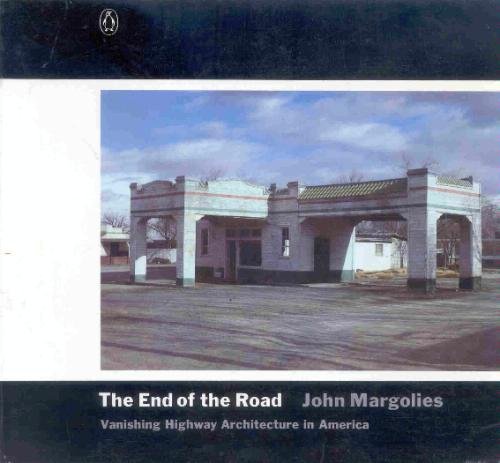
John Margolies was an American architectural critic and photographer.
I just spent (while researching the fantastic Jacques Moeschal) two hours intermittently trying to find the title of the book on roadside architecture I sold five years ago and then I found out that it is the one above: The End of the Road: Vanishing Highway Architecture in America (1981).
The link with Moeschal being that with lots of irreverence (I love the word, as well as the practice of irreverence) you can call the ‘signs’ of Moeschal ‘roadside attractions’.
RIP Jon Gibson was an American musician and visual artist.
Gibson’s death happened in 2020 but I forgot to give it attention.
Maybe I did not find the right record to play with it.
Today, via The Saturn Archives, a recently discovered high quality music channel on YouTube, I give you Two Solo Pieces (1977).
The beginning is a highly accomplished drone piece. The end is a piece with gamelan echoes.
Richard Corben was an American illustrator and comic book artist.
I liked his coloring.
Here the short film Neverwhere, from the film Heavy Metal.
He said sweet things about my hero Tanino Liberatore’s creation RanXerox.
Johnny Nash was an African-American singer-songwriter, best known for his 1972 hit “I Can See Clearly Now“.
On the Belgian popcorn scene, popular recordings of Nash included “Some of Your Lovin'”, “Old Man River”, “Moment of Weakness”, “Kisses”, “I’m Leaving”, “I’m Counting On You” and “Don’t Take Away Your Love”.
Tony Allen (1940 – 2020) was a Nigerian musician and drummer.
The importance of Allen? You simply cannot imagine Fela Kuti nor afrobeat without the drumming of Tony Allen during the period 1968 to 1979.
After parting with Fela Kuti it would take time for Allen to find his own sound.
This happened with the sublime EP Never Expect Power Always (1984), one of my favorite afrobeat compositions.
Other solo work of note includes Black Voices (1999), Tomorrow Comes The Harvest (2018, with Jeff Mills) and Sounding Lines (2018, with Moritz von Oswald).
To the international hipster crowd, Allen is probably best-known for playing drums on “La Ritournelle” (2003) by Sébastien Tellier, an iconic track for the contemporary cosmopolitan class.
The drumming on that track sounds like a “Funky Drummer” sample but it is in reality the live drumming of Tony Allen.
I’d say, if you are new to all this, start by listening to “Shakara (Oloje)” (1972) by Fela Kuti, then switch to Never Expect Power Always (1984) and end with Sounding Lines (2018).
Germano Celant was an Italian art historian known for coining the term “arte povera” (poor art) in 1967.
The ‘poor’ of that epithet refers to the materials.
I’ve always thought of ‘arte povera’ as a bit of a non-concept.
It is exemplary of that 20th century mania of coining names for invented new art movements.
Think surrealism, dada, popart, post-popart, avant garde, post-avantgarde, nouveau réalisme, neomodern, remodern, metamodern, postminimal, stuckism, neoism, op art, fluxus.
Oh please stop already.
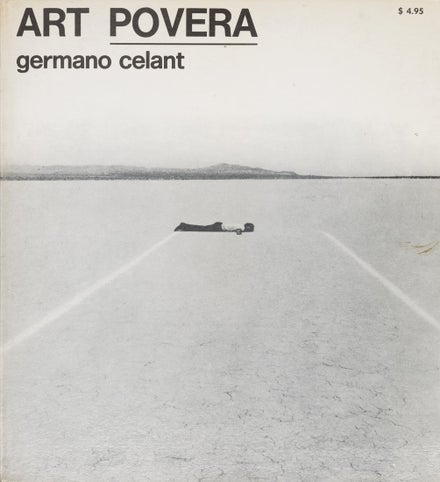
But then again, I like the cover of the 1969 book that made the term arte povera known around the world.
I wanted to check the book out, since my university has it in its library.
However, this being corona-time, the library is closed.
Claire Bretécher was a French cartoonist, co-founder of L’Écho des savanes.
I used to buy issues of L’Écho des savanes in the late 1980s, a particularly fruitful time for comics, with highlights such as Tanino Liberatore, Enki Bilal, Wim T. Schippers, Jacques Tardi, Guido Crepax, Jean Giraud, Milo Manara, Georges Pichard and François Schuiten.
There was something subversive about the whole comics scene in those days, what you may now call the pre-internet days. Shops all of over Europe catered to the tastes of underground comic lovers, or so it seemed.
Only now that Claire Bretécher is dead, I discover her Agrippine character who was the heroin of nine albums. On the first self-titled album of 1988 Agrippine is shown reading the fictional Heidegger in the Congo (1988), a reference to Tintin in the Congo (1931).
I have not had the time to fully investigate Heidegger in the Congo but I suppose the link is that Heidegger was a Nazi and that Hergé’s album in the Congo is now considered racist.
Above, you will find an episode of the televised Agrippine.
Alas. No subtitles.