Yearly Archives: 2008

First there is nothing, next there is depth of nothingness …


Ultramarinepigment.jpg

“First there is nothing, next there is depth of nothingness, then a profundity of blue”


[Amazon.com]
[FR] [DE] [UK]

I recently acquired the book above: “Art in Theory“. This is not a book you read from cover to cover, I am reading it the way I like reading most, by the index (and aided by Google book search). The introductory essays to each chapter are very good.

A copy from my first impressions posted on the Art and Pop wiki:

“One single text” by Bataille

Barthes in the From Work To Text on Georges Bataille:

“How do you classify a writer like Georges Bataille? Novelist, poet, essayist, economist, philosopher, mystic? The answer is so difficult that the literary manuals generally prefer to forget about Bataille who, in fact, wrote texts, perhaps continuously ‘one single text’.”

This reminds me of Richard Simmillion, a recurring character in W. F. Hermans‘s novels and stories. Hermans is also an author who wrote one single text.

On Bachelard

Facts long amassed, patiently juxtaposed, avariciously preserved, are suspect. they bear the stigma of prudence, of conformism, of constancy, of slowness,” writes Gaston Bachelard. –via ON INVENTING OUR OWN ART by Ibram Lassaw

Bachelard is also mentioned by Barthes in Mythologies.

“But since Saussure himself, and sometimes independently of him, a whole section of contemporary research has constantly been referred to the problem of meaning: psycho-analysis, structuralism, eidetic psychology, some new types of literary criticism of which Bachelard has given the first examples, are no longer concerned with facts except inasmuch as they are endowed with significance. Now to postulate a signification is to have recourse to semiology. I do not mean that semiology could account for all these aspects of research equally well: they have different contents. But they have a common status: they are all sciences dealing with values. They are not content with meeting the facts: they define and explore them as tokens for something else.”

Bachelard is also mentioned by Yves Klein in a Sorbonne lecture given in 1959.

“I unhappily did not have the pleasure of discovering the writings of Gaston Bachelard till very late, only last year in the month of April 1958. […] will reply by borrowing yet again from Gaston Bachelard that marvelous passage concerning blue from his book Air and Dreams. “This is primarily a Mallarmean document in which the poet, living in ‘contented world-weariness amidst oblivious tarns’, suffers from the irony of blueness. He perceives an excessively hostile blueness which strives with an indefatigable hand to ‘fill the gaping blue holes wickedly made by birds’. […] and that is the dwelling place of Bachelard’s beautiful phrase: ‘First there is nothing, next their is depth of nothingness, then a profundity of blue’.”

These are some of the quotes which make this volume worthwhile. I recommend this book.

The Munchers: a Fable (1973) by Art Pierson

[Youtube=http://www.youtube.com/watch?v=4oNf2m1gylQ]

The Munchers: a Fable (1973) by Art Pierson

This clip is somewhat of a mystery. Supposedly directed by Arthur P. Pierson, the film nor the director are listed at imdb. The http://www.afana.org/ showed both films during the 2000s:

  • Munchers: A Fable’ (1973) 10m, dir. Art Pierson. Clay and polymer tooth puppets bring decay to life.
  • ‘Whazzat?’ (1975) 10m, dir. Art Pierson. Here, nondescript clay figures attempt to identify an elephant.

I cannot track any info on this remarkable little film by Arthur P. Pierson. If you know more, please let me know. A further hint is this description of ‘Whazzat?’.

Party music from Belgium

Been listening to the Lio track below for the better part of the week. It’s similar in structure to “C’est bon pour le moral” (see Rita Cadillac post).

[Youtube=http://www.youtube.com/watch?v=dtlq3lTHa3A]

“Sage comme une image” (1980) by Lio

The title translates literally as “good as a picture” (as in “pretty as a picture”). I showed the clip to my kids but they thought it was awfully slow and old-fashioned. Evident is the 1980s fascination with the 1950s (record player, polka dots skirt, etc…) which ruled popular fashion at that time (the Gaultier era). The record is a good introduction to the work of francophone Belgian producer, musician and radio personality Marc Moulin, whose early work with Telex is still influential to the electroclash scene; the track below, “Moscow Diskow”, being a staple for DJs Frankie Knuckles and Ron Hardy on the dance floors of late 1980s Chicago clubs that were instrumental in the development of Chicago house music, and house music as such. What is to be appreciated is that Telex had a great sense of humor – for example – one of their compositions was called “Temporary Chicken,” which invariably makes me smile when I think of it.

To this day, “Moskow Diskow” remains of one of my favorite records to dance to, I pronounce it wmc #30. And yes, all this is Belgian.

[Youtube=http://www.youtube.com/watch?v=DFWdobNIcPQ&]

“Moscow Diskow” (1979) Telex

Etant donnés-ish x2

Untitled by Nicéphore Niépce's

Untitled by Nicéphore Niépce

I couldn’t help by noticing how very similar in feel this 19th century photograph is to Marcel Duchamp’s last work Etant donnés (and btw, I am looking for a precise date of when this work was first presented to the general public)

[Youtube=http://www.youtube.com/watch?v=zUkybjwRBns]

“Bleu” by Etants Donnés

Etants Donnés is the name of duo consisting of the brothers Hurtado (Marc and Eric), founded in Grenoble in 1980. Their name takes its direct inspiration from the last work by Marcel Duchamp. They made six films between 1982 and 1994, composed numerous scores and collaborated with major figures of the industrial rock genre: Genesis P-Orridge, Alan Vega, Michael Gira, Lydia Lunch and Mark Cunningham.

I am the black gold of the sun

Splendor Solis (1532-1535) - Salomon Trismosin

Splendor Solis (15321535) – Salomon Trismosin

[Youtube=http://www.youtube.com/watch?v=4DR_NMtBEj4]

“I am the Black Gold of the Sun” by the Rotary Connection (Wmc#29)

While researching world peace in relation to Georges Bataille, I found Splendor Solis, which reminded me of Rotary Connection‘s “I am the Black Gold of the Sun” voiced by the late Minnie Riperton (of “Lovin’ YouYouTubefame).


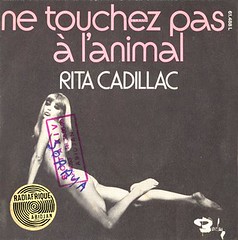
2 x Rita Cadillac = 2 x guilty pleasures

Rita Cadillac

“Ne touchez pas à l’animal” (1971) by Rita Cadillac via au carrefour étrange

“É Bom Para o Moral” (1984) by Rita Cadillac

The first Rita is French, she was an exotic dancer of the generation of previously mentioned Rita Renoir, the tragedienne of strippers. The title of her single reads “Do not touch the animal”.

The second Rita is Brazilian and her song translates as “It’s good for the moral”. It’s an outrageously uplifting Euro-dance song of the same mantle that holds Lou Deprijck, the virtually unknown but at the same time one of the most successful Belgian music producers ever, of whom I’ve given you guilty pleasures #7 and Que Tal America.

What Lou and Rita share is a love of the Brazilian thing, logical for Rita since she is Brazilian, logical for Lou since he loves party music and Brazilians have been very apt at producing party music.

Until his head fills the picture


“The Big Swallow” (1901) by James Williamson

[Youtube=http://www.youtube.com/watch?v=dzFh8rYMl6M&]

The Big Swallow (1901) aka A Photographic Contortion, produced and directed by James Williamson.

The sales catalog of this film describes the film as “A man reading finds a photographer with his head under a cloth, about to take his picture. He orders him off, approaching nearer and nearer until his head fills the picture, and finally his mouth only occupies the screen. He opens it, and first the camera, then the operator disappear inside. He retires munching him up and expressing great satisfaction.”

A terrific piece of early meta-cinema breaking the fourth wall.

This post is inspired by a recent article by Keith Sanborn “Second hand, second person, at a second remove, forms of address in Youtube in historical perspective,” published in Brouillon 4. Keith Sanborn is an American filmmaker, media artist and connoisseur of the cinema of Guy Debord. With Peggy Ahwesh, he made The Dead Man.

World music classics #29

Sleeve of the seven inch of Max Berlin’s “Elle et moi (1978)

Elle et moi” is a musical composition by Max Berlin, first published in 1978 on the Belgian recording label USA Import.

This is the type of track which has survived in popular consciousness through nightclub play rather than radio play. I can’t remember hearing “Elle et Moi” on any commercial radio station.

Skilled and knowledgeable DJs usually play “Elle et moi” after or before Gainsbourg’s 1968 Requiem pour un con (YouTube), from the soundtrack to the film Le Pacha.