Category Archives: Uncategorized

Gaston Bachelard @130

Gaston Bachelard by Jean Philippe Pierron (2012) with illustrations by Yann Kebbi
[Amazon.com] [FR] [DE] [UK]

Happy birthday Gaston.

Gaston was a philosopher so sui generis that he is indefinable.

He would have turned 130 today had eternal life been possible.

His intellectual heir is Peter Sloterdijk.

Update: I accidentally posted this several days early.

Listen to this drawing

The Music of Gounod” illustrates liminality, which in a previous post I called neither fish nor fowl, something inbetween.

At the same time it illustrates something non-existent, an impossible object, like music for the deaf or for people who are tone deaf. The aural experience has been synaesthetically translated in a visual experience.

Listen to this drawing, it seems to say.

I am reminded of the dictum by Walter Pater: “all art constantly aspires towards the condition of music.” And of medium specificity.

The red splodge representing the reign of Ivan the Terrible

The red splodge representing the reign of Ivan the Terrible in Gustave Doré’s ‘The History of Holy Russia’

Via via I discover Gustave Doré‘s The Rare and Extraordinary History of Holy Russia (1854), an illustrated book with 500 drawings executed by Doré when he was just 21.

Doré was a genius, perhaps only equaled by Grandville (thirty year’s Doré’s senior).

The History of Holy Russia features a number of experimental and metatextual elements which are as surprising as the black page in Tristram Shandy.

The red splodge above represents the reign of Ivan the Terrible.

The caption reads:

“Suite du règne d’Ivan le Terrible. Devant tant de crimes, clignons l’oeil pour n’en rien y voir que l’aspect général.”

English translation:

“Continuation of the reign of Ivan the Terrible. Faced with such crimes, let’s blink our eyes to not see anything than the broad picture.” (tr. J.W. Geerinck)

John Bulwer’s alphabetic ‘chirogram’

John Bulwer‘s alphabetic chirogram from Chirologia found via Victor Stoichita.

I’m fascinated by sign languages. I guess that’s because it’s one of those border states, a grey area of something neither fish nor fowl, something unclassifiable.

Sign languages are languages that do not make sound, they can be read but also felt. They involve lots of symbolism.

Oliver Sacks in The Man Who Mistook His Wife for a Hat (1985) mentions fascinating cases of deafblindness where tactile sign language is used.

This particular ‘chirogram’ was designed as a rhetorical aid.

On Hegel

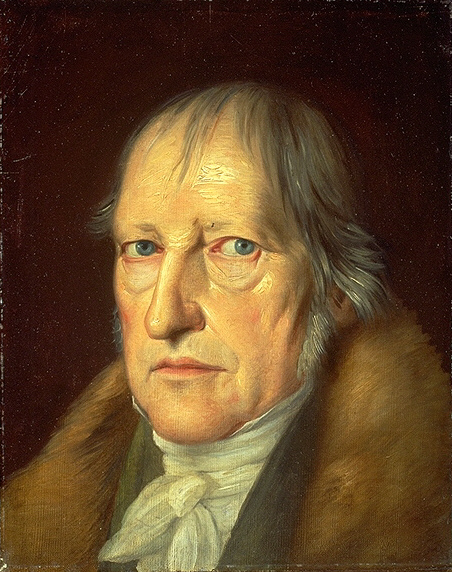
Portrait of Hegel by Jakob Schlesinger [1]

Sometimes it seems I have no opinion of my own. And I’m not even sure if I should mind.

Take the case of Georg Wilhelm Friedrich Hegel (1770 – 1831).

Last week I met with a philosophy professor who said that Hegel marks the dividing line between contemporary philosophy and modern philosophy and in the book I’m currently reading, Short History of the Shadow, Hegel’s Science of Logic is mentioned in the introduction.

So I’m wondering. What is my position vis-à-vis Hegel? Do I have a personal connection with him? I first check Jahsonic.com where, in 2006, I cited Hegel[2] with regards to the other, from a Simone de Beauvoir book.

Speaking of de Beauvoir, have you seen her gorgeous nude photo of Simone de Beauvoir?

I digress.

Next I try Google, I search for the string “Nietzsche and Hegel,”[3] because Nietzsche (1844 – 1900) is in my canon and I’d like to know what he thought of Hegel.

Bingo!

I find French philosopher Gilles Deleuze, also in my canon, who in Nietzsche and Philosophy says:

“There is no possible compromise between Hegel and Nietzsche” […]

Since I like both Nietzsche and Deleuze, must I conclude that I do not like Hegel? Or will have a hard time liking him?

Can I form my opinion based on the opinion of another person?

should do no such thing of course.

But I could if I wanted to.

And I can trust Nietzsche when he says Plato is boring, can’t I?
Butades, or, the magic of shadows, or, the invention of art

The Invention of the Art of Drawing (1791) illustrates the Butades myth.

The myth is reported by Pliny.

This is the story: a certain Kora (also called Callirhoe), was in love with a boy at Corinth who had to leave the country. Whereupon she drew on the wall the outline of the shadow of his face. From this outline her father Butades modeled a face in clay, and baked the model, thus preserving for his daughter a face in relief of the boy she loved.

My thoughts? Amazing, but, couldn’t Butades  just as well have made a death mask of the face of the boy?

This post is inspired by Victor Stoichita‘s book Short History of the Shadow (1997).

PS Pliny’s shadows remind me of da Vinci’s stains.