Poe’s impotence

Somewhat of a surprise was waiting when I finally held all 700+ pages of Marie Bonaparte‘s The Life and Works of E. A. Poe: a Psychoanalytic Interpretation in my hands and skipped to the psychoanalytical interpretation of Edgar Allan Poe’s short story “Loss of Breath.”

There, on page 373, Marie Bonaparte utters what any man dreads to hear: that he is impotent. Ouch. Poe must have turned in his grave when he heard of his post-mortem psychobiography and Bonaparte’s concern with his vita sexualis.

In “Loss of Breath”, my favourite Poe story, Marie Bonaparte finds the ultimate proof of Poe’s impotence. She equates the breath of Mr. Lackobreath, the sorry protagonist of the tale, with “pneuma,” “life force,” hence “sexual potency.”

To strengthen her argument, she cites Baudelaire who once said “There is not in all of Poe’s work a single passage that tends to lubricity or even to sensual pleasure“.

Not only was Poe impotent, according to Marie Bonaparte, he was a “repressed sado-masochist and necrophilist” (299) and his body of writing was the product of neurosis.

Illustration: photo of a silicone packer[2] by Canadaworker from Wikimedia Commons.

See also my two previous two odes to the flaccid phallus, the limp male member: Un priape marchant sur des pattes de coq[3] and votive phallus[4].
Ode to the ornamental print

The past few months saw me paying lots of attention to the ornamental print over at my Tumblr blog.

There is Balançoire chinoise[1] by French artist Jean-Baptiste Pillement., which is more of a decorative print than an ornamental print.  It is similar in style to Raccolta delle cose più notabili veduta dal cavaliere Wilde Scull [2].

The plate comes from the wonderful book Les Maîtres ornemanistes.

By the way, it would seem that the 1870s is the first period when serious attention was given to the ornamental print, judging from a tentative bibliography I’ve made:

The last two books in the list can be seen in full at Archive.org. Follow the links.

The grotesques of Arent van Bolten

Update 8/2//2014: there is a complete version incl. images at http://archive.is/XwhgQ

It’s been quite difficult to trace the provenance of the above print. It depicts two chimerical creatures, both with drooping breasts, watched over by three disembodied grotesque masks.

First, via Biomediale. Contemporary Society and Genomic Culture[1], a paper on chimaera phylogeny by Sven Drühl I found the unidentified print above. Searching some more, The Cabinet of the Solar Plexus[2] says that it is by Hendrick Goltzius.

However, the inexhaustable[3] Marinni contradicts this and attributed it to Arent van Bolten (c.1573 – c.1633)[4].

End of quest.

Two other favourites from that series include a grotesque holding a club spurning another grotesque[5] and two footed phalli stabbing each other while surrounded by two grotesque drooping masks that resemble an elongated scrotum[6], that last a real find for the metamorphic genitalia category.

Note the similarity to Les Songes Drolatiques[7] (1565) and the Varie Figuri Gobbi (1616, ‘Various Hunchbacked Figures’) by Jacques Callot.

PS. Europeana.eu has easy access to all of the prints[8].

The History of Erotica, from Caveman to Marquis de Sade

In September 2009 I bade you farewell.

I’m back with a book, a history of erotica which starts in prehistory and ends for now with Henry Fuseli,  J. – J. Lequeu and Marquis de Sade.

It features some 250 images and about as many citations.

It is for the time being only available in Dutch and costs 25 euros.

The book was presented on the evening of valentine’s day, 2011.

This blog …

I’ve decided to spend less time online so this blog closes temporarily. You can still find me posting at Tumblr, where I can be found at  http://jahsonic.tumblr.com, an image-centric microblogging site.

Deciding to spend less time online also involves not reading blogs anymore on a systematic basis. I followed about 140 blogs which proved way too many.

Gratuitous nudity #18

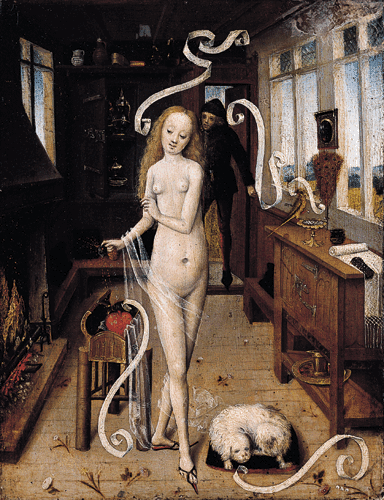
Liebeszauber (c. 1470, Magic of Love) is an Early Netherlandish painting depicting a nude woman casting a love spell over a young man who is about to enter her room. The painting is housed at the Leipzig, Museum der Künste. The woman has a tight pelvis, wide waist circumference and small breasts.

See love magic, anonymous masters, love spells, female body shape and Early Netherlandish painting.

More love magic in art and literature:

“A wild centaur named Nessus attempted to kidnap Deianira, but she was rescued by Heracles, who shot the centaur with a poisoned arrow. As he lay dying, Nessus lied to Deianira, telling her that a mixture of olive oil with the semen that he had dropped on the ground and his heart’s blood would ensure that Heracles would never again be unfaithful. ”

“Tristan goes to Ireland to bring back the fair Iseult for his uncle King Mark to marry. Along the way, they accidentally ingest a love potion that causes the pair to fall madly in love. In the “courtly” version, the potion’s effects last for a lifetime; in the “common” versions, however, the potion’s effects wane after three years.

“The opening of this comic opera finds Nemorino, a poor peasant, in love with Adina, a beautiful landowner, who torments Nemorino with her indifference. When Nemorino hears Adina reading to her workers the story of Tristan and Isolde, he is convinced that a magic potion will gain Adina’s love for him. The traveling quack salesman, Dulcamara arrives, Nemorino innocently asks Dulcamara if he has anything like Isolde’s love potion. Dulcamara says he does, selling it to Nemorino at a price matching the contents of Nemorino’s pockets. Unknown to Nemorino, the bottle contains only wine. ”

Let no man unwilling to engage in love affairs with other visitors enter my doors

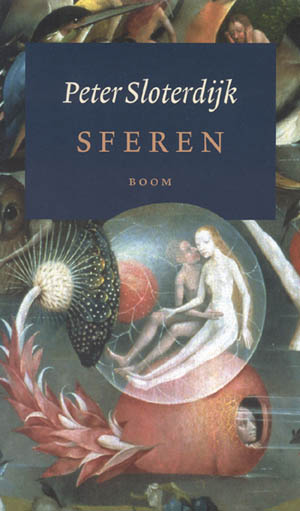
I finally hold a copy of Sferen in my hands, a Dutch translation of Spheres I and II, with a detail of two lovers in a bubble from the The Garden of Earthly Delights by Bosch on the cover.

The detail is “showing nudes cavorting within a transparent sphere. …The figures’s arms are entwined, while the female’s head bends towards the male’s attentive mouth.”(Belting)

Sloterdijk first caught my attention when stumbling on his arse comments.

“The arse seems to be condemned to live in the dark. Among the different parts of our body, it leads the life of a tramp. It truly is the idiot of the family. Yet it would be a miracle if this black sheep of the body did not have a ready opinion of the events taking place in higher regions, just like those who have been rejected by society often express the most sober views of it.” — Critique of Cynical Reason by Peter Sloterdijk

This book had me laughing on the second page when Sloterdijk adds an imaginary plate to hang above the entrance to Plato‘s academy (the original one is “let no one destitute of geometry enter my doors.”), titled “let no man unwilling to engage in love affairs with other visitors enter my doors,” thereby filling the world with an embodied philosophy, one which does not deny Eros.

RIP Les Paul (1915 – 2009)

Les Paul (1915 – 2009)

[Youtube=http://www.youtube.com/watch?v=3yuLChdljNE]

RIP Les Paul, 94, American guitarist and inventor. In 1954, Les Paul commissions Ampex to build the first eight track tape recorder, at his own expense.

“Country Living” recording above related to Les Paul via an “Ampex + Jahsonic” Google search.

Jahsonic is interested in the “recording studio as a musical instrument.”

Alfred Hitchcock @110

Alfred Hitchcock @110


Alfred Hitchcock KBE (August 13 1899April 29 1980) was a highly influential film director and producer who pioneered many techniques in the suspense and thriller genres.

Hitchcock’s films draw heavily on both fear and fantasy, and are known for their witticisms. They often portray innocent people caught up in circumstances beyond their control or understanding.

Until the later part of his career, Hitchcock was far more popular with film audiences than with film critics, especially the elite British and American critics. In the late 1950s the French New Wave critics, especially Éric Rohmer, Claude Chabrol, and François Truffaut, were among the first to see and promote his films as artistic works. Hitchcock was one of the first directors to whom they applied their auteur theory, which stresses the artistic authority of the director in the film-making process.

Psychoanalytical film theorists such as Slavoj Žižek (The Pervert’s Guide to Cinema) have noticed how Hitchcock often applied Freudian concepts to his psychological thrillers, as in Rebecca, Spellbound, Vertigo, Psycho, and Marnie. Additionally, Hitchcock often dealt with matters that he felt were sexually perverse or kinky, and many of his films aimed to subvert the restrictive Hollywood Production Code.

Cover: Murders on the Half-Skull by Alfred Hitchcock (1970, Dell [New York]). Cover artist ID anyone?

Let’s make some room for bad taste

[Youtube=http://www.youtube.com/watch?v=buPWYJf2Eu8&feature=fvw]

Let’s make some room for bad taste.

Enter Lolo Ferrari.

Lolo Ferrari, born Eve Valois (February 9, 1968 – March 5, 2000) was the stage name of a French dancer, actress, and singer billed as “the woman with the largest breasts in the world” though their size was artificially achieved. In 1995, she caused a sensation at the Cannes Film Festival with the presentation of the movie Camping Cosmos by Jan Bucquoy.

Camping Cosmos is a comedy film by Belgian director Jan Bucquoy, starring Lolo Ferrari. We see Belgians on holiday in a trailer park at the beach in the year 1986 with the first danger signals of AIDS. The purpose of the campsite entertainer is to bring culture to the common people; but they are not interested when the play of Bertolt Brecht Mother Courage and Her Children is shown. Then he launches a beauty contest, a song contest and a boxing match

In Camping Cosmos Lolo Ferrari comes out of the sea as an Aphrodite with the song of “Land of Hope and Glory” and having her first orgasm with the comic Tintin in the Congo. The influence of Jacques Lacan is imminent: Sex is the little Death. Arno Hintjens and Jan Decleir are a homosexual couple. The protest of the younger generation (Eve and her boyfriend) supposedly refers to Traité du savoir-vivre à l’usage des jeunes générations by Raoul Vaneigem. A character cites Louis Scutenaire and détournement publicitaire à la Marcel Mariën is used. Both were Belgian surrealists.

The film is awful but aged 34 and feeling you haven’t seen everything yet and after all, you are from Belgium, and you see it anyway. You rent it a second time (you must be bored) and thankfully the video store clerk alerts you to your mistake.