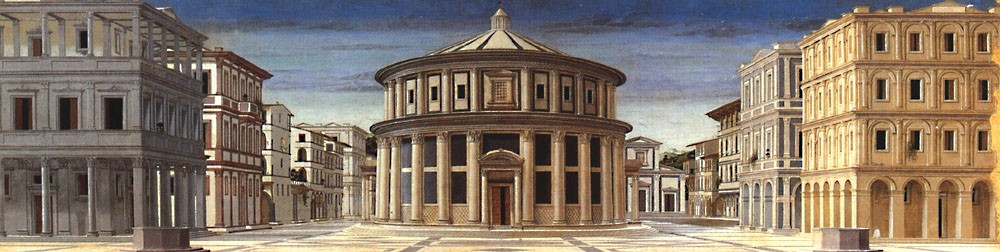
Ernst Gombrich @100

Ernst Gombrich @100

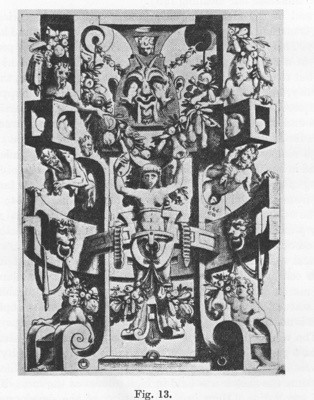
Floris-Decoration by you.

Cornelis Bos, Female herm (1546). Engraving, 243 x 179. Rijksmuseum, Amsterdam.

I first stumbled upon Ernst Gombrich via the enigmatic Ian McCormick who mentioned Norm and Form, volume one in Studies in the Art of the Renaissance in the bibliography of his excellent site[1] on the visual grotesque. By the way, if anyone has the lowdown on Ian McCormick, please let me know, he is one of the internet’s little mysteries.

But first some background info on Gombrich:

Sir Ernst Hans Josef Gombrich, OM, CBE (30 March 1909 – 3 November 2001) was an Austrian-born art historian, who spent most of his working life in the United Kingdom. Gombrich was close to a number of Austrian émigrés who fled to the West prior to the Anschluss, among them Karl Popper (to whom he was especially close) and Friedrich Hayek. He is best-known for his books Studies in the Art of the Renaissance, A Little History of the World, The Story of Art and Art and Illusion, which ushered in reader-response criticism in visual culture theory.

Back to the grotesque.

Gombrich collaborated with Ernst Kris (the art historian/ psychoanalyst who brought the grimacing sculptures[2] of Franz Xaver Messerschmidt) on a history of caricature. The Principles of Caricature was the fruit of this collaboration and it was first published in the British Journal of Medical Psychology in 1938, reprinted in full here[3]. The piece was later reprinted in Kris’s Psychoanalytic Explorations in Art (1952).

RIP Ronald Tavel (1936 – 2009)

RIP Ronald Tavel

Poster by Alan Aldridge for Chelsea Girls (1966), for which Tavel wrote the script.

Ronald Tavel (May 17, 1936 – March 23, 2009) was an American writer, director and actor, and was known for his work with Andy Warhol and The Factory. He was involved in the Playhouse of the Ridiculous and wrote the scripts for Chelsea Girls, Poor Little Rich Girl and Vinyl.

Nelson Algren @100

Nelson Algren @100

The Man with the Golden Arm

The Man with the Golden Arm (1949) by Nelson Algren

The classic modern novel about drug addiction.

Nelson Algren (19091981) was an American writer best-known for The Man with the Golden Arm (see drugs in literature and heroin in literature).

Allow me to digress.

Algren had a torrid affair with Simone de Beauvoir and they travelled to Latin America together in 1949. In her novel The Mandarins (1957), she wrote of Algren (who is “Lewis Brogan” in the book):

“At first I found it amusing meeting in the flesh that classic American species: self-made leftist writer. Now, I began taking an interest in Brogan. Through his stories, you got the feeling that he claimed no rights to life and that nevertheless he had always had a passionate desire to live. I liked that mixture of modesty and eagerness.”

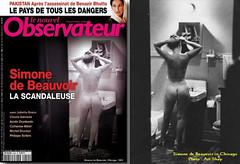
On January 3, 2008, French magazine Le Nouvel Observateur publishes a nude photo of Simone de Beauvoir by Art Shay with the title “Simone de Beauvoir la scandaleuse“.

ObsBeauvoir by gunthert

Simone de Beauvoir photo by Art Shay

End of digression.

Edward Steichen @130

Edward Steichen @130

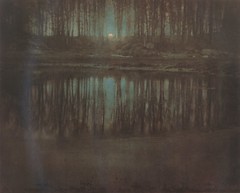
Steichen's The Pond-Moonlight

The Pond-Moonlight

Edward Steichen (18791973) was a pictorialist American photographer, painter, and art gallery and museum curator, born in Luxembourg, Europe. He is known for such photos as The Pond-Moonlight.

Pictorialism was a photographic movement in vogue from around 1885 following the widespread introduction of the dry-plate process. It reached its height in the early years of the 20th century, and declined rapidly after 1914 after the widespread emergence of Modernism.

.

Baron Haussmann @200, Haussmannization and creative destruction

Baron Haussmann @200

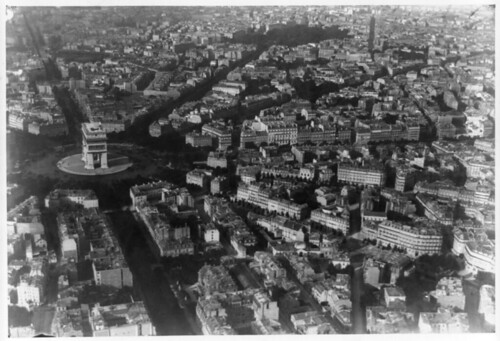
Paris_Arc_de_Triomphe by you.

Place de l’Étoile

Baron Haussmann (18091891) turned 200 today.

Haussmannwas a French urbanist who called himself an “artiste démolisseur,” literally translated as artist destroyer, a concept with a political equivalent of creative destruction. I’ve mentioned Haussmann and Haussmannization here [1] and here[2].

Haussmann’s renovation of Paris is often simply referred to as Haussmannization, connected to the notion of creative destruction, a political concept.

creative destruction, surplus product

The notion of creative destruction is found in the writings of Mikhail Bakunin, Friedrich Nietzsche, and in Werner Sombart‘s Krieg und Kapitalismus (War and Capitalism) (1913, p. 207), where he wrote: “again out of destruction a new spirit of creativity arises”. In Capitalism, Socialism and Democracy, the Austrian economist Joseph Schumpeter popularized and used the term to describe the process of transformation that accompanies radical innovation. It contrasts with various tactics of preservation and embalming the past.

Interestingly, Flaubert’s friend Maxime du Camp said:

“Paris, as we find it in the period following the Revolution of 1848, was about to become uninhabitable.” — [Paris Arcades] quoting from Maxime du Camp, Paris, vol 6 (Paris, 1875), p.253.

and

“Its population had been greatly enlarged and unsettled … and now this population was suffocating in the narrow, tangled, putrid alleyways in which it was forcibly confined.” — [Paris Arcades] quoting from Maxime du Camp, Paris, vol 6 (Paris, 1875), p.253.]

It was Jules Ferry who wrote “Les Comptes fantastiques de Haussmann,” his indictment of the bold handling of public funds for the Haussmannization. It was published in 1867, its title being a play on words between contes, stories or tales – as in Les contes d’Hoffmann or Tales of Hoffmann, and comptes, accounts.

RIP Manny Oquendo (1931 – 2009)

RIP Manny Oquendo (1931 – 2009)

Grupo Folklorico Y Experimental Nuevayorquino.
“Little Sunflower,” Freddie Hubbard original

Manny Oquendo was an American percussionist. His main instrument was the timbales, and was strongly influenced by Cuban drumming. He especially holds interest as the percussionist with own Conjunto Libre and Grupo Folklorico Y Experimental Nuevayorquino. His work can be classified as latin jazz, but he expanded the limits of his own genre by working with such artists as August Darnell and DJ Spooky. He had a worldwide hit with Freddie Hubbard’s “Little Sunflower” in 1983.

I discovered Manny Oquendo in the 1990s (my disco period) via Mericana Records, which was a sublabel of Salsoul Record. I listened to Grupo Folklorico Y Experimental Nuevayorquino and related groups a  zillion times. Brilliant.

Introducing Isabel Sarli and Latin American erotica

Isabel Sarli

Sarli in Fuego

Isabel Sarli in Fiebre

Sarli in Fiebre

Isabel Sarli

Sarli in El sexo y el amor

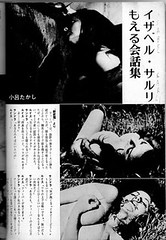
Isabel Sarli is an example of Latin American erotica.

In 1968 and 1969, the duo [Isabel Sarli and Armando Bo] gets their best (something like Sgt. pepper era for the Beatles) and produced their three masterpieces: “Carne“, “Fuego” y “Fiebre“, three films that are unique in the world, three films that influenced John Waters big time and were a clear precedent to his revolutionary work, three film that are, to me, the closer that Argentinian cinema got to a national cinema style, but in Argentina Bo was forbidden and imprisoned many times for obscenity. “Fiebre” is an amazing piece of experimental film-making. The idea is “Isabel (or her character, its the same) falls in love with a horse.” –Patricio García Martinez via IMDb

Armando Bo seems to be the Latin American equivalent of Tinto Brass, combining experimental cinema with erotica. Isabel Sarli would have surely played in Russ Meyer‘s breast fetishism films.

I’m very happy to have discovered Sarli (via Cinema of Obsession), I’ve pretty much documented (or at leased inventorized) European erotica and American erotica, touched upon Asian erotica, but Latin America, Africa and Australia drew blanks.

P.S. Most of the research on “world erotica” was done at Jahsonic.com.

RIP Uriel Jones (1934 – 2009)

RIP Uriel Jones (1934 – 2009)

[Youtube=http://www.youtube.com/watch?v=IVFT7i94zQU]

Ain’t No Mountain High Enough” (1967) by Marvin Gaye & Tammi Terrell

Uriel Jones (13 June 1934March 24, 2009) was an African-American musician. Jones was a recording session drummer for Motown Records‘ in-house studio band, The Funk Brothers, during the 1960s and early 1970s.

Jones was first hired by Motown as a fill-in for principal drummer Benny Benjamin; along with Richard “Pistol” Allen, he moved up the line as recordings increased and Benjamin’s health deteriorated. Jones had a hard-hitting, funky sound, best heard on the tracks for the hits “Ain’t No Mountain High Enough” – both versions, by Marvin Gaye & Tammi Terrell in 1967 and the 1970 remake by by Diana Ross, “I Heard It Through the Grapevine” by Marvin Gaye, “Cloud Nine” by the The Temptations (in which he was augmented by “Spider” Webb), Junior Walker‘s “Home Cookin’,” “I Second That Emotion” by Smokey Robinson & the Miracles, “For Once In My Life” by Stevie Wonder, and many more. His influences included Art Blakey. Jones became better known to music fans through his memorable appearance in the feature documentary film, Standing In The Shadows Of Motown.

RIP Nicholas Hughes (1962 – 2009)

Nicholas and Sylvia Plath

Nicholas Hughes with mother Sylvia Plath

Nicholas Hughes (January 17, 1962 – March 16, 2009), son of poets Ted Hughes and Sylvia Plath has commited suicide. He was suffering from clinical depression like his mother before him who took her life when he was one year old.

I first became empirically aware of the hereditary qualities of suicide via Night Falls Fast: Understanding Suicide, a 1999 book by Kay Redfield Jamison on suicide and manic depression.