Marilyn Manson and Kool & The Gang drummer @40 and 60

Marilyn Manson, American singer @40*

[Youtube=http://www.youtube.com/watch?v=jU6iP0WLsU8]

Tim Burton‘s The Nighmare Before Christmas re-cut with Marilyn Manson‘s version of “This Is Halloween“.

George Brown, American drummer of Kool & The Gang @60

[Youtube=http://www.youtube.com/watch?v=kfxaNR71tYM&]

Summer Madness” (1974)

*I think many people underestimate Marily Manson, I find his recycling of my intellectual darlings in such products as The Golden Age of Grotesque (which practically cannibalizes the whole of Voluptuous Panic: The Erotic World of Weimar Berlin) endearing. However, I do not count myself a fan.

Louis Braille @200

Louis Braille @200

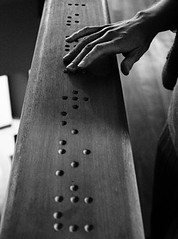
Braille

Louis Braille* @200

Louis invented Braille age 12.

Sensory depravation (I mean sensory impairments such as blindess or deafness, remember the film Peeping Tom, where the blind mother knows all along that the male protagonist cannot be trusted because she ‘feels’ this sort of thing?) is often a nice plot device.

Braille makes a clear statement that the reading experience is not visual per se.

*Louis Braille (January 4, 1809 – January 6, 1852) was the inventor of braille , a world-wide system used by blind and visually impaired people for reading and writing. Braille is read by passing the fingers over characters made up of an arrangement of one to six embossed points. It has been adapted to almost every known language.

Ah, woman, the incomplete sex

Film noir.

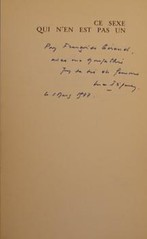
Ce Sexe Qui N'En Est Pas Un

This Sex which is Not One

I’ve only seen two film noirs in the 2000s. One was the neo-noir The Last Seduction, the other was The Naked Kiss.

Donald Westlake‘s recent death has inspired me to research film noir and noir fiction. My fondest memories of the noir thing are probably films such as Jim Thompson‘s Coup de Torchon and Charles Willeford‘s Miami Blues.

But above all the nobrow references in the bold film The Naked Kiss.

I was totally surprised to find references in that film to:

  1. Beethoven’s Moonlight sonata
  2. A Baudelaire quote
  3. Goethe
  4. A male version of Brigitte Bardot

The same astonishment took hold of me when researching Kiss Me, Deadly, Mickey Spillane‘s sixth novel featuring private investigator Mike Hammer. (because of the Signet Books and Fawcett Publications link).

Listen to the following dialogue excerpt (see below). Is there a better way to introduce This Sex which is Not One, feminism and the Oedipus complex and Pussy Talk? Most of contemporary theory is useless without its counterpart in popular culture.

[Youtube=http://www.youtube.com/watch?v=yjgDNvS8XVU&]

Kiss Me Deadly

Scrub to 6:30 for the dialog

Christina: You’re angry with me, aren’t you? Sorry I nearly wrecked your pretty little car. I was just thinking how much you can tell about a person from such simple things. Your car, for instance.
Hammer: Now, what kind of a message does it send ya?
Christina: You have only one real lasting love.
Hammer: Now who could that be?
Christina: You. You’re one of those self-indulgent males who thinks about nothing but his clothes, his car, himself. Bet you do push-ups every morning just to keep your belly hard.
Hammer: You against good health or somethin’?
Christina: I could tolerate flabby muscles in a man who may be more friendly. You’re the kind of a person who never gives in a relationship – who only takes. (Sardonically) Ah, woman, the incomplete sex. And what does she need to complete her? (Mocking) Why, man, of course. A wonderful man.
Hammer: All right, all right, let it go. That bus stop will be comin’ up pretty soon and I don’t even know your name.
Christina: You forget. I’m a loony from the laughing house. All loonies are dangerous. Ever read poetry? No, of course you wouldn’t. Christina Rossetti wrote love sonnets. I was named after her.
Hammer: Christina?
Christina: Yes, Mike. I got your name from the registration certificate, Mr. Hammer. Get me to that bus stop and forget you ever saw me. If we don’t make that bus stop…
Hammer: (confidently) We will.
Christina: …if we don’t, ‘Remember me.’

–Transcribed by filmsite.org [1]

And the  film score by Frank De Vol? Brilliant.

Happy birthdays J. D. Salinger (90) and Grandmaster Flash (51)

With all this dying, one would forget about the living. Fear not! Happy birthdays J. D. Salinger and Grandmaster Flash. The first birthdays of 2009.

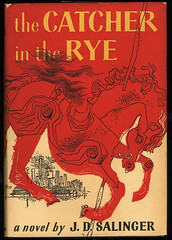
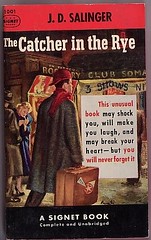
Jerome David Salinger (born January 1, 1919) is an American author best known for his 1951 novel The Catcher in the Rye, as well as his reclusive nature; he has not published any new work since 1965 and has not granted a formal interview since 1980.

Catcher in the Rye first edition

The Catcher in the Rye original cover

Catcher in the Rye by Signet

Signet Books “sensationalist” cover

The famous “fuck you” excerpt:

“‘That’s the whole trouble. You can’t ever find a place that’s nice and peaceful, because there isn’t any. You may think there is, but once you get there, when you’re not looking, somebody’ll sneak up and write ‘Fuck you‘ right under your nose. Try it sometime. I think, even, if I ever die, and they stick me in a cemetery, and I have a tombstone and all, it’ll say ‘Holden Caulfield’ on it, and then what year I was born and what year I died and then right under that it’ll say ‘Fuck you.’ I’m positive, in fact.'” – Holden Caulfield in The Catcher in the Rye page 183

[Youtube=http://www.youtube.com/watch?v=k3kRuJhIVIo]

The Message

Joseph Saddler (born January 1, 1958 in Bridgetown, Barbados), better known as Grandmaster Flash, is a hip hop musician and DJ; one of the pioneers of hip-hop DJing, cutting, and mixing. Grandmaster Flash and the Furious Five are best-known for their single “The Message“.

“The Message” is an old school hip hop song by Grandmaster Flash and the Furious Five released in 1982. The song’s lyrics were some of the first in the genre of rap to talk about the struggles and the frustrations of living in the ghetto. Another fuck you, I guess.

Deaths in 2008

[Youtube=http://www.youtube.com/watch?v=HXz22-_Io-c]

“Nobody had every done anything like this before” —Bebe Barron (1925 – 2008) on Anais Nin

RIP Donald Westlake

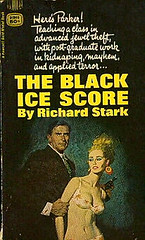
The Black Ice Score

A Gold Medal Books original by Westlake under the name Stark.

Donald Edwin Westlake (12 July 1933 in Brooklyn, New York31 December 2008 in Mexico) was an American writer, with over a hundred novels and non-fiction books to his credit. He specialized in crime fiction, especially comic capers with an occasional foray into science fiction. He created the psychopathic fictional character Parker.

lee marvin - ‘point blank’ by mr. diazzler

Film still from Point Blank

Outside of the world of literature he is perhaps best-known for the film adaptation of his novel The Hunter as Point Blank in 1967 with Lee Marvin. The Hunter was written by Donald E. Westlake under the pseudonym Richard Stark. The plot concerns a criminal, Parker (or Walker in Point Blank), who is himself betrayed, shot, and left for dead by his partner, and his relentless pursuit to retrieve his money and wreak revenge.
[Youtube=http://www.youtube.com/watch?v=XPKL3KHE–I]
Jean-Luc Godard‘s Made in USA (1966) which was an extremely loose adaptation of “The Jugger,” a novel by Westlake. Neither the film’s producer nor Godard purchased the rights to the novel, so Westlake successfully sued to prevent the film’s commercial distribution in the United States.

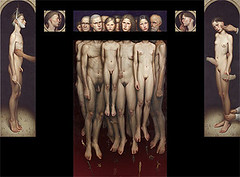
Introducing Dino Valls

Introducing Dino Valls
Dino Valls by Mujer Lagarto
Click for credits

Barathrum by luogo

Click for credits

Dino Valls is a Spanish painter born in 1959 in Zaragoza, presently living and working in Madrid. This self-taught artist studied Italian and Flemish masters of the 16th and 17th centuries and currently makes use of egg tempera.

[Youtube=http://www.youtube.com/watch?v=TaZ1vzqOecI]

Having previously obtained a degree in medicine, he is now one of the Spanish representatives of the vanguard of new figurative art[1], along with Odd Nerdrum in Norway and John Currin, Lisa Yuskavage in America where there is also the Lowbrow art movement, presided over by critics such as Suzanne G..

His work is also classified as fantastic art.

Here is an interesting YouTumentary with a soundtrack by Funkstörung.[2]

What the Butler Saw

I have received questions about the signification of What the Butler Saw in my post on the Düsseldorf erotic art exposition [1].

I’ve introduced two fictional characters on this blog. One has been rather active, Sholem Stein[2], another, Waloli has only done three posts[3]. The butler may be third character (although the only character I now feel comfortable with – in terms of what kind of message he can bring – is Sholem Stein.

But I sometimes feel it’s easier to express things in the third person, like Facebook invites you to do in their status updates.

What the butler saw

The butler is the voyeur, the ultimate peeping tom, the man who sees everything but whose duty it is to remain silent. Silence is golden, remember?

As for the encylopedic stuff:

What the Butler Saw first referred to an early mutoscope softcore series of erotic films.

Mutoscopes were a popular feature of amusement arcades and pleasure piers from the 1890s until the mid-20th century. The typical arcade installation included multiple machines offering a mixture of fare. Both in the early days and during the revival, that mixture usually included “girlie” reels which ran the gamut from risqué to outright soft-core pornography. It was, however, common for these reels to have suggestive titles that implied more than the reel actually delivered. The title of one such reel, What the Butler Saw, became a byword, and Mutoscopes are commonly known in England as “What-the-Butler-Saw machines.” (What the butler saw, presumably through a keyhole, was a woman partially disrobing.)
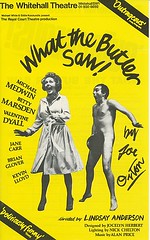
What the Butler Saw by Joe Orton

English playwright Joe Orton appropriated the title What the Butler Saw to make a theatrical farce of the same name, first staged in London on 5 March 1969. Cinema-goers recognised situations used by Orton’s contemporaries, the Carry On comedians of the late 1960s. For example, Carry On Doctor was showing whilst the play was being written in 1967.
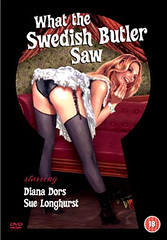
What the Swedish Butler Saw

An early 1970s reference is the title of the film What the Swedish Butler Saw, also known as Champagnegalopp, a Swedish film from 1975 directed by Vernon P. Becker. The story is based on the Victorian anonymous novel The Way of a Man with a Maid. This sex comedy, in English known as What the Swedish Butler Saw or Confessions of a Swedish Butler, the film starred Ole Søltoft and Diana Dors.
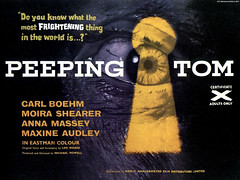
Peepint Gom

As of the 2000s, the expression What the Butler Saw has functioned as a byword for voyeurism in general, much like peeping tom before it.

A lovely surprise. I am spinning at a party, so it seems. Dear me.

Jahsonic

RIP Freddie Hubbard (1938 – 2008)

Moanin’ with Freddie Hubbard

Freddie Hubbard (1938 – 2008) was an American jazz trumpeter.

He was primarily known as a sideman to Art Blakey in the latter’s Jazz Messengers and many other jazzmen’s bands but achieved his greatest personal success in the 1970s with a series of albums for smooth jazz record label CTI Records. Although his early 1970s jazz albums Red Clay, First Light, Straight Life, and Sky Dive were particularly well received and considered among his best work, the albums he recorded later in the decade were bashed by critics for their commercialism.

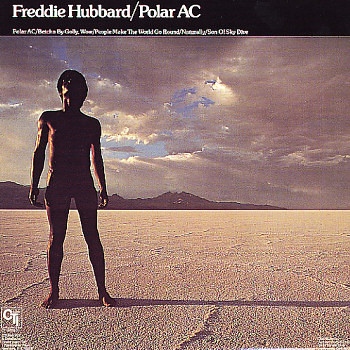
Freddie Hubbard Polar AC for CTI by you.

Polar AC

A particularly accomplished track is Gibraltar, compiled by Ashley Beedle on the Grass Roots album.

RIP Ann Savage (1921 – 2008)

RIP American actress Ann Savage at age 87, best-known for her iconic bad girl role in Detour.

[Youtube=http://www.youtube.com/watch?v=dFXQqEoNofA]

Ann Savage discusses Detour

Ann Savage (19212008) is mainly remembered as the cigarette-puffing femme fatale in Detour (1945) and other Hollywood B-movies and film noirs of the 1940s.

When it became public domain, Detour was often run on syndicated television and several versions were released on VHS home video. Although made on a small budget and containing only rudimentary sets and camera work, the film has garnered substantial praise through the years and is held in high regard. Director Wim Wenders called her work in Detour “at least 15 years ahead of its time”. The film’s ending is notable as an exemplum of involuntary manslaughter.

Ann most recently earned rave reviews in all media for her stunning performance as Canadian director Guy Maddin‘s mother in his most acclaimed film My Winnipeg (2008).