Proto-performance artists

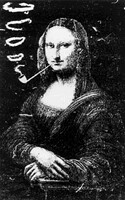
‘Augmented’ Mona Lisa (1882) by Sapeck

Sapeck (Eugène Bataille) (born in Mans in 1854) was a French protoperformance artist who was known to travel the streets with his head painted blue. In the first show of the Incoherents in 1882, he contributed an ‘augmented’ Mona Lisa (Mona Lisa smoking a pipe) that directly prefigures the famous Marcel Duchamp image L.H.O.O.Q. of 1919.

Speaking of Duchamp, Ombres Blanches recently wrote Duchamp’s Dahlia or The Man Ray Mystery, an essay on the possible inspiration of Duchamp’s Etant donnés by the Black Dahlia murder.

On whimsy and monochromatics

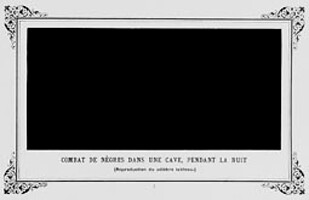
Combat de nègres dans une cave pendant la nuit

My previous post on Cohl led me to the French avant-garde of the 1880s and 1890s. Above is what is now generally held to be the first monochrome painting, rendered here in an appropriated version by Allais.

Here is the background:

Paul Bilhaud (born in Allichamps, December 31, 1854 – Avon, 1933) was a French poet and dramatist who belonged to the avant-garde group the Incoherents. He is the author of an all-black painting called Negroes Fighting in a Cellar at Night.

On October 1 1882 the “Exposition des Arts Incohérents” in Paris featured a black painting by the poet Paul Bilhaud titled Combat de nègres dans une cave pendant la nuit, which was appropriated in 1887 by the French humorist Alphonse Allais, in an album of monochrome pictures of various colors, with uniformly ornamental frames, each bearing a comical title. Allais called his all-red painting Tomato Harvest by Apoplectic Cardinals on the Shore of the Red Sea.

Negroes Fighting in a Cellar at Night predates Malevich‘s, Black Square on a White Field by 31 years.

Compiling this documentation, I stumbled on Il Giornale Nuovo’s post on Allais: Primo-Avrilesque and on Monochrome (une enquête) by L’Alamblog.

Fantasmagorie

[Youtube=http://www.youtube.com/watch?v=aEAObel8yIE]

Fantasmagorie (1908) – Émile Cohl

Émile Cohl (January 4, 1857 – January 20, 1938), born Émile Eugène Jean Louis Courtet, was a French caricaturist of the largely-forgotten Incoherent Movement, cartoonist, and animator, called “The Father of the Animated Cartoon” and “The Oldest Parisian”.

Émile Cohl began drawing cartoon strips and created a film in 1908 called Fantasmagorie. The film largely consisted of a stick figure moving about and encountering all manner of morphing objects, such as a wine bottle that transforms into a flower. There were also sections of live action where the animator’s hands would enter the scene. The film was created by drawing each frame on paper and then shooting each frame onto negative film, which gave the picture a blackboard look.

Cohl made Fantasmagorie from February to May or June 1908. This is considered the first fully animated film ever made. It was made up of 700 drawings, each of which was double-exposed, leading to a running time of almost two minutes. Despite the short running time, the piece was packed with material devised in a “stream of consciousness” style. It borrowed from J. Stuart Blackton in using a “chalk-line effect”, having the main character drawn by the artist’s hand on camera, and the main characters of a clown and a gentleman (this taken from Blackton’s “Humorous Phases of Funny Faces”). The film, in all of its wild transformations, is a direct tribute to the by-then forgotten Incoherent movement. The title is a reference to the “fantasmograph“, a mid-nineteenth century variant of the magic lantern that projected ghostly images that floated across the walls.

“Fantasmagorie” was released on August 17, 1908.

Fascinating.

One more.

[Youtube=http://www.youtube.com/watch?v=X-Wsv3FgLBE]

The Automatic Cleaning Company 
La maman et la putain

[Youtube=http://www.youtube.com/watch?v=hPyzYcrVU-k]

The Mother and the Whore (French La maman et la putain) is a 1973 French film directed by Jean Eustache. It is one the last typical Nouvelle Vague films and an extended essay on male angst, the war of the sexes and the Madonna-whore complex. A typical scene (at the beginning of this clip) is one where Marie comes home, puts a record on the turntable and listens to it in real time.

From the monologue:

…Pour moi il n’y a pas de putes. Pour moi, une fille qui se fait baiser par n’importe qui, qui se fait baiser n’importe comment, n’est pas une pute. Pour moi il n’y a pas de putes, c’est tout. Tu peux sucer n’importe qui, tu peux te faire baiser par n’importe qui, tu n’es pas une pute.
Il n’y a pas de putes sur terre, putain comprends-le. Et tu le comprends certainement.

La femme qui est mariée et qui est heureuse et qui rêve de se faire baiser par je ne sais qui, par le patron de son mari, ou par je ne sais quel acteur merdique, ou par son crémier ou par son plombier… Est-ce que c’est une pute? Il n’y a pas de putes. Y a que des cons, y a que des sexes. Qu’est-ce que tu crois. Ce n’est pas triste, hein, c’est super gai.

…Et je me fais baiser par n’importe qui, et on me baise et je prends mon pied.
…Pourquoi est-ce que vous accordez autant d’importance aux histoires de cul?
Le sexe…
Tu me baises bien. Ah! comme je t’aime.
Il n’y a que toi pour me baiser comme ça. Comme les gens peuvent se leurrer. Comme ils peuvent croire. Il n’y a qu’un toi, il n’y a qu’un moi. Il n’y que toi pour me baiser comme ça. Il n’y a que moi pour être baisée comme ça par toi.
…Quelle chose amusante. Quelle chose horrible et sordide. Mais putain, quelle chose sordide et horrible.

Sex and Drugs and Rock and Roll

[Youtube=http://www.youtube.com/watch?v=MpbVIrg-Jwg]

Sex and Drugs and Rock and Roll” is a modern variation of Wine, women and song. In the 20th century, particularly in Western usage, the expression “drugs, sex and rock and roll” often is used to signify essentially the same thing. The terms correspond to wine, women and song with edgier and updated vices. The term came to prominence in the sixties as rock and roll music, opulent and intensely public lifestyles, as well as libertine morals championed by hippies, came into the mainstream.

Wet Dream Film Festivals

Poster for first the Wet Dream Film Festival (1970) in Amsterdam

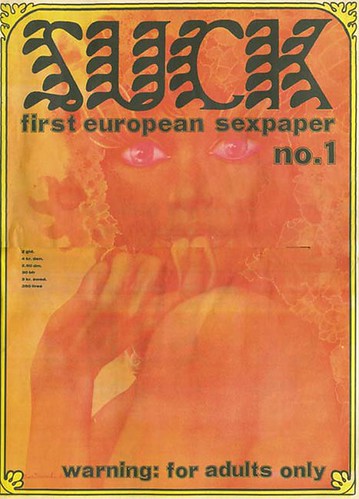
At the end of the 1960s and beginning of the 1970s, Amsterdam was somewhat of a countercultural capital. It was where Suck, The First European Sex Paper was published. Around this time two Wet Dream Film Festivals were organized. The first took place in the autumn of 1970, It had an international jury consisting of Germaine Greer, Jay Landesman, Richard Neville, Michael Zwerin, Didi Wadidi and Al Goldstein. The first prize went to Bodil Jensen in A Summer Day. The “Blast from the Past” award went to Jean Genet‘s film: Un chant d’amour. The Walt Disney Memorial Award went to Christie Eriksson‘s Snow White and the Seven Dwarfs. Other prizes were awarded for Peter Flemming, Walter Burns and Falcon Stewart. The Second Wet Dream Film Festival was held in 1971 between October 20 and October 25, again organized by Jim Haynes. Festival jury included Germaine Greer, Al Goldstein, William Holtrop, Didi Wadidi, Anna Beke and Michael Zwerin plus new-comers Mama Cass, Roland Topor, Heathcote Williams, William Burroughs, Carlos Clarens, Tomi Ungerer, Betty Dodson, Marie-France and Miss Angel. Jens Frosen (“Quiet Days in Clichy”) documented the event. Lou Sher, president of Sherpix, who picked up “Adultery For Fun and Profit” at the first festival, put up $1,000 for the first prize this year plus a promise of U.S. theatrical distribution. Organizer Haynes told Variety: “What most people don’t understand about last year’s Wet Dream Festival is that we are not concerned with pornographic aspects primarily, but with the libertarian concept. It is an attack on paternalism because it asks why people can’t see any image they want.”

This post is dedicated to the work of Earl Kemp.

Talking body parts

[Youtube=http://www.youtube.com/watch?v=uPUr94zcsaw]

Timmy and the Talking Body Parts

The Residents present a series of very short videos following the adventures of a 9 year old kid named Timmy. Talking body parts are a trope in the fantastique. Examples include Marquis which features extensive conversations of Sade talking to his genitals (and the genitals talking back to him), other fiction which employs the trope of the talking body parts are Naked Lunch (1959) by William S. Burroughs and the The Indiscreet Jewels (1748) by Denis Diderot.

Téléchat

[Youtube=http://www.youtube.com/watch?v=GUZHJSxRoII]

Téléchat

In 1983 Roland Topor creates with Henri Xhonneux the popular French TV series Téléchat, a parody of news broadcasts featuring puppets of a cat and an ostrich. Henri Xhonneux (1945 – March 1995) was a filmmaker. He used the pseudonym Joseph W. Rental. He is best known for his animation film Marquis and and the surreal television series Téléchat. I’ve mentioned Marquis here.

Connect the dots

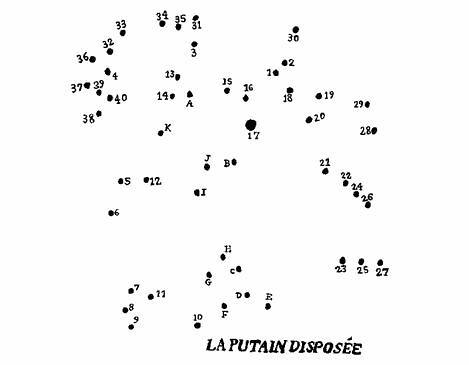
An article by Hannah Neumann for The Fed on erotic connect the dots. She mentions Benjamin Stout’s lithographs for The Lustful Turk and Les Flagelants Féminins. I was unable to find more info on Stout.

“Connect-the-dots (contemporarily known as ‘cunny constellations’ or ‘points d’amour’) were conceived as a method of bypassing obscenity laws in eighteenth-century Britain. Although they were commercially successful, the belief that their distributors were immune to arrest and seizure by the police was quickly proven false. As William Lazenby, a contemporary publisher of illegal erotica recalled, “We hadn’t reckoned on the coppers’ numeric acumen. T’was not long ‘fore we’d nary a tuppence earn with the rise in confiscations.” By the mid-1880s, erotic connect-the-dots had been abandoned in favor of less cryptic illustrations.” —Hannah Neumann