Yearly Archives: 2008

World music classic #47

As the days of my life have progressed, I’ve made up certain rules from myself: only eat chocolate if it’s from the brand Cote d’or, never buy music albums with ugly cover art, not allow to let in new stuff unless it connects with old stuff, etc… One of these rules is not to discuss music with anyone who does not have at least some cursory knowledge of Neil Young, Lee Perry, Arthur Russell, Serge Gainsbourg, Kraftwerk and Fela Kuti. I know that this makes me sound like an arrogant prick, but to my defense I blame it on my placement within what is known as the autistic spectrum.

[Youtube=http://www.youtube.com/watch?v=JRZdEqpTmD4]

Another part of my defense is that I have listened to a great variety of music. One of the albums which has enjoyed lots of my time and attention is the 1976 Super Ape album by Jamaican veteran Lee “Scratch” Perry, an album I rediscovered a couple of weeks after I had initially erroneously dismissed it. Super Ape is generally classified as a dub album, and to my knowledge, it is also the first reggae concept album. Please correct me if I’m wrong.

More goodness from 1976 (and here is more from my wiki):

Eddie Harris - It's All Right Now
Eddie Harris, It’s alright Now

Dino Risi (1916 – 2008)

Dino Risi (December 23 1916June 7 2008) was an Italian film director. With Ettore Scola, he was one of the most prolific exponents of Commedia all’italiana and was best-known for films such as Il Sorpasso and Profumo di donna.

Il Sorpasso (1962) – Dino Risi

The Easy Life (Italian: Il sorpasso) is a 1962 Italian cult movie directed by director Dino Risi. Often considered Risi’s masterpiece and one of the most famous examples of Commedia all’italiana film genre and a poignant portrait of Italy in the early 60s when the “economic miracle” (dubbed the “boom” -with the actual English word- by the local media) was starting to transform the country from a traditionally family-centered society into an individualistic, consumerist and shallower one.

Il sorpasso

Trailer [YouTube]

The soundtrack includes Italian 1960s hits such as “Saint Tropez Twist”[1] by Peppino di Capri, “Guarda come dondolo”[2][3] by Edoardo Vianello and “Vecchio frac” by Domenico Modugno.

PEPPINO DI CAPRI -  ST. TROPEZ TWIST (1962)

PEPPINO DI CAPRI – ST. TROPEZ TWIST (1962)

French theory: the Annales School

Ernst Bloch-Thomas_MunsterThe Annales School is a school of historical writing named after the French scholarly journal Annales d’histoire économique et sociale (first published in 1929 by Marc Bloch and Lucien Febvre) where it was first expounded. Annales school history is best known for its approach to history diametrically opposed to various great man theories, incorporating social scientific methods into history resulting in one of the first currents in social history. The Annales school critics influenced later thinkers like Michel Foucault, who, in turn, influenced other Annales thinkers such as American cultural historian Robert Darnton (The Literary Underground of the Old Regime) and the best-known exponent of this school: Fernand Braudel.

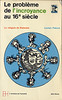
Lucien Febvre-Incroyance The Annalistes, especially Lucien Febvre, advocated a histoire totale, or histoire tout court, a complete study of a historic problem. While several authors continue to carry the Annales banner, today the Annales approach has been less distinctive as more and more historians do work in cultural history and economic history.

The images shown (Thomas Müntzer als Theologe der Revolution, 1921 in a French 10/18 translation and Le Problème de l’incroyance au XVIe siècle. La religion de Rabelais, 1942) are only tangentially related to the Annales School and were sourced at the enigmatic page La Passion des Anabaptistes by Belgian comic book creators Ambre and David Vandermeulen.

I can’t help but wondering what – if there was one – the relation of the Annalistes was to Georges Bataille, who started his journal Documents in the same year as Annales d’histoire économique et sociale. Perhaps Valter “Surreal Documents” knows?

Love Letters of Great Men

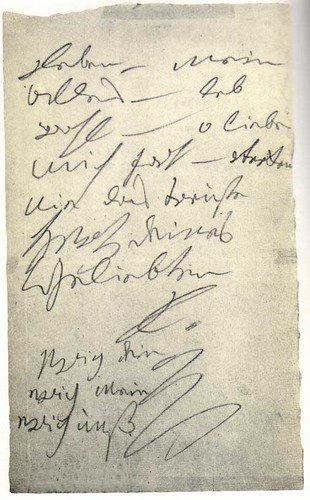
Love letter from Beethoven to an unknown woman (his Immortal Beloved), published in the fictional book Love Letters of Great Men. And I thought my handwriting was bad.

dir – mein Leben – mein alles – leb wohl – o liebe mich fort –
verken nie das treuste Herz deines Geliebten
L.

ewig dein
ewig mein
ewig uns

And this is the English translation

you – my life – my all – farewell. Oh continue to love me –
never misjudge the most faithful heart of your beloved
L.

ever thine
ever mine
ever ours

By Freudian free association: Du and Dir are German words for you. “Du” (Bist Alles)[1] is also the title of a European popular song by Peter Maffay later covered by David Hasselhoff [2]. In 1969, when this song came out, you could also have been discovering Kool & The Gang and The Stooges.

Matter?


[Amazon.com]
[FR] [DE] [UK]

The Big Penis Book is a 2008 book by Taschen on big penises and the men they belong to. The book, like its predecessor The Big Book of Breasts, was edited by Dian Hanson.

From a nobrow perspective it’s interesting that one of the earliest researchers on the subject was Caribbean author and theorist Frantz Fanon who covers this subject in some detail in Black Skin, White Masks (1952) tended towards the view that the supposed positive correlation between penis size and African ancestry is erroneous.

See penis size.

There is a very good Afro-Caribbean “mix tape”

There is a very good Afro-Caribbeanmix tape[1] (by DJ Geko Jones [MySpace] and a track listing here) over at Wayne and Wax. Other music blogs I am currently subscribed to include the Simon Reynolds, Swen’s blog[2], WFMU, Mixtuur, The Wire‘s The Mire[3] and Phinn. Woebot is still missed.

Needless to say, I cannot agree with Sebastian Horsley (Dandy in the Underworld ) when he angrily says:

I’ve had enough of this shit[4]. The internet is for those who lack the flair for conversation. A blog is what you write for after being rejected by all the reputable publishers. It is Loser Central. The last refuge of the refuse.

Where else but on blogs can I read, watch and listen at the same time. The only off-line media I still follow are Focus Knack (a Belgian general interest arts and culture mag), an occasional newspaper and occasional snippets of televised and radio-broadcast news.

Can you live without off-line media?

P.S. From that mixtape:

Eres para mi Julieta Venegas

Eres para mi Julieta Venegas

World cinema classics #52, 53 and 54

[Youtube=http://www.youtube.com/watch?v=oawa85d_bJY]

Red Road trailer

I watched the 2006 British film Red Road yesterday evening. The film felt like reading a nouveau roman: no interior nor exterior monologue whatsoever (by that I mean an almost wholly depersonalized narration), the story is revealed through images and short pieces of dialog and benefits from having no prior information of the plot. The film is very reminiscent of that other little gem, Intimacy , but also of Haneke’s Caché because of its intense claustrophobia and manic voyeurism.

As far as my interest in prurience goes, Red Road had everything I had found lacking in Lust, Caution.

Michael Dwyer notes:

“There are shades of Michael Haneke‘s best work about this often unbearably gripping psychological thriller. It is as frank in its sexual candour as in its scenes of unflinching violence, and it offers no soft dramatic compromises.”

Red Road is World Cinema Classic #52, Caché #53 and Intimacy #54.

Introducing French Book Covers

French blog Au carrefour étrange has ceased its activities for the time being and started a new blog called French book covers [1] which is illustrated with a chic cover photo [2] by the Italian designer and photographer Carlo Mollino. Its author, who goes by the pseudo of Losfeld, has a very extensive collection of books, running the gamut from surrealist theory to sleazy paperbacks, what I like to call nobrow.

A recent post[3] at this new blog featured cover art by French publishing house La Brigandine, for which Jahsonic regular Jean-Pierre Bouyxou has written novels under the pseudonym Georges Le Gloupier before that name was appropriated by the entarteur Noël Godin, a highschool buddy of Bouyxou. One particular of those novels is called Les Accidents de l’amer (Eng: Accidents of the Sea, or accidents of Bitterness, depending on where you place the apostrophe or blank space) and has one of the sexiest covers[4] I’ve seen in some time, due to the particular areola shape of the woman depicted.

I cannot pinpoint (or haven’t tried) the date of these publications, but I would gather mid to late 1970s.