Yearly Archives: 2008

Black Surrealism et al.

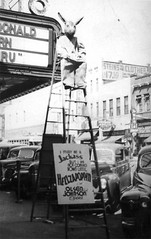
I may be a jackass

A “Jackass” sits atop a tall ladder in front of the Palmetto Theater to promote “Hellzapoppin” starring the comedy team of Olsen and Johnson. The sign on the ladder reads, “I may be a Jackass but I’m not coming down until Helzapoppin’ with Olsen and Johnson opens.” The film was released in 1941 by Universal Pictures. Via here

[Youtube=http://www.youtube.com/watch?v=Bmw7un31UR0&]

A Cadillac commercial by Dylan centered around Bob’s radio show

Spent yesterday evening in the vicinity of the Nachtegalenpark where I listened to The Faces, Nicola Conte‘s newest compilation but most of all to Bob Dylan‘s The Best of Bob Dylan’s Theme Time Radio Hour. Came home and got sick. Slept for more than 15 hours.

Woke up and thought about Black Surrealism, through my first exposure to the work of Slim Gaillard and his role in films such as the 1941 film Hellzapoppin’, of which Ado Kyrou was a fan. Black Surrealism is a concept first put forward by Robin D.G. Kelley in A Poetics of Anticolonialism (1999), although he had overlooked the popular dimension of the concept.

The popular strains of any art form are often forgotten, take for example Ma and Pa Kettle, the American comic duo known for their celebration of the absurd, but much less known and appreciated than comparable films by Jacques Tati (I am referring specifically to Tati’s attack on modernity which was just as prevalent in the Kettle films).

To conclude, a recommendation: if you only buy one CD in 2008, make it Bob Dylan‘s The Best of Bob Dylan’s Theme Time Radio Hour. You’ll enjoy tracks such as Mary Gauthier’s “I Drink”, Dinah Washington’s bawdy “Long Big Sliding Thing” and many more. Trust me.

For the sake of a book

[Youtube=http://www.youtube.com/watch?v=h4wyQCD70sQ&]

Truman Capote/Andy Warhol with the Rolling Stones

Yesterday evening, after visiting friends who provided me with a Joe Sarnoesque [1] experience of suburban want and need in the Antwerp district of the Tentoonstellingslaan, I finished my viewing of Capote, which sheds light on the nature of fiction and modern writing. The key to the film is in its final five minutes where Truman Capote contends that there was nothing he could have done to save the life of the murderers, but as Nelle (Christine Keener, who I recently admired in Friends with Money, a portrayal of American depression) responds, he did not want to do that. Implied is that he did not want to save the murderers for the sake of his book In Cold Blood and in fact, put his own life to a perverted use subjugated to the pursuit of writing fiction. (see semi-autobiographical and autofiction.)

Statues also die

[Youtube=http://www.youtube.com/watch?v=d5Pb9nykjQA]

Les Statues meurent aussi

Les Statues meurent aussi (Eng: Statues also Die) is a short subject documentary film by Chris Marker and Alain Resnais released in 1953 and financed by the anticolonial organisation Présence africaine. Its theme was that Western civilization is responsible for the decline of black art due to cultural appropriation. The film was seen at the Cannes Film Festival, it won the Prix Jean Vigo in 1954 but was banned shortly afterwards for more than 10 years by the French censor.

Aimé Césaire (1913 – 2008)


[Amazon.com]
[FR] [DE] [UK]

Aimé Fernand David Césaire (25 June 191317 April 2008) was a French poet, author and politician. He was with Léopold Sédar Senghor one of the figure heads of the négritude movement, the precursor to the Black Power movement of the 1960s. His writings reflect his passion for civic and social engagement. He is the author of Discours sur le colonialisme (Discourse on Colonialism) (1953), a denunciation of European colonial racism which was published in the French review Présence Africaine. In 1968, he published the first version of Une Tempête, a radical adaptation of Shakespeare’s play The Tempest for a black audience.

Contemporary philosophy

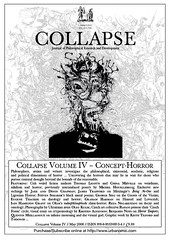
Collapse 4

Collapse IV (2008)

Order it here.

This looks interesting. Nice cover too. A bit arcimboldesque. I wonder who did it. This is the cover of a contemporary philosophy magazine of which this issue is dedicated to the theory of horror. Any philosophy of horror and the representation thereof (which is also the theory of the aestheticization of violence) needs to start with Aristotle, as I’ve stated before. Aristotle said on the subject:

“Objects which in themselves we view with pain, we delight to contemplate when reproduced with minute fidelity: such as the forms of the most ignoble animals and of dead bodies.” —Aristotle from the Poetics.

As you may have guessed by now, I have limited first-hand knowledge on some subjects; I do not have the patience to read Aristotle. Nevertheless, in my infinite ignorance, I dare to state that I like Aristotle and dislike Plato. Plato strikes me as a bore (much like Kant does), Aristotle was a sensationalist like myself. From “my” page on aestheticization of violence, Plato comes across as the sort of moral crusader I’ve never felt any sympathy for (except that they have sometimes pointed me in the direction of worthwhile art, see the censor/censored dilemma):

Plato proposed to ban poets from his ideal republic because he feared that their aesthetic ability to construct attractive narratives about immoral behavior would corrupt young minds. Plato’s writings refer to poetry as a kind of rhetoric, whose “…influence is pervasive and often harmful.” Plato believed that poetry that was “unregulated by philosophy is a danger to soul and community.” He warned that tragic poetry can produce “a disordered psychic regime or constitution” by inducing “a dream-like, uncritical state in which we lose ourselves in …sorrow, grief, anger, [and] resentment.

Back to contemporary philosophy. From Wikpedia:

“Philosophy has re-entered popular culture through the work of authors such as Alain de Botton. This trend is reinforced by the recent increase in films with philosophical content. Some films, such as Fight Club, eXistenZ, The Matrix trilogy, Little Miss Sunshine, and Waking Life have philosophical themes underpinning their overarching plots. Other films attempt to be overtly philosophical, such as I ♥ Huckabees.”

I’ve done Fight Club, eXistenZ, The Matrix and Little Miss Sunshine and of those three I like eXistenZ best. I will want to see Waking Life and I ♥ Huckabees. Where do I start. Huckabees? It stars Huppert. And from what I’ve Youtubed of Waking, it reminded me of Scanner Darkly, with which I was not too impressed (but has lingered on afterwards). Any thoughts, dear readers?

Update 17/4: More on Collapse. Collapse has links with New Weird and Speculative realism. The cover is probably by the Chapmans (“new etchings from Jake Chapman“). Of all its contributions I am most curious about Graham Harman on the unnatural bond between Husserl and Lovecraft and Iain Hamilton Grant on Lorenz Oken‘s naturphilosophische slime-horror.

Introducing Francesca Woodman

Francesca Woodman

Photo by Francesca Woodman, see more at the Google gallery

Just like the director Belvaux in the previous post, this talented photographer took her life, only much younger, she was only 22, and left behind a mere 500 photographs. Sometimes it feels like one could build an entire art history class around artists who’ve committed suicide.

American art critic David Levi Strauss wrote an essay about her; “After You, Dearest Photography: Reflections on the Work of Francesca Woodman,” which takes its title from “After you, dearest language” by André Breton’s in Introduction au discours sur le peu de realité.

Breton’s full quote reads: “Quietly. I want to pass where no one yet has passed, quietly! — After you, dearest language.”

That is exceedingly well said, mister Breton.

Film lovers, good evening!

Or, world cinema classic #43

[Youtube=http://www.youtube.com/watch?v=oi5rmt-gucs]

Man Bites Dog

After long and careful deliberation, I’ve decided against pronouncing this film a world cinema classic #43. Instead, I’ve chosen a 1992 film which was made in Belgium, and it’s probably one of the best-known Belgian films abroad of the late 20th century. The film dates of 1992 and much like the American film Natural Born Killers, is a satire on the media’s exploitation of graphic violence, only much better. Sadly, the director of this black mockumentary committed suicide two years ago, as often happens to very talented people with an appreciation of the darker side of life. Without further ado, I present you Man Bites Dog, one of the best features of the 1990s, a must-see feature film. As a seal of quality, it carries an NC-17 rating by the Motion Picture Association of America (such is the beneficial role of censorship organizations).

Eye candy #12

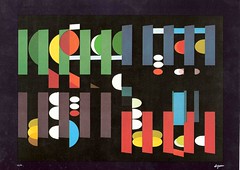
Yaccov Agam- Night over Jerusalem,silkscreen on plexi, 40X52 cm

Night over Jerusalem (1980s) by Yaacov Agam

It only rarely happens that a living artist releases work into the public domain. Yet it is precisely what happened to the work displayed above. Agam is an Israeli artist born in 1928, known for his kinetic art pieces.

This work brings up visions of Tati’s Playtime.

Tip of the hat to A Dictionary of the Avant-Gardes, which arrived in the mail this morning and the artists of which I am adding to my wiki. Lots of “concrete poetry” and “sound art” artists in this book.

I’m normally not very much into the rectangular modern art stuff, but this is a very “warm” piece, what do you think?

Cult fiction #4


[Amazon.com]
[FR] [DE] [UK]

Horror Panegyric is a 2008 book by Keith Seward which looks at the Lord Horror stories published by Savoy Books (David Britton and Michael Butterworth). The cover design is by British illustrator John Coulthart.

Lord Horror is the most recent work of literature after Last Exit to Brooklyn to be banned in England and obliged Britton to serve a term in a British prison.

Colin Wilson, in a review of the Lord Horror series remarked:

“I think that, as an exercise in Surrealism, Lord Horror compares with some of the best work that came out of France and Germany between the wars, for example Georges Bataille. The book has some brilliantly funny passages, particularly about Old Shatterhand. Britton is undoubtedly brilliant, but when I came to the bit about Horror hollowing out a Jewess’s foot and putting it over his penis, I started skipping. With the best will in the world, I couldn’t give his brilliant passages the attention they deserve because I kept being put off by this note of violence and sadism. No doubt it is because I belong to an older generation that is still basically a bit Victorian.”

Tip of the hat to Paul Rumsey.

What Andrew Keen does not understand

Via a local newspaper last Friday I was introduced to the reactionary thought of Andrew Keen (a self-proclaimed “leading contemporary critic of the Internet”) who is doing a book tour through Europe to launch his 2007 book The Cult of the Amateur in which – among other things – he states that “real” writers do not blog. A conspirator of thought of Keen, Marshall Poe, states that Wikipedia is not an encyclopedia, but a repository of common knowledge.”

Both Andrew Keen and Marshall Poe completely miss the point of blogging, Wikipedia and the nature of the internet in general. Even more, it’s not just that they don’t understand. The fact is is that they are fundamentally and ethically wrong.

1) A. Keen and M. Poe underestimate the importance of information access in the third and fourth worlds (and poor people everywhere) to a repository of books, encyclopedias and common knowledge:

Extremely knowledgeable people are paraphrasing information from a canonical list of books into Wikipedia, towards a new and yet unseen educational perennialism . People in such countries as Chad, Burkina Faso now have access to verifiable info and would not have it, if it were not for Wikipedia.

2) A. Keen and M. Poe underestimate the importance of common knowledge.

Common knowledge is good. We need common ground when discussing subjects. An encyclopedia=common knowledge copied from books (or from expert’s own minds). When Marshall Poe states that “Wikipedia is … not an encyclopedia, but a repository of common knowledge,” he forgets that people such as David Hume before him stated that “nothing is more usual than for philosophers to encroach on the province of grammarians, and to engage in disputes of words, while they imagine they are handling controversies of the deepest importance and concern.”

3) A. Keen and M. Poe fail to see what makes Wikipedia an interesting place for people who do have access to physical libraries:

For those of us who live in the First World, who do have access to the physical books, Wikipedia discloses info on the nature of knowledge and the social construction of knowledge via such features as the “what links here” and “disambiguation” pages.

I do not feel that strongly about points 2 and 3, which is intellectual nitpicking which makes no difference to the stomachs of people in the world, but point one, information access in the third and fourth worlds, is something I feel very strongly about and leads me to conclude that Keen and Poe do not have their hearts in the right places.