Hal Blaine was an American drummer.
Some of the more notable records he played on include the Ronettes’ single “Be My Baby” (1963) and the Beach Boys’ album Pet Sounds (1966).
Of his solo work, Psychedelic Percussion (1967) [above] is of note.

Hal Blaine was an American drummer.
Some of the more notable records he played on include the Ronettes’ single “Be My Baby” (1963) and the Beach Boys’ album Pet Sounds (1966).
Of his solo work, Psychedelic Percussion (1967) [above] is of note.
Carolee Schneemann was an American artist who flourished in the 1960s and 1970s with her “body art”
Her best-known piece is Interior Scroll (1975), a performance in which she produced a scroll from her vagina while standing.
Her films include Fuses (1967) in which Schneemann and her then-boyfriend James Tenney are having sex, a reaction to Stan Brakhage’s Window Water Baby Moving (1959) which shows Brakhage’s wife giving birth.
Above are fragments of Fuses set to an educative narration made as a school or university assignment.
Keith Flint was an English vocalist and dancer associated with the electronic dance act The Prodigy.
He contributed to “Out of Space” (1992) which sampled the classic reggae track “Chase the Devil” (1976) by Max Romeo, which was produced by Lee Scratch Perry.
That track featured the Afrofuturist lines “I’m gonna send him to outa space, to find another race.”
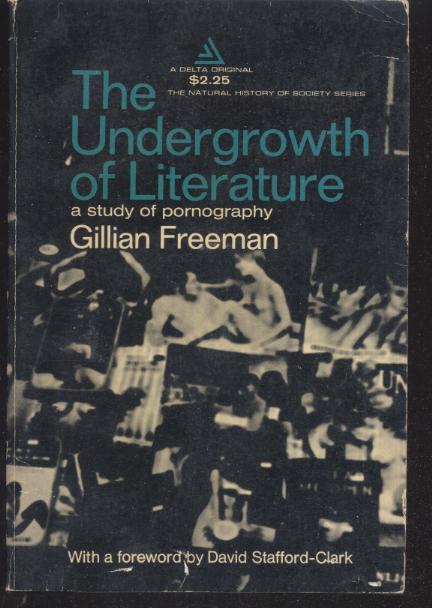
Gillian Freeman was a British writer best known for her book The Undergrowth of Literature (1967), a pioneering study of pornography.
At first I thought I’d not pay her death any attention, since I do not own a copy of The Undergrowth of Literature, the reason I discovered Mrs. Freeman in the first place. But I changed my mind when I found out that the Hendrik Conscience Heritage Library had a copy of this book in its warehouses, so off I was.
Leafing through the book (200 pp.) one finds references to other studies of porn from that era but most of all one is struck by the female point of view. Mrs Freeman is one of the first porn researchers to put forward that female sexual fantasies can be found in women’s magazines:
“I have merely made a survey of current fantasy literature which overtly or covertly, supplies the stimulus which so many people need, from the romance of Woman’s Own to the sado-masochism of Man’s Story” — p. 1
As always the negative criticism is most amusing:
“[the book is] nothing more than a collection of quotes, précis, paraphrases and photographs from current pornographic publications and glossy magazines … there is no love like the liberal prig‘s love for perverts and perversions”. –Stephen Vizinczey,The Times, 4 November 1967
Since Undergrowth is not in Google Books, I thought I’d give you the index. This may be useful to the aspiring pornosopher although apart from its focus on herstory it does not come near the qualities of Sex in History (1954) and Eros Denied (1964).
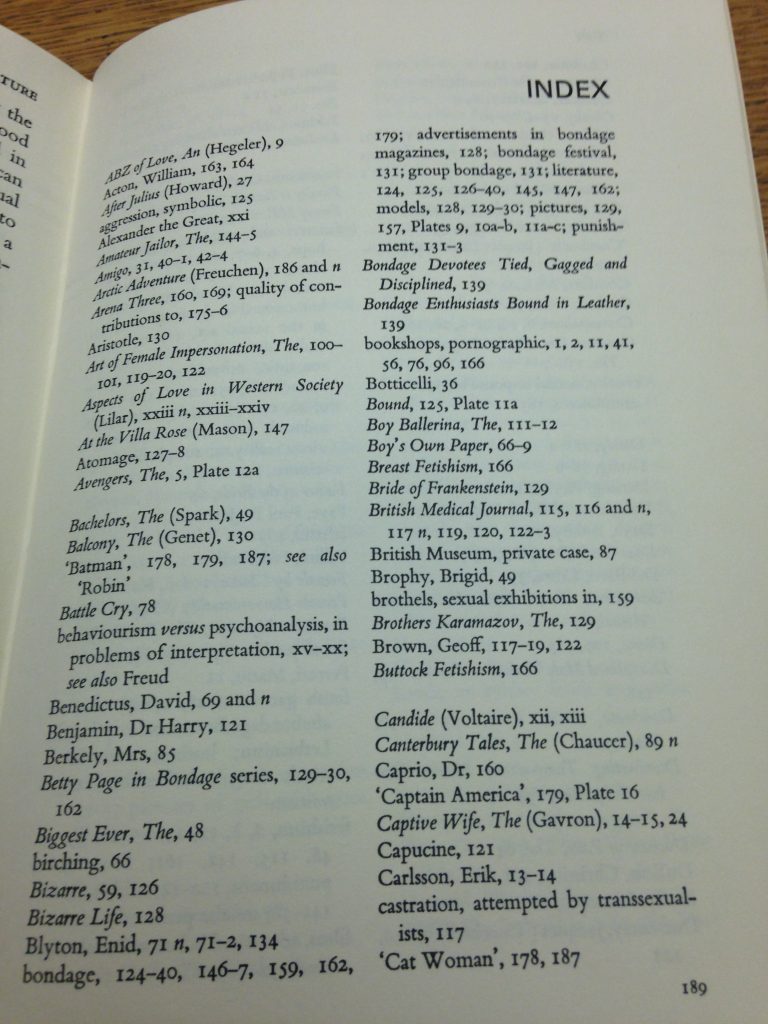
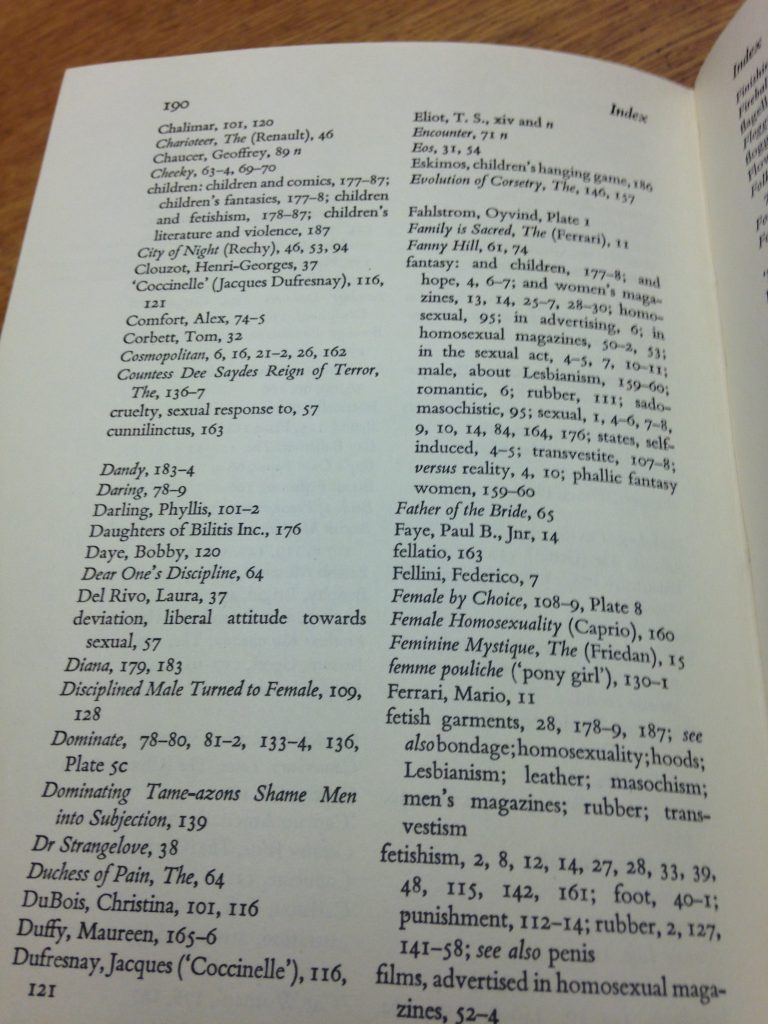
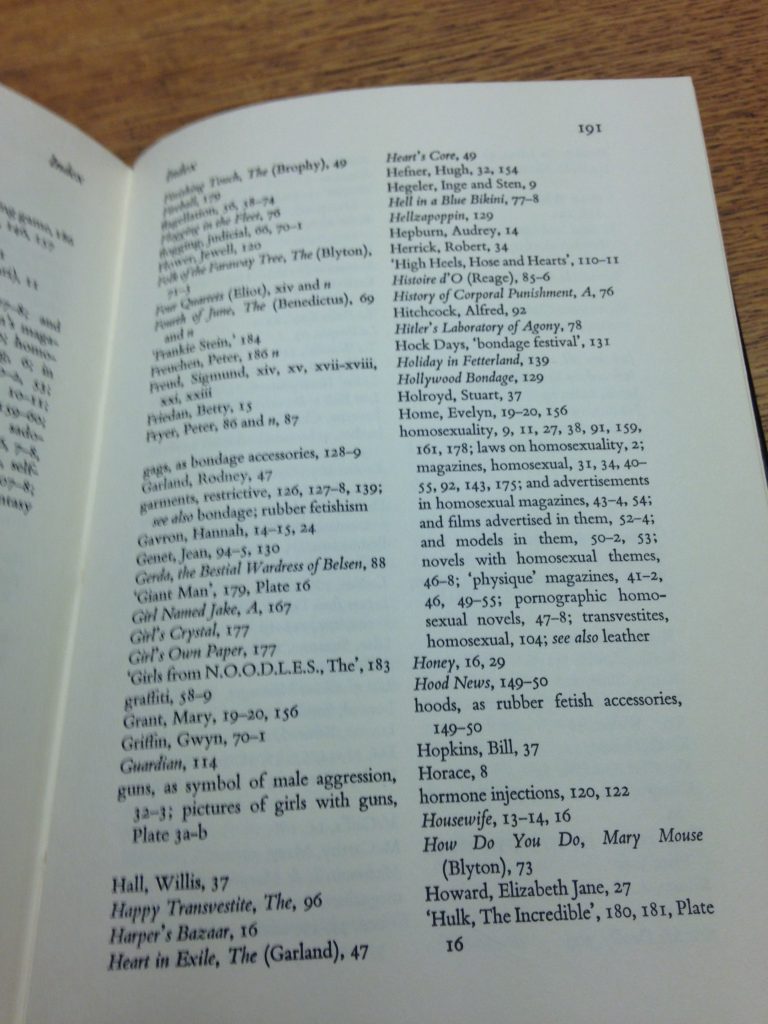
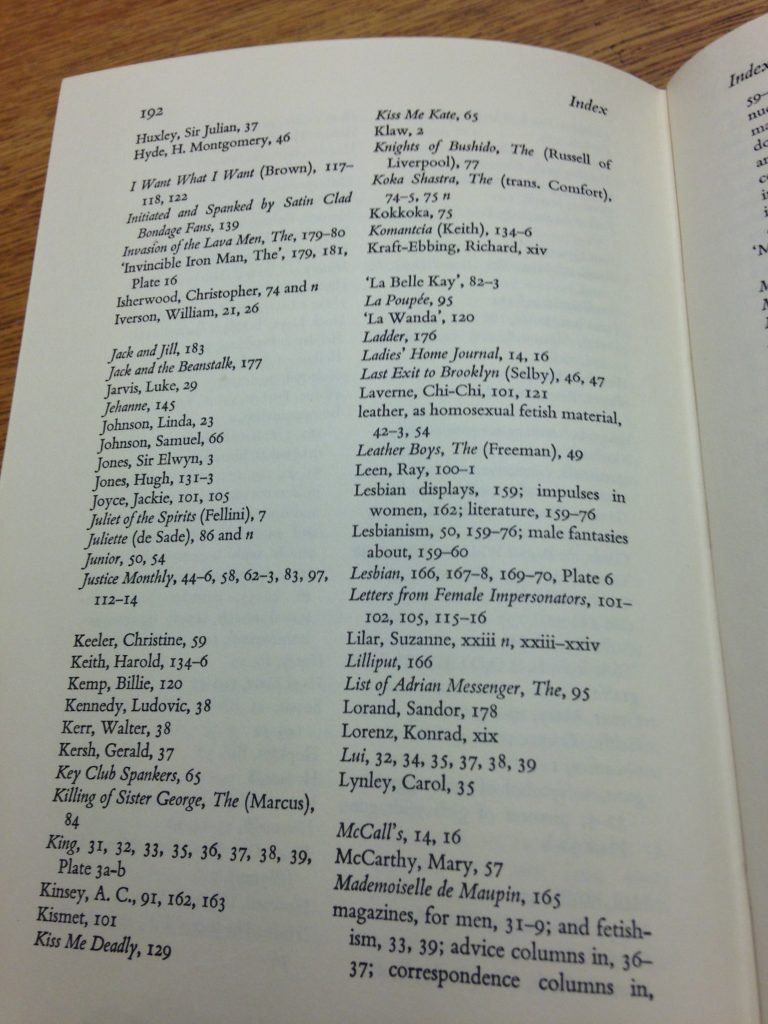
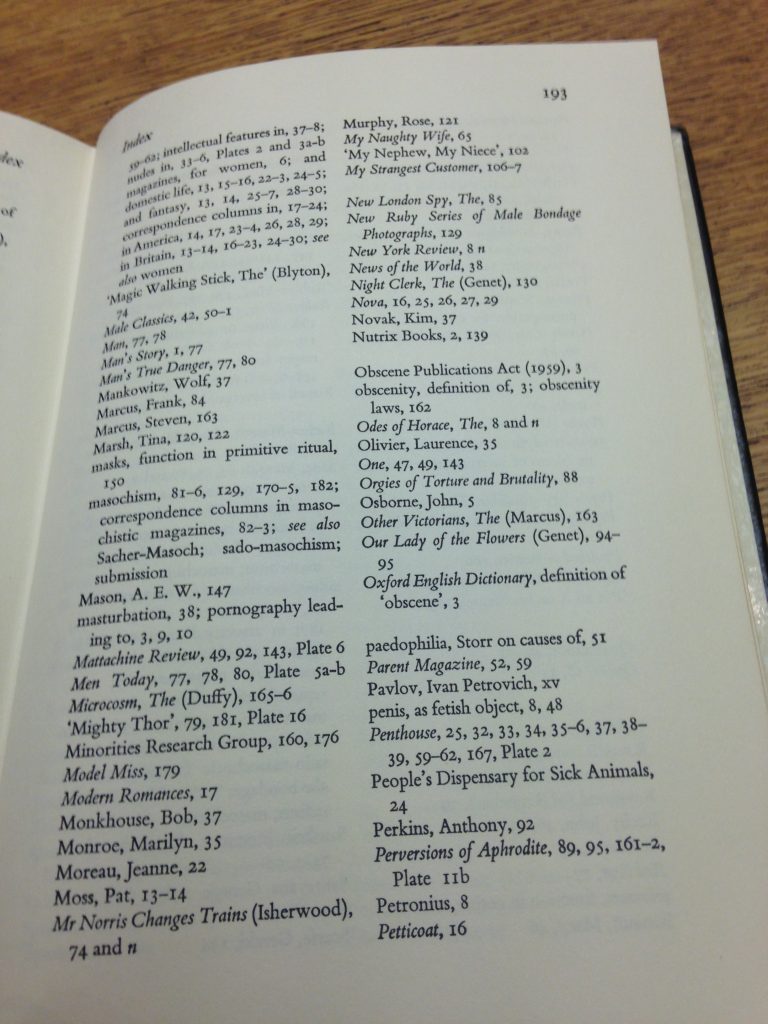
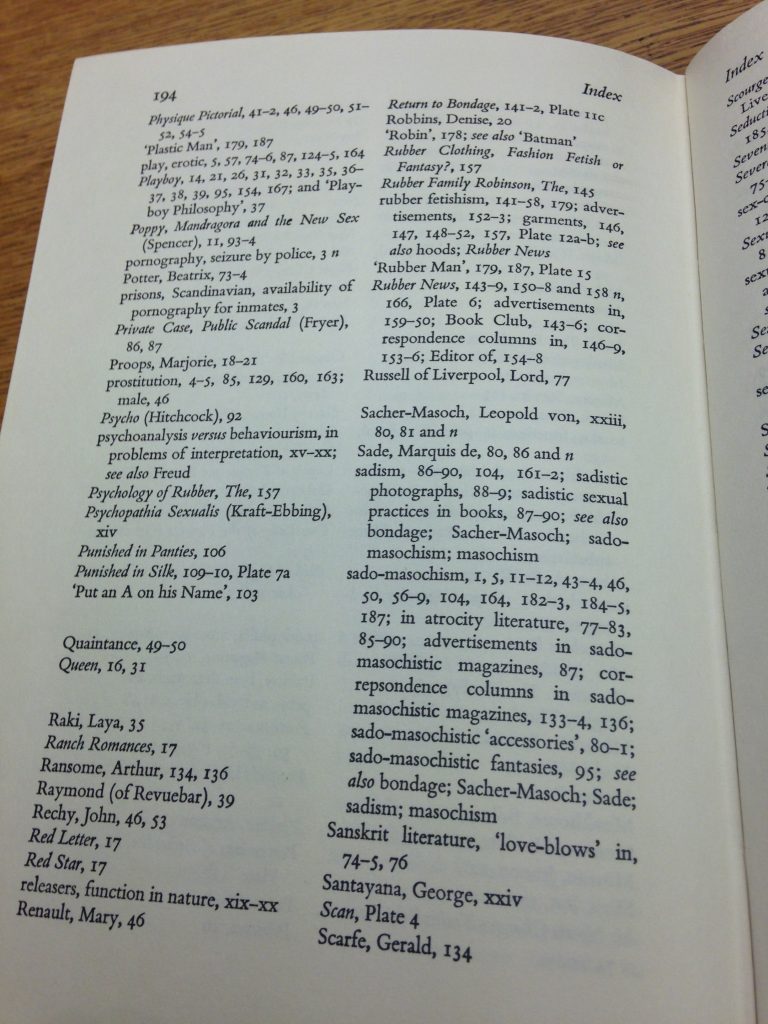
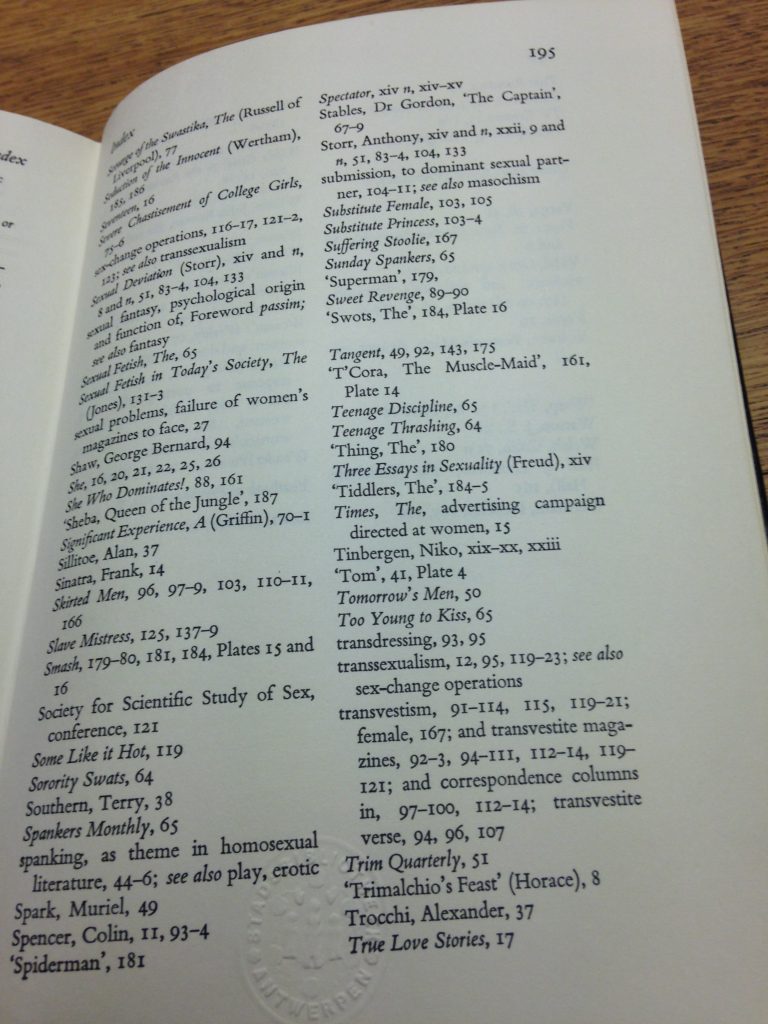
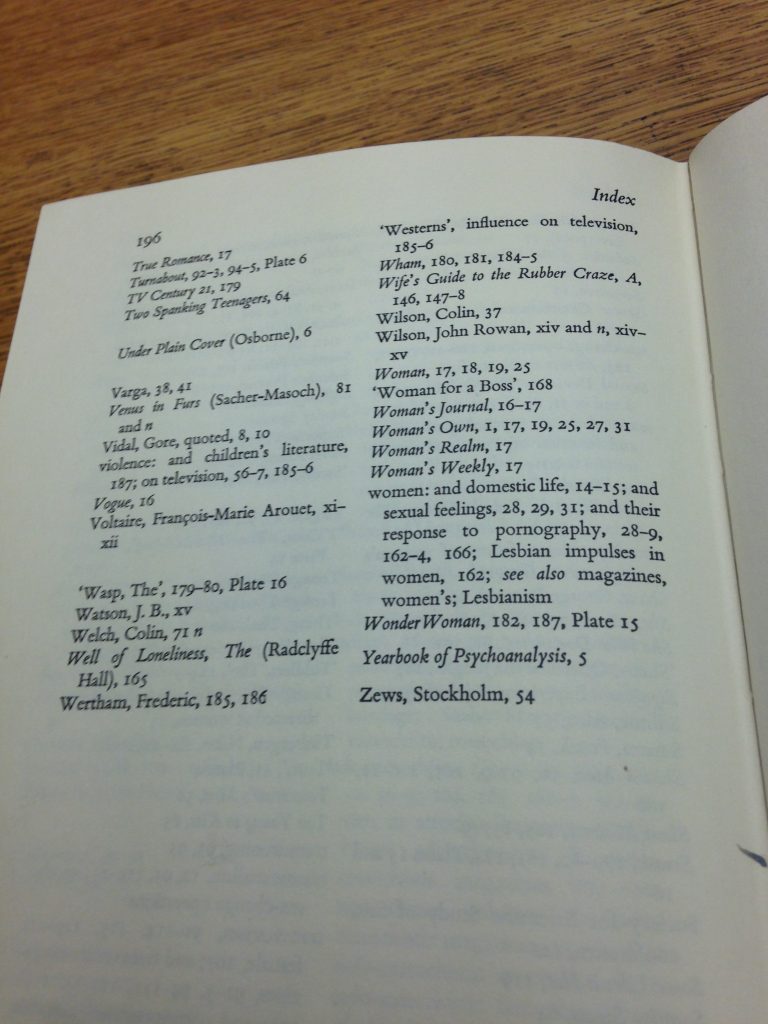
Gillian Freeman also wrote the thought sequences dialogue for The Girl on a Motorcycle (1968).
I wonder who is inheriting Mrs. Freeman’s library.
André Previn was a German-American musician best known for his film scores.
He first came to my attention when his ex-wife Dory Previn died in 2012.
After some quick glancing through my archives, I find that a ‘porn groove’ on the compilation The Mood Mosaic Vol. 3 “The Sexploitation” is of Previn’s hand, a track called “Executive Party” composed for the film Rollerball.
In the clip above that song is heard in a wonderfully strange scene “shot in the pre-dawn “magic hour,” as the wealthy, decadent upper-class fire explosive rounds at a line of towering trees, setting fire to them one after another, reveling in destruction” [1].
A example of pure wanton waste of excess energy.
Mark Hollis was an English musician and singer-songwriter, the co-founder, lead singer and principal songwriter of the band Talk Talk.
I never knew their song “Such a Shame” was inspired by Luke Rhinehart’s The Dice Man (1971).
In fact, I never really knew Talk Talk at all, outside of the hits.
Tonight, I played some of their music and put “The Rainbow” from the 1988 album Spirit of Eden on repeat.
Stanley Donen (1924 – 2019) was an American film director and choreographer best-known for Singin’ in the Rain (1952).
We remember him fondly for directing Bedazzled, an updated version of the Faust legend set in 1967.
Dudley Moore plays a lonely young man whose unrequited love of his co-worker drives him to attempt suicide. Just then the devil (Peter Cook) appears and offers him seven wishes in exchange for his soul.
The film’s fun-loving association with the Swinging London of the 1960s is smart and well-executed.
Love it.
Via the death of Ken Nordine I find out that Henry Jacobs died.
Henry Jacobs was an American sound artist and humorist, known for the radio program Music and Folklore, the TV program The Fine Art of Goofing Off (1971–1972) and compositions such as “Sonata For Loudspeakers” (1955).
He also invented the fictional characters Sixt Von Arnim, Sholem Stein and Shorty Petterstein.
Of these three, Sholem Stein is my favorite. I used him as a mystification in my book on the history of erotica in which I put the following words into his mouth:
“Man reveals his true nature in his fears and desires. Show me what he is afraid of, show me what excites him, I will tell you who he is.”
I use Sholem Stein off and on nowadays, I usually have him cite dicta I don’t know who to ascribe to.
Ken Nordine (1920 – 2019) was an American voice artist, best known for his series of spoken word jazz poetry albums, the first of which was Word Jazz (1957).
He also recorded a version of Balzac’s risque story “A Passion in the Desert” (1955).
RIP Lonnie Simmons, American record producer (“Don’t Stop the Music“).
Lonnie Simmons was an American record producer best-known for co-writing “Don’t Stop the Music” (1978).
In 1981, the song was successfully covered by Bits & Pieces [above].