Loisirs Littéraires au XXe siècle (above, English: “Literary leasures in the 20th century”) is the title of an illustration from the story “The End of Books” by French writer Octave Uzanne and illustrator Albert Robida, a story about a post-literate society in which readers have become ‘hearers,’ i. e. consumers of audio books. It was published in the collection Contes pour les bibliophiles (1895). The illustration depicts a female reader of the 20th century, imagined by Robida, who is listening to “12 poètes assortis” (twelve assorted poets) in on a balcony overlooking a future city.
RIP José Ramón Larraz
https://www.youtube.com/watch?v=C7EFyYXcylM
RIP José Ramón Larraz (1929 – 2013).
After the death of Jesús Franco earlier this year, fellow countryman Larraz was the last survivor of “sexual revolution“-era European exploitation cinema.
Now the two last two last survivors of that sensibility are Radley Metzger (born 1929) and Roger Corman (born 1926).
My first exposure to Larraz was the VHS cover of La visita del vicio (The Coming of Sin). For the infamous Pasiphae scene from La visita del vicio shot scroll to 15′:32”.
Video: Eurotika! Larraz episode (1992).
I’ve previously mentioned Larraz here: https://blog.jahsonic.com/daedalus-devised-a-hollow-wooden-cow/
The Unswept Floor, or, of vestiges and precursors
Earlier this summer, I leafed through Medieval Modern: Art out of Time, which finds precursors of modern art in medieval art.
Apparently vestiges of modern art can be found in ancient art too.
Illustration: The Unswept Floor(detail)
Today, I discovered The Unswept Floor by a certain Herakleitos, a copy of The Unswept Floor 2nd-century BC original mosaic by Sosus of Pergamon described by Pliny in his Natural History (XXXVI, 184):
“[Sosos] laid at Pergamon what is called the asarotos oikos or ‘unswept room,’ because on the pavement was represented the debris of a meal, and those things which are normally swept away, as if they had been left there, made of small tessera of many colours.”
Making a mosaic floor with leftovers of food discarded from the table. How ‘modern’ is that?
I am reminded of Eaten by Marcel Duchamp, one of the snare pictures by Swiss artist Daniel Spoerri, ‘depicting’ the remains of a meal eaten by Marcel Duchamp.
Necrotourism (2)
Six years ago, I posted a picture of Walter Benjamin’s grave[1], in Portbou, Spain.
One year ago, I stayed for a few days in El Port de la Selva, right next to Portbou, unaware that it was the location of Passages; Homage to Walter Benjamin (above).
Now I want to go back.
See necrotourism or tomb tourism.
In praise of artificial ruins
![A cross section of the Broken Column House at the Désert de Retz as recorded in Les jardins anglo-chinois by Georges-Louis Le Rouge, 1785 [1]](https://blog.jahsonic.com/wp-content/uploads/2013/08/A-cross-section-of-the-Broken-Column-House-at-the-Désert-de-Retz-as-recorded-in-Les-jardins-anglo-chinois-by-Georges-Louis-Le-Rouge-1785-1-178x300.jpg)
A cross section of the Broken Column House at the Désert de Retz as recorded in Les jardins anglo-chinois by Georges-Louis Le Rouge, 1785
The Broken Column House (the “colonne brisée”, or ruined column) is an artificial ruin in the French landscape garden Désert de Retz.
Books are dumb
http://www.youtube.com/watch?v=2zYkuiw3IV0
Dumb as in mute.
That’s what occurred to me when I was reading Rayuela (1963) by Julio Cortázar with all its references to jazz recordings on the drunken nights of the ‘The Serpent Club’.
That’s were Jazzuela (2001) comes in.
The CD brings together the music of Rayuela.
On the turntable (above): Lionel Hampton & His Orchestra – “Save it Pretty Mamma.”
RIP Andre Lewis
http://www.youtube.com/watch?v=D4_jWgu2eAs
RIP American musician and producer Andre Lewis (1948 – 2012). He played keyboards for The Mothers of Invention after George Duke left.
Under the pseudonym Mandré, he recorded three space funk LPs, concealing his identity with a space helmet (which looks similar to the helmets used by Daft Punk in their “Get Lucky” single.)
He is best-known for the “space funk” composition “Solar Flight (Opus 1)” (above).
RIP Jacques Carelman
RIP Jacques Carelman, 83, French painter, illustrator and designer (Catalogue d’objets introuvables) (above).
On Umberto Eco’s ‘Foucault’s Pendulum’, unreadability and the ‘cacopedia’.

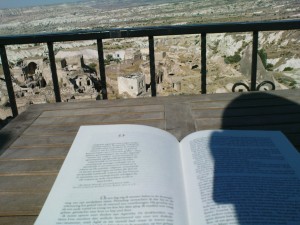
My copy of ‘Foucault’s Pendulum’ overlooking the Pigeon Valley from the rooftop of Has Konak in Cappadocia
As is often the case, the most salient bits of a book only become apparent a while after finishing it.
So it was only after a week or so after digesting the 600+ pages of Foucault’s Pendulum that the phrase “urban planning for gypsies” suddenly sounded in my ears:
‘Listen, Jacopo, I thought of a good one: Urban Planning for Gypsies.’
‘Great,’ Belbo said admiringly. ‘I have one, too: Aztec Equitation.’
‘Excellent. But would that go with Potio-section or the Anynata?’
‘We’ll have to see.’ Belbo said. He rummaged in his drawer and took out some sheets of paper. ‘Potio-section…’ He looked at me, saw my bewilderment. ‘Potio-section, as everybody knows, is the art of slicing soup. No, no,’ he said to Diotallevi. ‘It’s not a department, it’s a subject, like Mechanical Avunculogratulation or Pylocatabasis. They all fall under the heading of Tetrapyloctomy.’
‘What’s tetra…?’
‘The art of splitting a hair four ways. Mechanical Avunculogratulation, for example, is how to build machines for greeting uncles.’
As it turns out, “urban planning for gypsies, the art of slicing soup, Morse syntax, the history of antartic agriculture, the history of Easter Island painting, contemporary Sumerian literature, Montessori grading, Assyrian-Babylonian philately, the technology of the wheel in pre-Columbian empires, and the phonetics of the silent film” and other nonsensical endeavors are part of what Eco has termed the cacopedia.
What baffled me while reading Foucault’s Pendulum, is the commercial success of the novel, a book full of esoteric references to the Kabbalah, alchemy and conspiracy theories.
It makes you wonder what the owning/reading ratio is. Just imagine the number of people who bought it or got it as a gift but left it unopened on their shelves.
The book is unreadable for the uninitiated, the name-dropping is so extensive that critic and novelist Anthony Burgess suggested that it needed an index. In fact, Wikipedia produced two of them: Concordance of Eco’s Foucault’s Pendulum and Concordance of Eco’s Foucault’s Pendulum (2).
I’m back
I just got back from the enchanted moonscapes of Cappadocia in Turkey where (some) people still live in fairy chimneys, conical tuff rocks with pointed tops hollowed out from the inside.
Extremely spectacular.
And I finally read Foucault’s Pendulum by Umberto Eco.
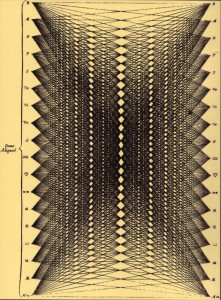
From that book is Athanasius Kircher‘s Epilogismus Combinationis Linearis (above).