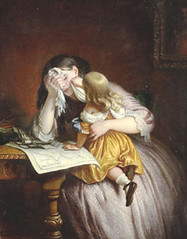
For a beautiful woman, the battle never ends

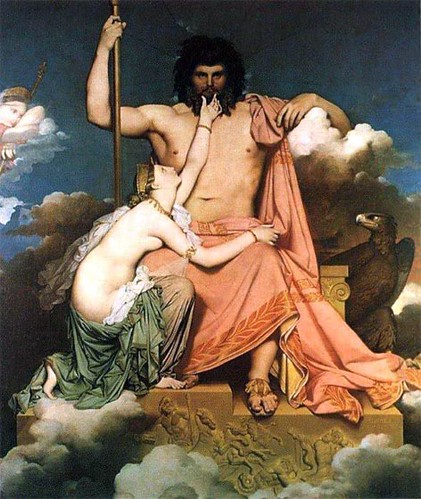
Jupiter and Thetis by you.

Click for credits

“An objective and unprejudiced look at the real world shows that only a limited category of men have gorgeous women: religious leaders, billionaires, film and television stars, famous actors, famous directors and gangsters.” —Francesco Alberoni in L’Erotismo (translation mine) [1].

Alberoni arrives at this argument by positing that able, attractive and even fascinating men have been known to choose to be with less attractive or even ugly women. This is because they know the price that comes with beautiful women.

The price – still according to Alberoni (I agree) – is battle. Splendid beauty is indissolubly connected to power, and power is connected to danger, much like that other category in aesthetics, the sublime. Alberoni goes on to invoke Helena as the archetypical beautiful woman in Goethe’s Faust.

Faust asks:

Before the prize of beauty, lo I stand,
But who assures the prize to me?

Because Faust knows, as was the case with Helen of Troy that for a beautiful woman, the battle never ends.

Jacques Mesrine: in the vortex of related events

[Youtube=http://www.youtube.com/watch?v=FOfUbthtDhQ&]

If there is one current film I would like to recommend, it’s Public Enemy Number One (Part 1)[1], a biopic of French criminal Jacques Mesrine with sympathies for the European radical political urban guerrilleros RAF and Red Brigades, who eventually died in the late seventies for craving his 15 minutes of fame somewhat too eagerly. The film was produced by Thomas Langmann.

If you want to know who Mesrine was, watch this YouTumentary[2] set to “Comptines d’un autre été here as The Pian (Life is a song)” from the Yann Tiersen score of Amelie Poulain. Or better still, this documentary footage[3].

Public Enemy Number One (Part 1) is based on Jacques Mesrine‘s 1977 autobiographical bookL’Instinct de mort” and stars Vincent Cassel (L’Appartement, Irréversible) as Mesrine and costars Gérard Depardieu, Mathieu Amalric and Cécile de France (Haute Tension). A sequel “L’Ennemi public n°1” (“Public Enemy Number One (Part 2)”) was released in French theaters last November.
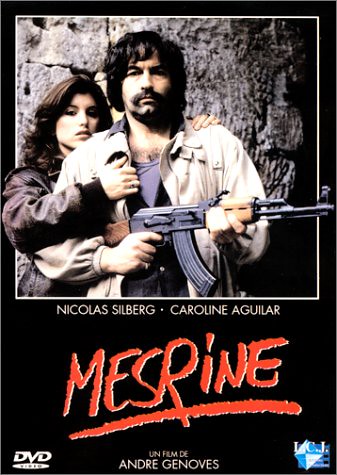
Mesrine by André Génovès by you.

This is all well-known. Lesser-known and very intriguingly I discovered the film Mesrine, directed by a certain French producer and/or writer of whom not much more than his IMDb filmography. The filmography in case is impressive and noted by a bleak, grim and dark worldview. In fact wholly antithetical to the Amélie score featured above. The man is André Génovès.

André Génovès was born 1941 and is a French film producer noted for working with Claude Chabrol and being involved with Barocco, The Butcher (film), The Unfaithful Wife, A Real Young Girl, This Man Must Die, Mesrine (film), and Les Innocents aux mains sales.
Keystone Kops by you.

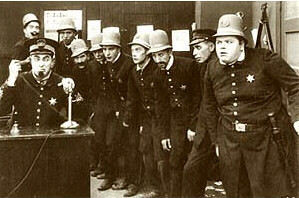
In a perverse way, this film reminds me of police comedy films about bungling police officers who almost lose their job due to the excessive intelligence and dexterity of the criminals.

In 1980 the police comedy film Inspecteur la Bavure[4] with Coluche and Gérard Depardieu has Depardieu’s character, Morzini, directly inspired by Jacques Mesrine.

Bungling police officers are part of the making fun authority figures trope, as seen in Keystone Kops, Inspector Clouseau, Police Academy, Taxi (franchise) and Carry On Constable.
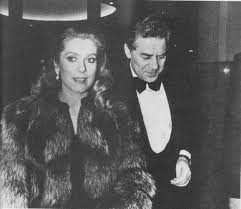
Catherine Deneuve  and Gérard Lebovici

Coming back to Mesrine, in the vortex of related events, after Jacques Mesrine’s death, his daughter Sabrina was adopted by Gérard Lebovici, French film producer, editor and patron to Guy Debord. Lebovici was also the manager of Jean-Pierre Cassel, yes the father of Vincent Cassel.

The tale is not finished. This whole history, its thematics and fiction, its personae and actual actors are further interwoven.

“On March 7 1984 Gérard Lebovici was found shot dead in the front seat of his car in the basement of the Avenue Foch carpark in Paris. There was swift confirmation that he had died on 5 March from four bullets fired from behind into the back of the neck. The assassins have never been caught.”

“Whatever happened to Sabrina?” is what Sholem Stein wants to know.
RIP French film producer Christian Fechner

[Youtube=http://www.youtube.com/watch?v=WxCSQY4zskg]

La Fille sur le pont

best knife-throwing-act scene ever, testimony to a strange kind of eroticism.

French film producer Christian Fechner died today. He was 64. He produced a great number of films but is best-remembered for L’Aile ou la Cuisse, Camille Claudel, Les Amants du Pont-Neuf, Élisa, and La Fille sur le pont.

That last film, with its English title Girl on a Bridge was directed by Patrice Leconte and was featured on this blog two years ago[1]. The film is superb, it is now World Cinema Classic #72.

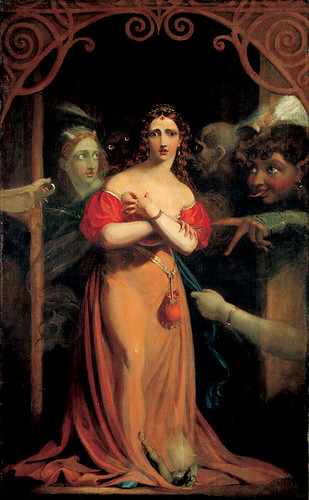
The swarm of spirits came clambering up to her

Bertalda, Assailed by Spirits by Theodore Von Holst by you.

Bertalda, Assailed by Spirits by Theodore Von Holst

“Bertalda then showed the piece of gold she was given to the goblins below, and they laughed themselves half-dead over it and hissed at her. At last they all pointed at me with their metal-stained fingers, and more and more wildly, and more and more densely, and more and more madly, the swarm of spirits came clambering up to her.” –remix of Undine

Damsel in distress trope in Undine, actually a take on tentacle eroticism of which I am so fond.

Indescribable, unspeakable, ineffable and inexplicable

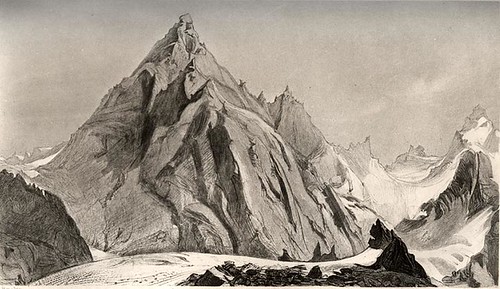
The Aigiulle Blaitiere. c. 1856 by John Ruskin by you.

The Aigiulle Blaitiere. c. 1856 by John Ruskin

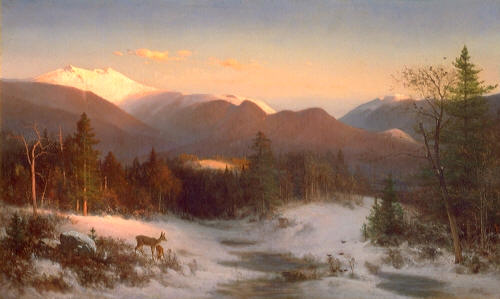
A painting by Thomas Hill dated 1870 by you.

A painting by Thomas Hill dated 1870

Reading the opening chapter of Ivins‘s Prints and Visual Communication[1] on the indescribability of things (and the need for photographic representations) reminded me of the garland and the Greek Anthology.

Googling for “indescribability” brings up this interview regarding the sublime, indescribability and mountain literature and mountain art.

The trope of unrepresentability is probably the commonest of all in mountain literature and art: the throwing up of the hands, the confession of the inadequacy of representation to catch the phenomena of the mountain world. I remember reading the journal of an Edinburgh bishop from the 1760s who’d gone on a mini-Caledonian tour. He writes: “I looked north and saw rank on rank of unspeakably beautiful…” He crosses out “unspeakably”—he’s obviously unhappy with it—and writes instead “mountains so beautiful I could not describe them.” Then he crosses that out, and we get four synonyms for “indescribable,” the first three crossed out. What’s exciting about Ruskin is that instead of acquiescing to indescribability, he tries to enact it, to let his art or prose take the forms of their subjects. In his drawing of the Glacier du Bois, near Chamonix, for example, the whole image is vortical; everything is being tugged by some centripetal force which has no apparent center but which is clearly at work. It’s hard to say what that force is, but it has something to do with time, a kind of deep time that is at work in that viewing moment. The glacier looks like a river in flood, in spate; the sun looks to have been absorbed by it, and there’s an inexplicably detached tree bole and root in the foreground. Even his curving signature seems to be vulnerable to the vortex. –Brian Dillon interviewing Macfarlane [2]

My love for subjects starting with un-, in-, a- and variants is great and started with with the notion of unfilmability. Notable related concepts to indescribability include unspeakable, ineffable and inexplicable.

They connote to absence, lacking, contrary, opposite, negation and reversal, concepts and tropes very apt to denote their positive counterparts.

For what is there to say on effability if one does not investigate its negative: ineffability?

The whole of this subject touches on representation in the arts and of course, medium specificity.

Older links to this subjects are general aesthetics and the sublime.

To end with a quote which I cannot reproduce verbatim:

Sex begins where words stop”. —Georges Bataille.

I’ve explored the previous notion here[3].

Harpo Marx @120

Harpo Marx @120

[Youtube=http://www.youtube.com/watch?v=Wtc9a4TgRus]

Harpo Marx (18881964) was one of the Marx Brothers, a group of Vaudeville and Broadway theatre entertainers who achieved fame as comedians in the American film industry, greatly admired by the French surrealists and properly identified as American Surrealism.

Harpo was well known by his trademarks: he played the harp; he never talked during performances, although he often blew a horn or whistled to communicate with people; and he frequently used props – one of his most commonly used props in films was a walking stick with a built-in bulb horn.

He is exemplar of selective mutism, aphonia and the silent protagonist.

A little known fact is that in 1937 Salvador Dalí visited Harpo Marx in Hollywood to write the scenario for Giraffes on Horseback Salad, a film that was never produced. Photographic evidence of this encounter is perhaps this: “Dalí sketches Harpo Marx at the barbed wire harp”[1].

Freeing the hand (media theory)

Prints and Visual Communication (1953) – William Ivins [Amazon.com] [FR] [DE] [UK]

I’ve read ten pages of William M. Ivins, Jr.‘s Prints and Visual Communication and this work is incredible and incredibly neglected. In its first ten pages it presents a full revisionist history of Classical Antiquity vs. The Dark Ages (what the Greeks and Romans didn’t have). (see “Technology and Invention in the Middle Ages“, Lynn White, published in Speculum#15, April 1940)

But more remarkable still:

From the blurb:

“The sophistication of the photographic process has had two dramatic results–freeing the artist from the confines of journalistic reproductions and freeing the scientist from the unavoidable imprecision of the artist’s prints. So released, both have prospered and produced their impressive nineteenth- and twentieth-century outputs.”

With all Ivins’s talk about “freeing the artist from the confines of journalistic reproductions” with regards to the invention of the photographic process, I find it very surprising to find no mention of Walter Benjamin‘s The Work of Art in the Age of Mechanical Reproduction in this book. Benjamin wrote in 1935/1936:

“For the first time in the process of pictorial reproduction, photography freed the hand of the most important artistic functions which henceforth devolved only upon the eye looking into a lens.”

Thomas Cook @200

Thomas Cook @200* 

Thomas Cook by you.

Thomas Cook’s guide books contributed to the concept of the armchair traveler.

Many people still prefer the real thing.

So did our protagonist.

She asks:

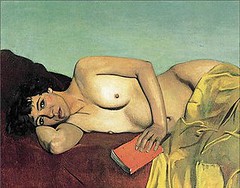
Félix Vallotton "La Lecture abandonnée" (1924)

“Where are you going?”

He answers:

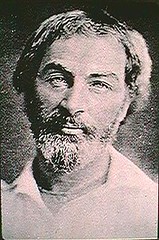
Probably 1854. Daguerreotype. Photographer unknown probably Gabriel Harrison

“To the Great Exhibition in London. I took your copy of The Stones of Venice , I hope that’s alright?”

“I booked a ticket with Cook

She shouts:

(Melo)dramatic scenes in painting

“Don’t leave me now!” – “Where are you going?”

He answers:

Probably 1854. Daguerreotype. Photographer unknown probably Gabriel Harrison

“To the Exposition Universelle in Paris. I took your copy of Walt Whitman‘s I Sing the Body Electric, I hope that’s alright?”


*Thomas Cook was a British travel agent, born exactly 200 years ago today. He commodified the Grand Tour and invented tourism as we know it today. He gave you a A Room with a View in Tuscany. His guide books contributed to the concept of the armchair traveler.