Fanny Hill @ 260
“…and now, disengag’d from the shirt, I saw, with wonder and surprise, what? not the play-thing of a boy, not the weapon of a man, but a maypole of so enormous a standard, that had proportions been observ’d, it must have belong’d to a young giant. Its prodigious size made me shrink again; yet I could not, without pleasure, behold, and even ventur’d to feel, such a length, such a breadth of animated ivory! perfectly well turn’d and fashion’d, the proud stiffness of which distended its skin, whose smooth polish and velvet softness might vie with that of the most delicate of our sex, and whose exquisite whiteness was not a little set off by a sprout of black curling hair round the root, through the jetty sprigs of which the fair skin shew’d as in a fine evening you may have remark’d the clear light ether through the branchwork of distant trees over-topping the summit of a hill: then the broad and blueish-casted incarnate of the head, and blue serpentines of its veins, altogether compos’d the most striking assemblage of figure and colours in nature. In short, it stood an object of terror and delight.
But what was yet more surprising, the owner of this natural curiosity, through the want of occasions in the strictness of his home-breeding, and the little time he had been in town not having afforded him one, was hitherto an absolute stranger, in practice at least, to the use of all that manhood he was so nobly stock’d with; and it now fell to my lot to stand his first trial of it, if I could resolve to run the risks of its disproportion to that tender part of me, which such an oversiz’d machine was very fit to lay in ruins.”
Fanny Hill is a fictional character which debuted in 1748 in the novel of the same name as its titular character. Memoirs of a Woman of Pleasure as it was originally titled is a novel presented as a memoir (see literary mystification) by John Cleland, written in 1748 while Cleland was in debtor’s prison in London (see also: literature written in prison), often called the first pornographic novel, it has become a byword for the battle of censorship of erotica.
[Youtube=http://www.youtube.com/watch?v=zCuwz9ckm54]
“How should you like to be a virgin again, Fanny?”
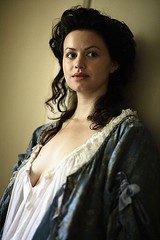
The novel was adapted for film several times, most recently in the Andrew Davies-directed BBC serial in 2007. Andrew Wynford Davies (born 1936) is a British author and screenwriter. His film and television adaptations include Othello (2001), Moll Flanders (1992), The Chatterley Affair and Fanny Hill (2007), where Rebecca Night is Fanny Hill.
The book concerns the titular character, who begins as a poor country girl who is forced by poverty to leave her village home and go to town. There, she is tricked into working in a brothel, but before losing her virginity there, escapes with a man named Charles with whom she has fallen in love. After several months of living together, Charles is sent out of the country unexpectedly by his father, and Fanny is forced to take up a succession of new lovers to survive.
What is remarkable and innovative about the novel is that Cleland’s writing style is witty, learned, and full of Classical asides. Also, Fanny herself does not, like Roxana or Moll Flanders, repent. She has no remorse for her education in sex, although she does realize that she is being exploited. Further, Fanny acts as a picara: as a prostitute she shows the wealthy men of the peerage at their most base and private . Samuel Richardson and Daniel Defoe had written about women forced into compromised situations before, and they had hinted graphically enough that the subversive and erotic context was present, but neither made their heroines women of pleasure. Neither of them imputed to their women any joy in their situation, whereas Cleland does.
The novel satirised the literary conventions and fashionable manners of 18th century England, it was more scandalous for depicting a woman, the narrator, enjoying and even reveling in sexual acts with no dire moral or physical consequences. The text is hardly explicit as Cleland wrote the entire book using euphemisms for sex acts and body parts, employing 50 different ones just for the term penis. Two small earthquakes were credited to the book by the Bishop of London and Cleland was arrested and briefly imprisoned, but Fanny Hill continued to be published and is one of the most reprinted books in the English language. However, it was not legal to own this book in the United States until 1963 and in the United Kingdom until 1970.
An obscenity trial of an unexpurgated edition of Fanny Hill in Denmark in 1964 led to the conclusion that pornography was not harmful to adult readers. Pornography was subsequently decriminalized, first in Denmark, the rest of Scandinavia following suit.
This decision influenced obscenity and pornography laws in the United States, because some of the Danish findings (most prominently the work of Dr. Berl Kutchinsky) were republished in the first Presidential Report on Obscenity and Pornogarphy, the so-called Lockhart report.
On March 21 1966, the United States Supreme Court ruled in Memoirs v. Massachusetts that the previously banned novel “Fanny Hill” did not meet the Roth standard for obscenity.
Fanny Hill is — along with Robinson Crusoe (1719), Pamela (1740), Dom Bougre (1741), Le Sopha, conte moral (1742), Thérèse Philosophe (1748), Les Bijoux indiscrets (1748), Tristram Shandy (1760-1770), The Castle of Otranto (1765), Les Liaisons dangereuses (1782), The 120 Days of Sodom (1785), The Mysteries of Udolpho (1794), La Religieuse (1796), The Monk (1796), L’Histoire de Juliette (1797) — one of the undisputable instances of 18th century cult fiction, and central too any serious study of 18th century literature.
There is so much too say about Fanny, I’ll summarize it in a tag cloud:
- 1001 Books You Must Read Before You Die, Erotic literature, Memoir, European erotica, History of erotic depictions, British erotica, 18th century in literature, Erotomania, Memoirs v. Massachusetts, Whore dialogue, Sexual revolution in Scandinavia/Notes, The Secret Museum: Pornography in Modern Culture, Characters in The League of Extraordinary Gentlemen, Literature written in prison, Jahsonic’s literary canon, Preponderance of female characters, The Lustful Turk comparison to Fanny Hill, A maypole of so enormous a standard, Novel presented as a memoir‘
Let me end with an excerpt, that shows the beauty of the purple prose
“[t]here alone she existed, all lost in those delirious transports, those extasies of the senses, which her winking eyes, the brighten’d vermilion of her lips and cheeks, and sighs of pleasure deeply fetched, so pathetically express’d. In short, she was now as mere a machine as much wrought on, and had her motions as little at her own command as the natural himself, who thus broke in upon her, made her feel with a vengeance his tempestuous tenderness, and the force of the mettle he battered with; their active loins quivered again with the violence of their conflict, till the surge of pleasure, foaming and raging to a height, drew down the pearly shower that was to allay this hurricane.” —Fanny Hill
… and point you in the direction of some valuable remarks on slowed down time in literature:
Colin Wilson aptly observes in the The Misfits: A Study of Sexual Outsiders how John Cleland in Fanny Hill had succeeded to slow down time by which he meant that “the time it takes to read [some scenes] is obviously a great deal longer than the time it took to do.” He goes on to describe how Richardson had done the same in Pamela and Clarissa, assuming that
“Pamela and Clarissa became so real to the reader’s imagination that we want to linger. A century and a half later, Marcel Proust will carry the same assumption to extraordinary lengths, virtually persuading the reader to abandon his normal sense of time. No writer before the time of Richardson would have dreamed of attempting such a feat: Cervantes, Lesage, Defoe, all relied on a profusion of incident to hold the reader’s interest. –page 84.
Richardson and Cleland had the excuse that their era was pre-cinema, Proust wrote his most time-oriented work in In Search of Lost Time (1913 -1927) when cinema was already happening, but not during the sound film era. Is this kind of writing, which slows down time, still done? And how has cinematic time influenced time in literature?
See also: literary technique