René Magritte @110

René Magritte (1898 – 1967) was a Belgian painter, with Paul Delvaux the best-known representative of Belgian Surrealism.

He became well known for a number of witty images and the use of self-referentiality in such works as The Treachery Of Images (This is not a pipe (Ceci n’est pas une pipe), the best illustration to the concept of the map is not the territory.

His work frequently displays a juxtaposition of ordinary objects in an unusual context, giving new meanings to familiar things (see recontextualization). The representational use of objects as other than what they seem is typified in his painting, The Treachery Of Images (La trahison des images), which shows a pipe that looks as though it is a model for a tobacco store advertisement. Magritte painted below the pipe, This is not a pipe (Ceci n’est pas une pipe), which seems a contradiction, but is actually true: the painting is not a pipe, it is an image of a pipe. (In his book, This Is Not a Pipe, French critic Michel Foucault discusses the painting and its paradox.) Mention of This Is Not a Novel by David Markson is also in place here.

All this is conveniently known and one should also point to Magritte predilection for the bowler hat.

Most of the work of Magritte strikes as profoundly unerotic, cerebral and situated to the wrong side (left brain) of the twentieth century art faultline, but appearances deceive.

Attempting the Impossible (1928) [1]
Les Amants / The Lovers. (1928) [2]
Le Viol (1934) – René Magritte [3][4]
Collective Invention (1934) [5]
Les Bijoux Indiscrets (1963) [6]

Many of these works hint at tainted and thwarted love and eroticism, skewed by a desire for paraphilic love and expression. There are hints of pygmalionism, attraction to independent body parts, rape and sensory deprivation. Unlike his contemporary André Masson, Magritte never takes on these subjects head-on, fodder for psychosexual interpretations which would conclude: repressed sexuality.

Alain Robbe-Grillet‘s  La Belle captive.

New to me in the 2000s was Alain Robbe-Grillet’s cinematic take on the sophistry of Magritte. Grillet managed to eroticize the unspoken eroticism of Magritte in his film La Belle captive.

In 1983 Grillet releases his feature film La Belle captive in a production by Anatole Dauman‘s Argos Films.

The film is named after a painting by René Magritte, and is also the name of a 1975 photonovel of La Belle Captive: A Novel written by Robbe-Grillet and illustrated with Magritte’s paintings. To complicate things still further “La Belle Captive” is an extended series of over a dozen paintings, worked on during four decades, with its primary subject the easel, suggesting art and reality held captive. In the case of the film, Grillet chose to interpret the title of the film literally by playing on the trope of the damsel in distress.

To be disovered remains the 1955 documentary film Magritte by Belgian filmmaker and cultural anthropologist Luc de Heusch.
Introducing “At Her Discretion”

Introducing “At Her Discretion.”

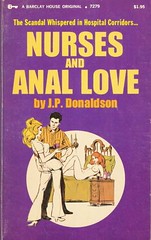
Nurses and Anal Love

pulp fiction cover

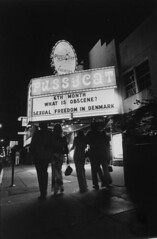
What is obscene

Life Magazine photo of unidentified theatre advertising Pornography in Denmark

http://atherdiscretion.tumblr.com/

At her discretion is an Anglophone visual culture blog, self-described as “The vintage, the modern, the strange and erotic. It’s sometimes NSFW.” It’s very prolific and highly entertaining.

Some notable blogs include BibliOdyssey, A Journey Round My Skull, Femme Femme Femme, Hugo Strikes Back, ponyXpress, John Coulthart‘s Feuilleton and Adventures in the Print Trade.

Il Giornale Nuovo was one of the most renowned but has been defunct since 2007.

Tip of the hat to Paul Rumsey.

Tracing the European avant-gardes in intimate detail

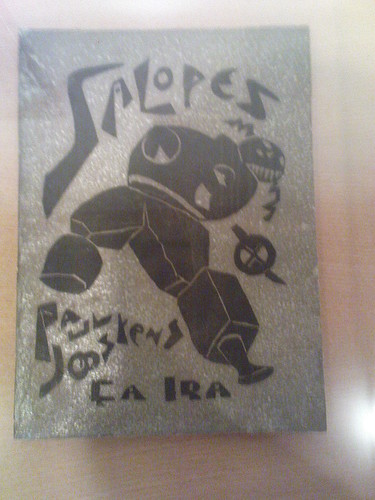
Salopes by Paul Joostens by you.

“Salopes ou le quart heure de rage au soleil” by Paul Joostens

Part of the fun of having my own wiki is being to able to trace the things I find in intimate detail and thus not only arriving (as in this case) at the Antwerp underground, the Belgian avant-garde and abstract art in Belgium but eventually arriving at a European and even worldwide encyclopedia of the avant-gardes.

What came before.

Three weeks ago I discovered a cover illustration by Paul Joostens entitled Salopes (bitches in French) published by Belgian avant-garde publisher Ca Ira!.

Today I finished my entry on Ca Ira!, a who’s who of the Belgian avant-garde.

Ca Ira! was an Antwerp based Belgian publisher who published Clément Pansaers‘s L’apologie de la paresse [1] in 1922. The title Ça ira comes from a song of the French Revolution (Ah! ça ira, translated as: “We will win!”).

Ca Ira! also published work by Paul Neuhuys, Han Ryner, Paul Colin, Céline Arnauld, Picabia, René Arcos, Wies Moens, Charles Plisnier, Romain Rolland, Theo Van Doesburg, Stendhal, Pascal Pia, Renée Dunan, Frans Masereel, Piet Mondriaan, André Salmon and Jean Cocteau.

Ca Ira! was also the title of a monthly magazine that featured avant-garde art, literature and politics. It was founded by a group of young artists, who came out of the smoking war-wrecked world of 1919 with a new élan. Twenty editions were published between April 1920 and January 1923 under the direction of Maurice van Essche, Paul Neuhuys and Willy Koninckx.

The members (many of whom later achieved great fame and notoriety) included Paul Colin, Theo van Doesburg, the young poet Maurice Van Essche, Abel Lurkin, Paul Neuhuys, Arthur Pétronio, Charles Plisnier, Han Ryner, while very appealing dada and expressionist woodcuts and linotypes were added by Floris Jespers, Paul Joostens, Frans Masereel, Jan Cockx, Jozef Cantré, Karel Maes and Jozef Peeters. One finds incidental contributions by Paul Van Ostaijen, Paul Éluard, Francis Picabia, Ezra Pound, Iwan Goll, Blaise Cendrars and Lajos Kassák.

Guy Peellaert (1934 – 2008)

Guy Peellaert is dead.

JodelledePeellaert by you.

Les aventures de Jodelle by Peellaert

Guy Peellaert (April 6 1934 in Brussels, Belgium, 17 November 2008, Paris) is a Belgian artist, graphic designer, painter and photographer, best-known for his vinyl album cover designs of the 1960s and 1970s, such as Diamond Dogs by David Bowie.

He debuted as a theater set designer but first made his mark as comic book creator. His style was evidently inspired by the psychedelic and Pop art aesthetics celebrated in the 1960s (see Hapshash and the Coloured Coat in the UK).


Elvis Presley by Guy Peellaert by Fluffy Kitten Mittens

From : Rock Dreams, Albin Michel, Paris,1974

[Amazon.com]
[FR] [DE] [UK]

His graphic novel Les aventures de Jodelle appeared in Hara-Kiri. Éric Losfeld published it in book version in 1966. The heroine protagonist Jodelle was styled after French singer Sylvie Vartan). Peellaert followed up with a second version, co-written with Pascal Thomas for a new heroine, Pravda, la survireuse (this time the French singer Françoise Hardy served as a model). 35 years later, the couturier Jean-Charles de Castelbajac would use the imagery of Pravda and Jodelle for his collection Physical graffiti in 2001.

Most recently, Peellaert did a series of photo-collages on Belgian popular music for Belgian magazine Focus Knack.

[Youtube=http://www.youtube.com/watch?v=rmtD6dkwZqI]

Jeu de massacre by Alain Jessua

He also designed the French Pop art film Jeu de massacre film by Alain Jessua, with music by The Alan Bown Set.

Ennio De Concini (1923 – 2008)

Ennio de Concini is dead

Ennio De Concini (19232008) was a prolific Italian screenwriter and film director, winning the Academy Award in 1962 for his screenplay for Divorce, Italian Style. He achieved cult notoriety with Europa di notte (1959) and Bava‘s Black Sunday (1960).

La Maschera del demonio / Black Sunday (1960) – Mario Bava [Amazon.com]

La Maschera del demonio/Black Sunday (1960) – Mario Bava [Amazon.com]
image sourced here.

Maschera del demonio, La/Black Sunday (1960) – Mario Bava [Amazon.com]
image sourced here.

Black Sunday (Italian title: La maschera del demonio) is a Italian gothic horror film directed by Mario Bava, from a screenplay by Ennio de Concini and Mario Serandrei, based very loosely on Nikolai Gogol’s short story “Viy”. The film stars Barbara Steele. It was Bava’s directorial debut, although he had helped direct several previous feature films without credit.

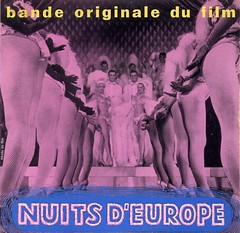
Europa di Notte soundtrack by Jahsonic

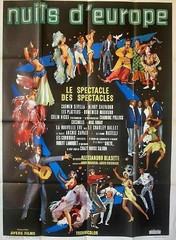
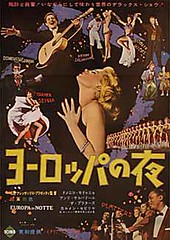
Europa di Notte by JahsonicEuropa di Notte Japanese poster by Jahsonic

Europa di notte (Nuits D’Europe/Europe by Night) is a 1959 Italian film directed by Alessandro Blasetti, written by Ennio De Concini and Gualtiero Jacopetti. This documentary in the “sexy” “mondo” genre is a potpourri of contemporary nightclub and striptease acts recorded all over Europe, including the Crazy Horse Saloon in Paris. Stripteaseuses Dolly Bell, Lily Niagara and Carmen Sevilla are credited. The soundtrack of the film featured “Dans mon île[1] by French singer Henri Salvador, an early influence on the emerging bossa nova style. Scenes of the film are also featured in Do You Remember Dolly Bell?, the first feature film directed by Emir Kusturica.

Colin Hicks & The Cabin Boys appeared in the Italian film Europa di notte (Europe By Night / Nuits D’Europe ) with Giddy Up a Ding Dong[2]

Joris Ivens @110

Joris Ivens @110

Misere au borinage by Ivens and Storck

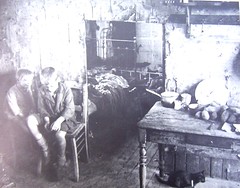
Misère au Borinage

Joris Ivens (18981989) was a Dutch documentary filmmaker and devout communist. He is internationally known as a foremost documentarist of the early twentieth century, noted for his co-direction of the political film Misère au Borinage, which I had the pleasure of screening in class last year.

Borinage is noteworthy in media theory because it proves the inherent ficticiousness of the documentary film.

Like most documentaries, it mixes reality and fiction, and in this case, contrary to authorial intention. For the film, the two directors had arranged a manifestation with extras from the Borinage. The miners were to walk behind a portrait of Karl Marx. The police mistook it for a real manifestation, they intervened and the “protest” was dispersed. This was filmed by Ivens and Storck.

It would cause Walter Benjamin to write in The Work of Art in the Age of Mechanical Reproduction:

“Similarly, the newsreel offers everyone the opportunity to rise from passer-by to movie extra. In this way any man might even find himself part of a work of art, as witness Vertov‘s Three Songs About Lenin or Ivens Borinage.”

Foretelling Andy Warhol’s famous 15 minutes dictum, Benjamin added that “Any man today can lay claim to being filmed.”

[Youtube=http://www.youtube.com/watch?v=d4mvpRDp6wk&]

Rain, accompanied by unknown beats.

If Borinage is a Blakean dystopianand did those feetanti-industrialization document, Ivens also made Rain, a much more impressionist affair, generally considered a “city symphony,” a loosely outlined genre typified by Manhatta (1921) and Berlin: Die Sinfonie der Großstadt, (1927).

There was a tremendous fascination with the metropolis, the big city during the 1920s and 1930s, dubbed fittingly for this context, as the Machine Age. Mostly associated with visual culture such as the decorative style Art Deco, the arts movement Cubism, Streamline Moderne appliance design and architecture and Bauhaus style; there were also the films including Chaplin’s Modern Times and Lang’s Metropolis.

Often overlooked are the “city novels,” mostly labeled a modernist subgenre but in reality as old as the novels of Charles Dickens. For our purpose I include Rainer Maria Rilke’s The Notebooks of Malte Laurids Brigge (1910), John Dos Passos‘s Manhattan Transfer (1925), Alfred Döblin’s Berlin Alexanderplatz (1929), James Joyce’s Ulysses (1922) and T. S. Eliot’s vision of London in The Waste Land (1922). Especially John Dos Passos‘s Manhattan Transfer (1925) is of importance here as it offers the most positive view of the dynamics of speed, the modern way of life and the unavoidable fragmentation of existence.

While writing this post, the painting below was constantly on my mind. Paris in the rain. That why Paris invented arcades, and Benjamin could write about the romantic mediatic aspects of the city.

Gustave Caillebotte: Urban Impressionist (1995) – Anne Distel
[Amazon.com]
[FR] [DE] [UK]

François Caradec (1924 – 2008)

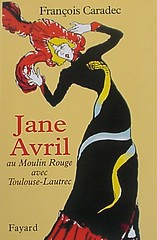
Jane Avril by  François Caradec

François Caradec is dead. “Oh no,” shouts Jane Avril

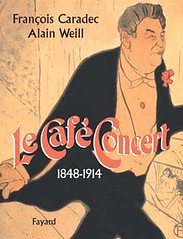
Cafe concert by Caradec

“We’ll see about that,” says the café concert visitor

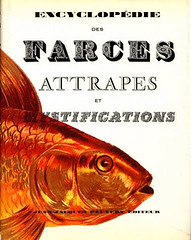
Encyclopédie des FARCES et ATTRAPES et des  MYSTIFICATIONS

“It’s not a farce,” says the book that ought to know

François Caradec (Quimper, 1924November 13, 2008) was a French 20th century writer, biographer and historian of French popular culture and the history of the comic book in particular. He was a member of the Oulipo and a regent in the Collège de ’Pataphysique. He is the co-author of the history of farces, Encyclopédie des farces et attrapes et des mystifications.[1].

He wrote biographies on Lautréamont, Alfred Jarry, Raymond Roussel (translated by Ian Monk for Atlas Press), Alphonse Allais, Henry Gauthier-Villars, Le Pétomane and Jane Avril.

Hauntology and Burial Mixes

[Youtube=http://www.youtube.com/watch?v=68RrcW3yVjY&]

“What a Mistry ” Tikiman

Hauntology is a concept in nascent state (to borrow a term from Francesco Alberoni). That’s why it is still flexible. Any good music with the word “burial” in it deserves to linked with the concept. Not including Basic Channel‘s Burial Mixes has been an oversight. I just set that straight. (within 15 minutes from time of posting, check Google)

Some background info on Basic Channel and its reggae releases labeled Burial Mix. If Wackies Records is the natural heir to Lee Perry (the same laid-back percussion, flying cymbals en relaxed groove), then the Burial Mix releases are the natural heirs to Wackies. There, we’ve just connected the 1970s to the 2000s

Some obliquely related burial imagery:

Tomb of Pompeii by Jean-Baptiste Tierce, 1766

Tomb of Pompeii by Jean-Baptiste Tierce, 1766

Cenotaph for Newton (1784) by French architect Étienne-Louis Boullée

Cenotaph for Newton (1784) by French architect Étienne-Louis Boullée

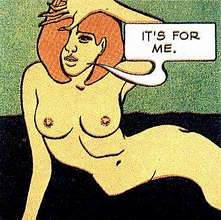
Gratuitous nudity #14

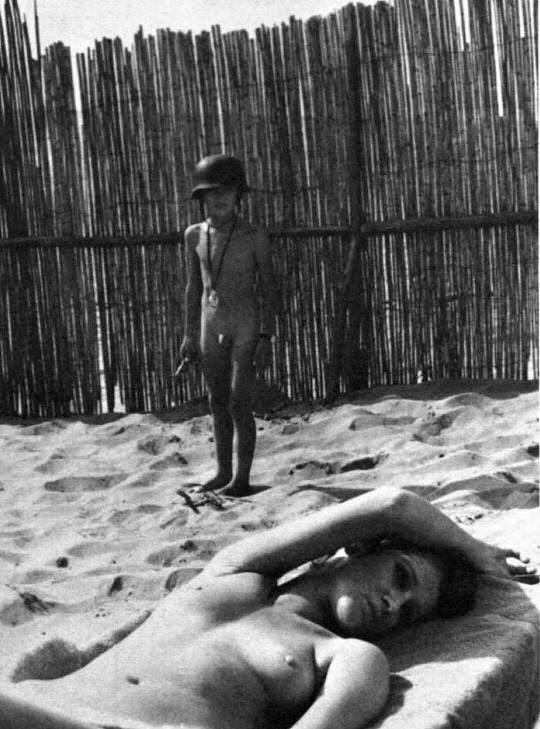
My previous post provides me with an opportunity to provide you with a new instance of gratuitous nudity: a beautiful still from Africa Addio.

Africa Addio (1966) – Gualtiero Jacopetti, Franco Prosperi
Image sourced here. [Dec 2005]

Africa Addio is a 1966 Italian documentary film about the decolonization in Africa. It was shot over a period of three years, by Gualtiero Jacopetti and Franco Prosperi, two Italian filmmakers who had gained fame a few years earlier (with co-director Paolo Cavara) as the directors of Mondo Cane in 1962. The image was taken from the Captain Trash[1] site somewhere in 2005. This site is a treasure trove of “trash culture“. See its Google gallery here. See for example this image, of which I do not know the provenance.

Any similarity to any person, event, or institution is intentional and anything but coincidential

In search of intentional and unintentional similarities in fiction

[Youtube=http://www.youtube.com/watch?v=CrV1sfJHLHg]

Addio Zio Tom (Goodbye, Uncle Tom) (1971) by Gualtiero Jacopetti and Franco Prosperi

“All events, characters and institutions in this motion picture are historically documented and any similarity to any person, black or white, or to any actual events, or institutions is intentional and anything but coincidential.” –from the credits to Goodbye Uncle Tom, see fictionalization and fiction disclaimer.

Thus opens or closes Goodbye Uncle Tom of which a clip is listed above and it provides an excellent introduction to the tenuous relation between fiction and reality.

Addio zio Tom (1971) – Gualtiero Jacopetti, Franco Prosperi
Image sourced here. [Dec 2005]

Two more quotes provide further food for thought:

“It’s no wonder that truth is stranger than fiction.” Fiction has to make sense – Mark Twain
“The mind of man can imagine nothing which has not really existed.” —Edgar Allan Poe, 1840

If we represent the relationship between fiction and reality on a sliding scale we find on the left hand side: fiction which makes no claim to reality. This kind of fiction is nowadays always preceded by the fiction disclaimer:

“Any resemblance to persons living or dead is purely coincidental.”

The above is sometimes preceded by “The characters in this film are fictitious,”.

This kind of fiction is helped by Poe’s quote in its theoretical approach. If done well, this kind of fiction is called the fantastique, that area of literary theory which provides us with an unresolved hesitation as to our position on the reality/fictitiousness scale. Another growth of this kind of fiction is the roman à clef a novel and by extension any sort of fiction describing real-life events behind a façade of fiction. The reasons an author might choose the roman à clef format include satire and the opportunity to write about controversial topics and/or reporting inside information on scandals without giving rise to charges of libel.

On the right hand side of the scale we find fiction that does make claim to reality. This kind of fiction is nowadays usually preceded by the claim based on true events:

This kind of fiction is helped by Twain’s quote in its theoretical approach. Real stories are often so unbelievable that we need to make the claim that they are based on actual events.

As a narrator of fiction, one is always aided by this claim to capture the audience’s interest. This is true in the case of a joke (tell it as if it has happened to you), in the case of novels (Robinson Crusoe was soi-disant based on actual events) and film (Texas Chainsaw Massacre (1974) was supposedly about Ed Gein)

A whole range of concepts falls into this category, listed under the heading fictionalization: faction, based on a true story, false document, nonfiction novel, true crime (genre), histories (history of the novel), stranger than fiction and mockumentary.

The funny thing about the right hand position on the fiction/reality scale is that the act of narrating alters reality by default. I always illustrate this point by going back to your youth. You had a brother or sister and you fought with him over something. You went to your mother or father or any other judge-figure, who gave you both the opportunity to tell the story. You both came up of course with a different version.

Which brings me to the Heisenberg uncertainty principle and the observer effect. If the act of perception alters reality, the act of telling a story alters reality. That is why I dislike films such as Schindler’s List because in this case, “real” documentary material is available. Maybe this is also the case for Goodbye Uncle Tom, but boy, I sure would like to see that film.