Mitch Mitchell (1947 – 2008)

RIP Mitch Mitchell

[Youtube=http://www.youtube.com/watch?v=jmFhgpL_rQY]

Voodoo Child (Slight Return)

John “Mitch” Mitchell (July 9, 1947 November 12, 2008) was an English drummer, best-known for his membership in The Jimi Hendrix Experience. Mitchell was known for his work on such songs as “Manic Depression” (a 3/4 rock waltz that finds Mitch playing a driving afro-cuban inspired beat), “Voodoo Child (Slight Return)[1], “Fire” and “Voodoo Chile” (a deep blues groove with subtle hi-hat). Mitchell came from a jazz background and like many of his drummer contemporaries was strongly influenced by the work of Elvin Jones, Max Roach, and Joe Morello.

Mitchell pioneered a style of drumming which would later become known as jazz fusion. Alongside Hendrix’s revolutionary guitar work and songwriting, Mitchell’s playing helped redefine rock music drumming.

Electric Ladyland cover, photo by David Montgomery

The death of Mitch gives me the opportunity to discuss the photo on Electric Ladyland, one of my alltime favourite record covers. The photo depicts nineteen nude women lounging in front of a black background.

“The cover was put together by Chris Stamp and Track Records art director David King while Hendrix was in the US. Stamp sent King and photographer David Montgomery down to the Speakeasy to round up some girls, with the brief to make them look like “real people. At £5 a head (or £10 with their knickers off) this sounds like authentic Stamp.” —33⅓ on Electric Ladyland by John Perry[2].

One of the 19 girls, Reine Sutcliffe, told the music paper Melody Maker:

“It makes us look like a load of old tarts. It’s rotten. Everyone looked great but the picture makes us look old and tired. We were trying to look too sexy, but it didn’t work out.”

British visual culture connoisseur Stephen Bayley adds:

“The concept was fully in accordance with the spirit of the Sixties: at the same time Harry Peccinotti and David Hillman had done a memorable photo feature for Nova magazine” –The Independent on Sunday, July 16, 2006 by Stephen Bayley[3]

I’m afraid I can’t agree with miss Sutcliffe on this matter. I find the realism in this photo not enticing but more than fascinating nonetheless, though I also admit I empathize about denying her five minutes of glamourous fame.
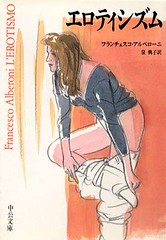
L’erotismo by Francesco Alberoni (1986)

L'erotismo by Francesco Alberoni by Jahsonic

Looks like Japanese translation of L’erotismo

I started reading Francesco Alberoni‘s L’erotismo (“Eroticism”, 1986). I discovered Alberoni through de Botton when I read Essays in Love, Alberoni’s predecessor is a cult item.

The main discourse of the book is difference between female and male feelings for eroticism along the continuity/discontinuity axis, an approach I believe first explored by Georges Bataille, although Alberoni invokes Pascal Bruckner and Alain Finkielkraut (Le nouveau désordre amoureux).

It also mentions a 1894 funny study by Francis Galton on skin sensitivity in women and men: The relative sensitivity of men and women at the nape of the neck.

The book is well-informed and references Nina Baym (mother of Nancy Baym) and her work on women’s fiction and female reading and writing practice (and the mishistoriography thereof). It equates female pornography with the novels of Barbara Cartland and her equivalents in Europe (Liala in Italy and Delly in France).

Also mentioned are Helen Hazel, the author of Endless Rapture: Rape, Romance and the Female Imagination[1], a work on the rape fantasy (bodice rippers), and Opus Pistorum by Henry Miller (but actually ghost-written by female writer and entrepreneur Caresse Crosby.

And I’ve only read 10 pages.

Dare I say one of the more interesting works on eroticism to have crossed my hands?

P. S. I’m reading a Dutch translation, I’m not sure if L’erotismo has been translated into English.

In praise of compilations


[Amazon.com]
[FR] [DE] [UK]

One of the best CDs in my collection is Nova Classics 01. I am not much of an album man, so my entire collection nearly consists of CD comps (besides my record collection, which is mainly twelve inch singles).

Over the summer, when we were in Nocito I was joined by friends and I had the Nova Classics 01 with me.

So this friend really liked it and two weeks ago I proposed that I’d buy it for her. The prices were incredibly high however and I was lucky to find a copy for 20USD in the states, because the prices were between 50USD and 290USD.

The good news for you my friends, is that I’ve managed to track down YouTube version of 12 out of the 17 songs.

Enjoy by clicking the numbers.

My inner werewolf

The Howling (1981) – Joe Dante [Amazon.com] [FR] [DE] [UK]

I woke up yesterday night bathing in sweat. I get up. I look outside, full moon. That explains. My inner werewolf was trying to get out.

So I give you Joe Dante‘s The Howling, IMNHO the best werewolf film since WWII. Dante was an alumnus of Roger Corman, for whom I have an excessively soft spot. The film is WCC #71.

Introducing Adventures in the Print Trade

Introducing Adventures in the Print Trade[1] by British writer Neil Philip, who currently has a post on Degenerate Art during Nazism, a fave subject of mine, illustrating the beneficial side effects of censorship best illustrated by Lichtenberg:

“The book which most deserved to be banned would be a catalogue of banned books.” —Georg Christoph Lichtenberg, Aphorisms (G 37 in R. J. Hollingdale‘s translation and numeration)

Neil, author of Adventures in the Print Trade, begins his post thus:

“In 1929, the artist Richard Lindner, whose work can be considered the bridge between Cubism, Surrealism, and Pop Art, was appointed art director of the Munich publishing house of Knorr and Hir. Lindner remembered, “I saw Hitler every day in Munich at the Café Heck, a small café with about ten tables and thirty seats… Hitler used to sit there every day at his usual table. Our table was beside his and we knew each other because we avoided direct contact… He always wanted to be with artists.”[2]

The Window, 1958 Original lithograph by Richard Lindner [3]

Child’s Head, 1939 Original lithograph by Paul Klee [4]

Le Jardin d’Amour, 1981 Original silkscreen by Herbert von Arend [5]

Aus de Walpurgisnacht, 1923 Original woodcut by Ernst Barlach [6]

Woodcut for 10 Origin, 1942 Original woodcut by Wassily Kandinsky [7]

Untitled, 1979 Original lithograph by Boris Herbert Kleint [8]

Maschinenwerkstätte, 1921 Original lithograph by Lili Réthi [9]

Fabulously original, my only and usual gripe is that, art blogs should use Flickr or a similar service.

RIP Miriam Makeba

RIP Miriam Makeba

[Youtube=http://www.youtube.com/watch?v=85_9mKTg_Do]

Live version of “Pata Pata

South African singer Miriam Makeba died yesterday while touring in Italy. She was 76 and best-known for being a vocal anti-apartheid activist, her 1967 song “Pata Pata[1][2] and her marriages to fellow country trumpeter Hugh Masekela and American “Black pride“/”Black Power” activist Stokely Carmichael.

Pata Pata” is a musical composition recorded by South African singer Miriam Makeba and released in 1967 on Reprise Records.

“Pata Pata” was co-written by Miriam Makeba and Jerry Ragovoy. After Makeba was signed to Warner/Reprise Records and published her first singles, the record company needed several songs to finish a Makeba album. Legend has it that she had told Reprise she wanted to do ballads, so they put her together with Jerry Ragovoy, the R&B writer/producer who was on staff at Warner Brothers at the time. Not being familiar with her, the night before their first recording session, he went to see her in a club in Greenwich Village, where she did a show comprised completely of African folk music. He was captivated to the point that, the next day, he just had Makeba and her sister sing a number of the songs into a tape recorder. One of them became “Pata Pata.”

[Youtube=http://www.youtube.com/watch?v=Pygqt0uwnuc&]

Studio version of “Pata Pata

The song was covered by Osibisa and Percy Faith.

In her political activism, Makeba reminds me of Fela Kuti and most of all, Josephine Baker.

Ennio Morricone @ 80 II

[Youtube=http://www.youtube.com/watch?v=f7Nw_yEh6G0&]

Se telefonando” (1966) by Mina (for previously unreleased footage of Mr. Stein, scrub to 0:39.)

“The extraordinary thing about “Se telefonando” is that it has everything which is expected from a song: verse, structure and melody. Yet it also, very subtly, negates these qualities. The musical elements are reduced to handful of spiraling notes.” —Sholem Stein

Tim Lucas also had the birthday of Ennio Morricone on his mind today and wrote:

“I recently posted here about Morricone’s soul-stirring pop song “Se telefonando,” which comes as close to his own standards of perfection as anything else I’ve heard — but it’s not film music. It was only within the past year or so that I finally heard something else from Morricone’s catalogue that I believe — in its romanticism, melancholy, majesty and drama — stands as a true equal to the likes of such outstanding OUATITW tracks as “Jill’s America[1] or “Man with a Harmonica.”[2] That cue is “Amore come dolore” (“A Love Like Sorrow”), a haunting 6:10 piece from Luciano Ercoli‘s 1970 giallo thriller Le foto proibite di una signora per bene[3].[4]

This is a quote from the “previous post” Lucas referred to:

“No less a musical authority than FILM SCORE MONTHLY‘s John Bender considers this song, written by Ennio Morricone and performed by Mina Mazzini, to be the most sublime few minutes in the history of pop music.”[5]

[Youtube=http://www.youtube.com/watch?v=uKSuG1LOaYI&]

Se telefonando” (1966) by Mina

I agree with both Tim and John, “Telefonando” is on the list of my most cherished YouTube discoveries of the last few years.

[Youtube=http://www.youtube.com/watch?v=0cWzxJvgWc8]

Sunday Morning” (1966) by The Velvet Underground

What both Tim and John have not mentioned is the extraordinary similarity in the opening piano line of “Telefonando” with the opening “bell” line of The Velvet Underground‘s “Sunday Morning“, which was recorded and released a few months after “Telefonando” in that same year 1966.

Ennio Morricone @ 80

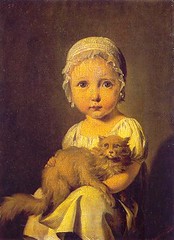
Boilly girl with kitten

Girl with kitten says: happy birthday Ennio. (2008)

Mondo Morricone is a series of three CDs featuring  original music by Ennio Morricone taken from cult Italian movies (1968-72). Cult Italian films include Spaghetti Westerns and giallo films such as What Have You Done to Solange?.

Mondo Morricone (1996) – Ennio Morricone [Amazon.com] [FR] [DE] [UK]

More Mondo Morricone (1996) – Ennio Morricone [Amazon.com] [FR] [DE] [UK]

Molto Mondo Morricone – Ennio Morricone [Amazon.com] [FR] [DE] [UK]

Ennio Morricone (born November 10, 1928; sometimes also credited as Dan Savio or Leo Nichols) is an Italian composer especially noted for his film scores. He has composed and arranged scores for more than 400 film and television productions, more than any other composer living or deceased. He is best known for the characteristic sparse and memorable soundtracks of Sergio Leone‘s spaghetti westerns A Fistful of Dollars (1964), For a Few Dollars More (1965), The Good, the Bad and the Ugly (1966) and Once Upon a Time in the West (1968), immediately recognizable due to Alessandro Alessandroni‘s whistling.

Ivan Turgenev @ 190

Ivan Turgenev @ 190

Great Short Stories of the World

I cannot find any interesting visuals for Turgenev, I gave up and give you the above, an ode to the short story. For what is a novel? Is it not a padded short story?

Ivan Turgenev (November 9, 1818September 3, 1883) was a Russian novelist and playwright best known for his novel Fathers and Sons. He popularized the concept of superfluous man in The Diary of a Superfluous Man (1850).

He also wrote short stories, such as The Mysterious Tales, some of which are collected in Fantastic Tales: Visionary and Everyday (Calvino) and Blood and Roses : Vampires in 19th Century Literature (Gladwell and Havoc). I just ordered the latter.