Icons of erotic art #8

Zygotic Acceleration, Biogenetic, De-Sublimated Libidinal Model (Enlarged x 1000) (1995) [1] is a sculpture by Jake and Dinos Chapman. It depicts lifesize fibreglass mannequins of children with genital organs of both sexes attached to their faces. It was shown at the Sensation exhibition in 1997, along with Great Deeds Against the Dead.

Sexual organs attached to faces is something I have been pondering on for as long as I can remember. What would have been the solution of the human race if this had been the case? How would we have covered the “pubic” area? How would lovemaking have looked like? This work by the Chapmans is remarkable, as is much of their other work. No doubt they are one of the most interesting contemporary artists.

In case you have been wondering why I only link to the pictures in this series, instead of showing the artworks in-line, the answer is that I keep a strict copyright policy after having had a run-in with my local copyright enforcement agency, SABAM, about two years ago. Since then, I only publish artworks by artists who have been dead for more than seventy years. Such is the law in Belgium. Belgian copyright law is even so strict that it prohibits to show photographs of buildings.

Hear it and weep

[Youtube=http://www.youtube.com/watch?v=QNGvlWHQCwc]

Elevator to the Gallows (1957) Louis Malle

The Miles Davis score to Elevator to the Gallows was recorded 50 years ago. It has been described by jazz critic Phil Johnson as “the loneliest trumpet sound you will ever hear, and the model for sad-core music ever since. Hear it and weep.”

Previously on this blog: As she stalks through the night …

Streetcar through the eyes of Stella

Streetcar

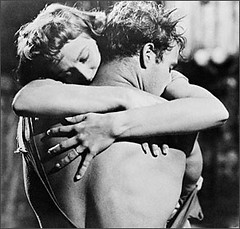
Kim Hunter (Stella) takes Stanley (Marlon Brando) back.

A Streetcar Named Desire is a 1947 play written by Tennessee Williams. It was both a critical and box office success. The story concerns a sexual triangle of Blanche DuBois—a pretentious, fading beauty; macho alpha male Stanley Kowalski, a rising member of the industrial, inner-city immigrant class; and Stella Kowalski, the submissive sister of Blanche.

Stella is a victim of domestic violence and often finds herself taking refuge at her neighbour Eunice’s home, only to return to Stanley when he cries for her to take him back. Blanche, who has arrived for a “visit”, is horrified by her sister’s situation and tries to convince Stella to divorce Stanley, but Stella refuses, bound to Stanley by sexual attraction and her pregnancy with his child.

The night Stella is having their baby, Stanley drunkenly happens upon Blanche and rapes her. This sends Blanche completely over the edge into a nervous breakdown, and Stanley forces Stella to send her off to a mental institution.

In some versions of A Streetcar Named Desire, Stella leaves Stanley after she finds out about the rape.

Milyunanochesco

Il Fiore delle mille e una notte/Arabian Nights (1974) – Pier Paolo Pasolini [Amazon.com]

Comparing Antoine Galland‘s and Richard Burton‘s translations of The Book of One Thousand and One Nights, Jorge Luis Borges wrote:

“Another fact is undeniable. The most famous and eloquent encomiums of The Thousand and One Nights – by Coleridge, Thomas de Quincey, Stendhal, Tennyson, Edgar Allan Poe, Newman – are from readers of Galland’s translation. Two hundred years and ten better translations have passed, but the man in Europe or the Americas who thinks of the Thousand and One Nights thinks, invariably of this first translation. The Spanish adjective milyunanochesco [thousand-and-one-nights-esque] … has nothing to do with the erudite obscenities of Burton or Mardrus, and everything to do with Antoine Galland’s bijoux and sorceries.” –Jorge Luis Borges, “The Translators of The Thousand and One Nights

The image above is from the 1974 film adaptation by Pasolini. It laterally depicts a nude man and woman facing each other. The woman sits, legs apart; the man kneels in front of her and points a bow to her genital area. The tip of the arrow has a phallus attached.

United Colors of Benetton

[Youtube=http://www.youtube.com/watch?v=V1fNsjx1R6I&]

One of the few interesting magazines to come out of the late 20th and early 21st centuries was Colors by Benetton. Their first ever issue in 1991 featured an unwashed newborn baby [1] . Here [2] is an overview of the first 60 issues.

Benetton is nowhere as big a brand today as it was in the 1980s and while I was not exactly taken with their clothes, I did like the ads. I don’t see a comparable contemporary brand such as Tommy Hilfiger kicking this century a conscience.

Benetton Priest kissing a Nun

The mood wasn’t always as serious though, witness this playful update of the nunsploitation theme to the 20th century: a priest kissing a nun.

Cult fiction #2

The Diceman (1971) – Luke Rhinehart

[Amazon.com] [FR] [DE] [UK]

The Dice Man is a comedic novel published in 1971 by George Cockcroft under the pen name Luke Rhinehart and tells the story of a psychiatrist who begins making life decisions based on the casting of dice. The novel is noted for its subversivity, anti-psychiatry sentiments and for reflecting moods of the early 1970s. Due to its subversive nature and chapters concerned with controversial issues such as rape, murder and sexual experimentation, it was banned in several countries. Upon its initial publication, the cover bore the confident subheader, “This book can change your life” and quickly became a modern cult classic.

Previous entries in this series.


World music classics #14

[Youtube=http://www.youtube.com/watch?v=S7dAxvj2mlU]

Rockit (1983) – Herbie Hancock

I believe I’d never seen the Godley & Creme video to this song before. What a strange affair. Definitely a work of the uncanny, celebrating disembodied body parts and general weirdness.

Also check one of my guilty pleasures: “I’m Not in Love” by 10cc. I love the soundscapes of that one.

See previous entries in this series.