-
Quick Study:
The English translation of Anti-Oedipus appeared in 1977. By a total coincidence — one that is really not much of a coincidence at all — so did (I Can’t Get No) Satisfaction
-
DC’s: Insidetheroar presents … Funk Day
* “Betty Davis is the funk,” says poet and rapper Saul Williams. “It’s not just that she’s sexy and the music is sexy, but she’s just so in the pocket! The notes she chose, the placement, to be able to dance around the music. Man, she killed that shit.”
-
Pruned: Brodsky & Utkin
For this slow, languorous Midwestern autumn Sunday, here are some Soviet Glasnost neoavant-garde paper architecture by Brodsky & Utkin.
-
xupacabras: Hommage a Balthus
Foto de Alexandre Maller
-
Ein Hungerkünstler
An Illustration for Kafka’s Ein Hungerkünstler (A Hunger Artist) by Andrzej Ploski, circa 1983,
Lequeu’s 250th anniversary
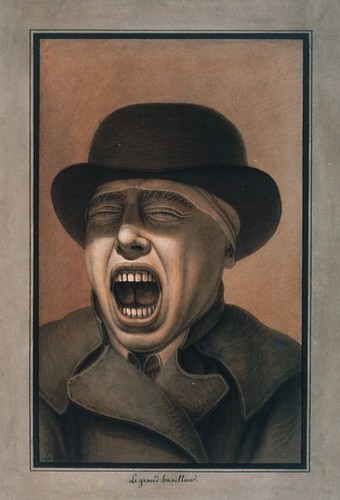
‘Le grand baailleur [sic],’ drawing by J-J Lequeu, from between
1777-1824 (Eng: the big yawner)
Jean-Jacques Lequeu (Rouen, September 14 1757 – 28 March 1826) was a French draughtsman and visionary architect. Today is his 250th anniversary.
Born in Rouen, he won a scholarship to go to Paris, but following the French revolution his architectural career never took off.
He spent time preparing the Architecture Civile, a book intended for publication, but which was never published. Most of his drawings can be found at the Bibliothèque nationale de France. Some of them are sexually explicit (Le Dieu Priape [1] (ca. 1779 – 1795) which shows a rather large male phallus and Trois images du sexe féminin) and are kept in the Enfer of the library. Most of these drawings have been reproduced in Duboy’s book but can also be found in Sade / Surreal.
Danish painting

Cypid and Psyche

Woman in front of Mirror (1841)

“Portrait of Anna Maria Magnani” (1814), I like her heavy gaze.
Work by Christoffer Wilhelm Eckersberg
Così fan tutte

All Ladies Do It/Così fan tutte (1992) – Tinto Brass [Amazon.com]
Così fan tutte, ossia La scuola degli amanti, (Eng: “They all do it” or “They are all like that”) opera buffa by Wolfgang Amadeus Mozart and a bawdy film by Tinto Brass. Mozart took as a theme “fiancée swapping” which dates back to the 13th century, with notable earlier versions being those of Boccaccio‘s Decameron and Shakespeare‘s play Cymbeline. Elements from Shakespeare‘s The Taming of the Shrew are also present. Furthermore, it incorporates elements of the myth of Procris as found in Ovid.
Although the title is usually translated into English as “They All Do It”, Italian speakers will notice that the word “Tutte” has a feminine ending on it. The title can thus be translated as “All Women Do It” (i.e. cheat), or even “Women are all the same”.
Elsewhere #2
-
WOEBOT: Conspicuous Consumption: The Swiss Road-show
-
Rendez-vous au Cabaret du néant – L’Alamblog
-
Morbid Anatomy: Cabaret du Néant (Tavern of the Dead) c.1890
-
BIZARRE (nouvelle série, n° 29-30, 2e trimestre 1963)– L’Alamblog (Tarzan issue)
-
Flickr: Photos from seasons in the black sun
- More by seasons:


- More by seasons:
-
Diableries by the Nonist
World dance music classics #6
[Youtube=http://www.youtube.com/watch?v=9yE-hUJYrvs]
Sueño Latino (1992) – Derrick May mix
Sueño Latino is an Italo disco duo from Italy, formerly known as Righeira. In 1989 they released a famous eponymous house–techno song Sueño Latino. The track is based on Manuel Göttsching‘s E2-E4. It was remixed by May in 1992. The track you hear here as in a post by Youtube user Tuneseeker is cut off during the drop out.
More Italo here.
See previous entries in this series.
World dance music classics #5
[Youtube=http://www.youtube.com/watch?v=-U-ppc4lYyg]
Miss You (1978) – The Rolling Stones
“Miss You” is a 1978 song by The Rolling Stones, from their album Some Girls. You need the twelve inch version.
The Rolling Stones disco years:
Several of the songs on 1976’s Black and Blue had boasted vague dance influences, and certain songs such as “Hot Stuff” were essentially compromises between Mick Jagger’s growing interest in contemporary dance music and Keith Richard’s obsession with reggae. “Miss You” was the first Rolling Stones single with prominent disco influences however, most noticeably in Charlie Watts‘ thumping, four-on-the-floor drum beat, and in Bill Wyman‘s funky, grooving bass-lines
See previous entries in this series.
Liquid Flesh and Café Sky
Broken Projector is holding a double bill blogathon. Being more of an archivist than a writer, I am not sure if I will write my entry for Liquid Sky /Café Flesh, especially considering that I have not seen either in its entirety. In an admitted extremely oblique way, Liquid Sky has already had its double bill on this blog: with a work by Eugène Atget.
The second significant artwork of the 20th century

The Fourth Estate, Il Quarto Stato (1901) – Giuseppe Pellizza da Volpedo
The second significant artwork of the 20th century is The Fourth Estate, a 1901 painting by Giuseppe Pellizza that depicts in – “MGM grandeur” – sepia-toned rows of handsome Italian workers marching toward a new dawn behind two men and a woman holding a baby.
This entry is part of a new series: “100 artworks that set the world on fire (while no one was watching)”, inspired by Wire’s 100 records that set the world on fire (while no one was listening).
See the previous entries here.
Informe, abjection and Robert Gober
Happy birthday Robert Gober. Google gallery.
I have found 35 useful sources for the informe, the abject, and religious purity, which tend to be related in current discourse. These terms are often seen as variations on a theme but should be considered as quite separate according to Rosalind Krauss (see October Winter 1993 and Krauss, 1997).
Three theorists appear in this discourse: Georges Bataile, Julia Kristeva, and Judith Butler.
The artists that have been associated with the informe, the abject, and the grotesque include Fontana, Joel-Peter Witkin, Robert Gober, John Miller, David Hammons, Cindy Sherman, Kiki Smith, Paul McCarthy, Mike Kelley and David Lynch. [1]