Yearly Archives: 2008

Daydreamt


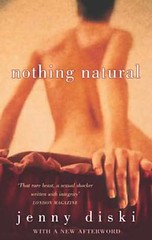
Nothing Natural by Jenny Diski

[Amazon.com]
[FR] [DE] [UK]

While reading Jenny Diski‘s Nothing Natural (1986) I daydreamt of publishing my own version of this 1980s version of the classic novel Gordon by Edith Templeton.

The Jahsonic edition had a cover photograph by American photographer Roy Stuart. It depicted either the “La Bonne” (the maid) scene — one of the most erotic scenes in contemporary erotica — or “The Wall” scenario, which is very similar (although with a reversal of gender) to a dream scene in Breillat‘s masterpiece Romance X.

My edition is rewritten to provide for more intelligent discourse and snappier metaphors, and the perspective is changed from Rachel to Joshua. Joshua being the voice of a post-war Sade.

Sonny Okosuns (1947 – 2008)

Sonny Okosuns (1947May 24 2008) was a Nigerian singer and musician.

He is known for his contributions to the Sun City album and for his African reggae

Okosuns first came to international attention with the 1977 composition “Fire in Soweto[1]“.

Please listen to “Tire Ni Oluwa”[2], which is a groovier track.

Speaking of African reggae, Nina Hagen released a single of that name in 1979, of which a twelve inch mix was also released. This is the seven inch or album version:

[Youtube=http://www.youtube.com/watch?v=jM6QRjzE5gw]

African Reggae” (1979) Nina Hagen

From her album Unbehagen

“African Reggae” is WMC #50, this nobrow track appeals to both the punk and the black music crowd and would not be out of place in the German opera category, although probably only for its formal qualities, i.e. the voice of Hagen. The B-side to “African Reggae” was Lucky Number, originally recorded by Lene Lovich [3], Hagen covered the song the following year[4]. Hagen’s version was spunkier.

The Miraculous Milk of the Virgin (IoEA#28)

It’s time for icon of erotic art #28.

“The Miraculous Milk of the Virgin”[1] is a photograph by Bettina Rheims published in her collection I.N.R.I.. The photo was taken in March 1997 and exhibited at the Galerie Jérôme de Noirmont.

Galerie Jérôme de Noirmont[2] is a French art gallery located in Paris. Currently at the gallery is an exhibition by Bettina Rheims, Just like a woman[3], from May 30 – July 16 2008. The exhibition is illuminated by texts by Serge Bramly.

The Miraculous Milk of the Virgin” is icon of erotic art number 28.

The photo is an obvious reference to the lactation miracles, also called Maria lactans (German page).

Maria Lactans painting, probably depicting Clairvaux

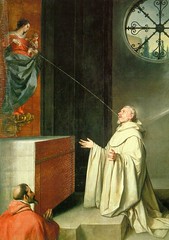
Unidentified “Maria lactans” painting depicting St. Bernard of Clairvaux?

From the blog “The hanged man” comes this comment:

Before they were suppressed by the decorous reforms of Trent, these images supported an astonishing range of piety. The medieval craving for physical contact with the divine took satisfaction in reports of lactation miracles.

While St. Bernard of Clairvaux knelt in prayer, a statue of Maria Lactans came to life and bestowed three drops of milk on his lips. St. Gertrude the Great nursed the Baby Jesus and Blessed Angela of Foligno nursed at Christ’s side. Lidwina of Schiedam saw Mary and her attendant virgins fill the sky with floods of their milk. In legend, suckling the Virgin or living saints brought healing and blessings.

Religious allegories celebrated lactation. Mary was the maiden in the garden who gave suck to the unicorn-Christ, the innocent victim hunted by men. Ecclesia, Sophia, Caritas, and sundry Virtues were shown as nursing mothers.[4]

Poking around on Google, I found the image above [5], can anyone ID?

A related IoEA was the Roman Charity one.

Mais où sont les neiges d’antan?

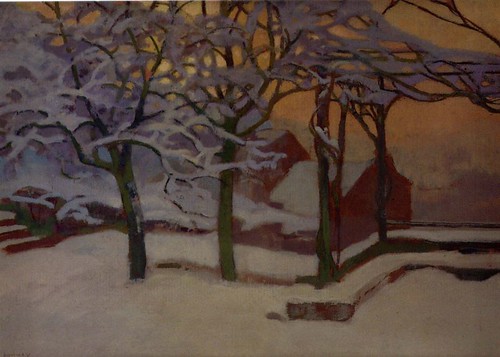
Work by Belgian artist Auguste Donnay (1862 – 1921)

Posting this painting was inspired by a recently opened exhibition in Brussels:Oriental Fascination – Japonism in Belgium, which from today until 28 September 2008 will show for the first time in Belgium, Japonism in Belgium, from the collection of Feliks Jasienski in Krakow. The exhibition is at the Brussels Town Hall, in the very center of Brussels.  Some of Donnay’s work is on display.

The above painting is of course not representative of the exhibition, but I wanted to show it to you anyway, since discovering interesting work from my native Belgium is always a pleasure.

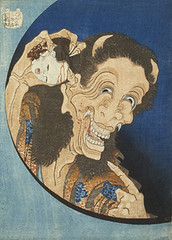
Below a work from Hokusai, the artist most typical and best-known for the European fin de siècle craze known as Japonism.

Hokusai Old woman

Work by Hokusai

The titular phrase of this post is from a poem by François Villon, “Ballade des Dames du Temps Jadis”, with its famous line: Mais où sont les neiges d’antan ?, translated in English as “Where are the snows of yesteryear ?”

Erotická revue

Erotická revue 1

Erotická revue 2

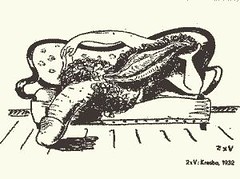
The Erotická revue[1] was an arts journal launched by Czech surrealist Jindřich Štyrský in 1930. It is also the name of the blog of American author Evie Byrne[2].

From Evie Byrne’s blog come:

Pompeii bedroom scene

Pompeii bedroom fresco

Sarah Goodridge, Beauty Revealed (Self-Portrait), 1828

Work by Sarah Goodridge

Emmanuel de Ghendt (1738-1815), Midday Heat, an engraving after Baudouin

Emmanuel de Ghendt (1738-1815), Midday Heat, an engraving after Baudouin

Speaking of Czech surrealism, I just found some Svankmajer clips at YouTube. Some of his best work: Dimensions of Dialogue (1982), which shows Arcimboldo-like heads gradually reducing each other to bland copies (“exhaustive discussion”[3]); a clay man and woman who dissolve into one another sexually, then quarrel and reduce themselves to a frenzied, boiling pulp (“passionate discourse”[4]); and two elderly clay heads who extrude various objects on their tongues (toothbrush and toothpaste; shoe and shoelaces, etc.) and use them in every possible combination, sane or otherwise (“factual conversation”[5]). Follow the links to see more of Jahsonic fave Svankmajer.

Last minute, it’s Trevor Brown day[6] over at Dennis Cooper‘s blog.

Rietveld @ 120

Gerrit Rietveld (June 24, 1888June 26, 1964) was a Dutch furniture designer and architect.

Onbeschilderde_Rietveldstoel

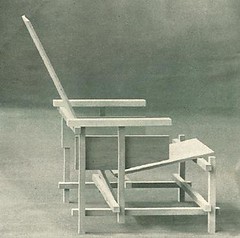
Leunsteul van Rietveld. Circa 1918. Published in De Stijl, second year, number 11 (September 1919). Photographer unknown, so copyright expired on 1-1-1990.

Rietveld designed the Red and Blue Chair in 1917, but changed its colors to the familiar style in 1918 after he became influenced by the ‘De Stijl‘ movement

Rietveld chair

Picture of a replicum of the Red and Blue Chair designed by Gerrit Rietveld. Picture taken by Wikipedia user Ellywa, with permission of the owner of the chair.

See also Dutch design, modernist design.

Giambattista Vico @ 340

“The universal principle of etymology in all languages: words are carried over from bodies and from the properties of bodies to express the things of the mind and spirit. The order of ideas must follow the order of things.” —Giambattista Vico, The New Science

New Science (1775) by Giambattista Vico

depicted is a revised 1744 edition

Giambattista Vico or Giovanni Battista Vico (June 23, 1668January 23, 1744) was a Counter-Enlightenment Italian philosopher, best known for his New Science. Vico was an outsider genius, who lived in near poverty and never met a thinker of equivalent magnitude.

Vallotton’s nudes + IoEA #27

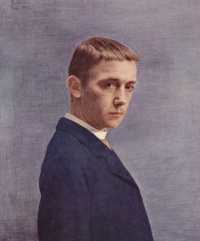
Félix Vallotton (December 28 1865December 29 1925) was a Swiss painter and graphic artist, an important figure in the development of the modern woodcut; his work was recently celebrated in the 2007-08 retrospective Félix Vallotton: An Idyll at the Edge held in Zürich and Hamburg.

Self portrait, 1885, oil on canvas, by Félix Vallotton

Self portrait, 1885, oil on canvas, by Félix Vallotton

I’ve mentioned Swiss painter and woodcutter Félix Vallotton before here, he is one of the most interesting painters of the early 20th century. Tip of the hat to “Femme, femme, femme“, the blog, for bringing the crouching woman to my attention. The work of Vallotton is plentiful, varied and in the public domain and his edginess foreshadows the palatable work of art deco artist Tamara de Lempicka, and I have reason to imagine that Balthus was not averse to his work.

From my Flickr set:

vallotton_ballon_512x400FelixVallotton_3_Women_1907Felix Valloton Sitting woman with cat
Vallotton Femme nue regardant dans une psycheFelix-Vallotton woman with one naked breastvallotton moonlight

The “Crouching Woman with Cat” (4th painting from the left) reminded me of the opening “kitty milk” scene in Story of the Eye, the novel by Georges Bataille, which was analyzed by Roland Barthes in his essay, “Metaphor of the Eye”, published within Bataille’s own journal Critique, shortly after Bataille’s death in 1962. Barthes’s analysis centers on the centrality of the eye but also traces a second series of liquid metaphors within the text, which flow through tears, cat’s milk, egg yolks, frequent urination scenes, blood and semen, an analogy which might not be out of place in this painting.

Here are some of your favorites from other Flickr members.

Paris, Pompidou by iarasette Art tag from never_summer (Switzerland) by paolagaidolfi The Toilette -  Félix Vallotton by erikarivera1019 félix_vallotton by janvaneyck

The woman in red is quite strange, the corpse very macabre.

As a final encore, let me give you the work that introduced me to Vallotton:
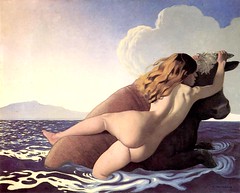
Vallotton, Abuction of Europe

Abduction of Europe (1908) by Félix Vallotton

Update 22/6/08

Two more of his paintings
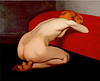
Valloton's Abandon

Abandon

Vallotton's study of buttocks

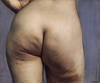
The “bottom” one represents Icon of erotic art #27 ( IoEA #27),

One of the more beautiful depictions of the female posterior.
Anecdotal nightlife histories and erotic dictionaries

Histoire anecdotique des Cafés & Cabarets de Paris (1862) Alfred Delvau

Histoire anecdotique des Cafés & Cabarets de Paris is a book on Parisian cafés by Alfred Delvau with illustrations by Gustave Courbet, Félicien Rops and Léopold Flameng.

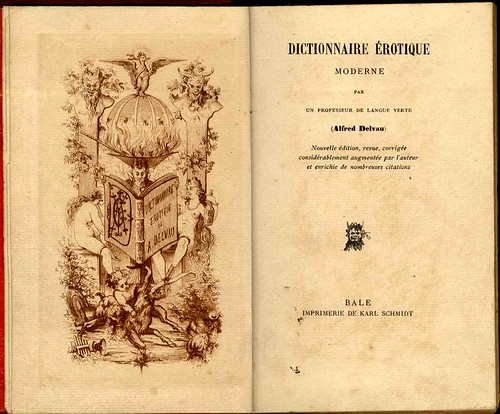
Delvau also wrote Dictionnaire érotique moderne (1864):

This edition printed by Gay et Doucé in 1876 for the members of the “Biblio-Aphrodiphile Société” with an engraved frontispiece by Chauvet after Félicien Rops. With a “Glossaire érotique” by Louis de Landers (= August Scheler). The volume was also published by Editions 10/18.

Entomology of the Pin-Up Girl

FIRST, LET us not confuse the pin-up girl with the pornographic or erotic imagery that dates from the dark backward and abysm of time. The pinup girl is a specific erotic phenomenon, both as to form and function. –Bazin

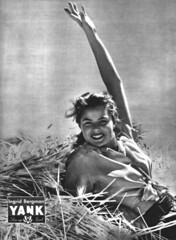
Ingrid_Bergman Yank Army Weekly

A public domain photo of Ingrid Bergman

André Bazin‘s 1946 essay “Entomology of the Pin-Up Girl,” was first published as “Entomologie de la pin-up girl “, L’Écran français issue 77, September 1946.

It starts thus:

Definition and Morphology

A wartime product created for the benefit of the American soldiers swarming to a long exile at the four corners of the world, the pin-up girl soon became an industrial product, subject to well-fixed norms and as stable in quality as peanut butter or chewing gum. Rapidly perfected, like the jeep, among those things specifically stipulated for modern American military sociology, she is a perfectly harmonized product of given racial, geographic, social and religious influences.

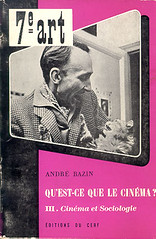
Bazin_What_Is_Cinema

Entomology of the Pin-Up Girl” is featured in Qu’est-ce que le cinéma?