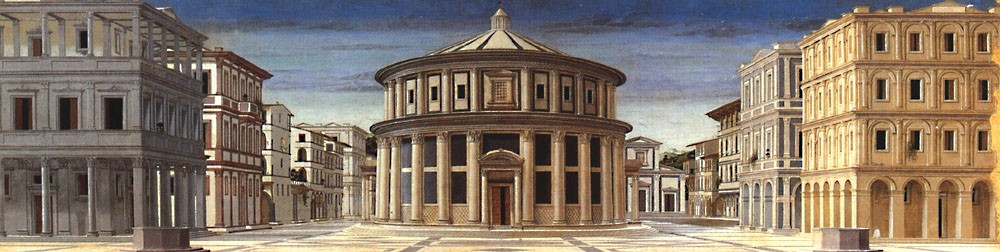
This is a fresco.
It’s quite wonderful the way the houses are stacked.
I feel I have to go to Italy and see all the delights with my own eyes.
See the previously posted “The Unswept Floor, or, of vestiges and precursors.”
This is a fresco.
It’s quite wonderful the way the houses are stacked.
I feel I have to go to Italy and see all the delights with my own eyes.
See the previously posted “The Unswept Floor, or, of vestiges and precursors.”
When a friend of a friend recommended The Barbarians by Italian writer Alessandro Baricco a year ago I dismissed it as yet another instance of much resented cultural pessimism.
I was wrong.
It is the most refreshing cultural criticism books of the last twenty years. The discourse on the Chinese wall alone — “an idea written in stone,” Baricco calls it — is worth the price of the book.
The book is held together by four mottoes, one of which is “Zu Micky-Maus,” a fragment by personal poulain Walter Benjamin. Benjamin is also quoted with the dictum (new to me) “Boredom is the dream bird that hatches the egg of experience.”
In the first part “plunder” the author takes us on a tour around the pillaged villages of wine, soccer and books to inspect the ravages that the barbarians have inflicted.
The second part is about Google and honors Google with the title “new Gutenberg”. This part also speaks of us humans becoming fish, breathing through gills, becoming mutants.
The third part is about loosing’s one’s soul, a common complaint of cultural elitists.
Part IV is dedicated to some keywords of barbarism. I especially remember spectacle, and I could not help being reminded of Guy Debord’s The Society of the Spectacle.
10/10 for this nobrow masterpiece.
I viewed the film Hitchcock last night. It features Geoffrey Shurlock as the censor of the Motion Picture Production Code, who says with regards to the production of the film Psycho:
Some thoughts:
I never knew that the American censor was involved during pre-production, i.e. before the shooting of the film.
It appears that the introduction of sound film coincides with the drafting of the Production Code. Did sound pose a threat more than imagery? Or was it the combination of sound and image that finally saw film evolving from a mere sideshow attraction to a genuine and ‘real’ mode of fiction consumption?
I remember a scene in Duck Soup where the Marx Brothers poke fun at the Production Code by showing a woman’s bedroom and then showing a woman’s shoes on the floor, a man’s shoes and horseshoes. Harpo is sleeping in the bed with a horse; the woman is in the twin bed next to them.
I remember extensive coverage of Psycho, Hitchcockianness and toilets in Enjoy Your Symptom! and The Pervert’s Guide to Cinema, both by Slavoj Žižek.
Above: “The Murder” by Bernard Herrmann used in the shower scene. “The Murder” is World Music Classic # 811.
Prince Jazzbo toasting on “Croaking Lizard“
Linval Roy Carter (3 September 1951–11 September 2013), better known as Prince Jazzbo, was a Jamaican reggae and dancehall deejay and producer.
“Croaking Lizard” is a musical composition by Lee Perry, published on the 1976 Super Ape album.
On this recording, Prince Jazzbo is heard chanting (toasting is what the Jamaicans call it) over the “Chase the Devil” riddim. The lyrics are largely nonsensical. Shards of texts I recognize are “on the river bank” and what I believe is “it’s slippery out there.”
Super Ape is a seminal recording in the history of 20th century music.
Allegory of the World (1515) from the studio of Joachim Patinir
Allegory of the World (1515) is the title of an anonymous Flemish painting, attributed to the school of Joachim Patinir.
The work comes from the collection of the prince of Salm-Salm and is now in the collection of the Museum Wasserburg Anholt. It was first exhibited at the Meisterwerke westdeutscher Malerei in Düsseldorf in 1904.
On a globe of glass the artist has painted the joys and miseries of the world, with its gallows and torture wheels. The rocky and fantastic landscape is indeed reminiscent of Patinir. Through an opening on the left, a young man with a long stick tries to enter. A Flemish inscription tells us that he would like to cross the world without bending:
We see him coming out on the other side, middle aged and laughing, holding his long crooked stick. He has recognized the need to bend.
See also
Limestone rock formation in the White Desert, Egypt (Hathor13 photo[1])
See also non-man-made art, mushroom rocks, In praise of erosion.
Alamut, vestiges of an impregnable castle (photo Payampak source).
As I wrote in a post 10 months ago in a post over at Tumblr[1], there once was an artist who:
“had a garden. And every day, maybe several times a day, that artist walked a certain marked path in his garden, until the soles of his shoes had flattened the grass and eroded a path. I guess he then took a photo of his garden with its newly formed path. Maybe he sold the photos.”
Yesterday, I find out the name of this mysterious land artist, of which I had been ignorant for more than 20 years. It is a certain Richard Long (born 1945) and instead of my imagined curved geoglyph, he walked a straight line.
Richard Long first came to the attention of the art world with A Line Made by Walking in 1967 — three years before the iconic Spiral Jetty — and repeated the exercise in 1972 on a much larger scale and with more efficiency in Peru.
Where in Peru this was, I have been unable to find out, I wonder if it’s still there. Maybe it’s not far from When Faith Moves Mountains (2002) by Francis Alÿs.
Illustration: cover of a book on Richard Long‘s A Line Made by Walking by Dieter Roelstraete.
Loisirs Littéraires au XXe siècle (above, English: “Literary leasures in the 20th century”) is the title of an illustration from the story “The End of Books” by French writer Octave Uzanne and illustrator Albert Robida, a story about a post-literate society in which readers have become ‘hearers,’ i. e. consumers of audio books. It was published in the collection Contes pour les bibliophiles (1895). The illustration depicts a female reader of the 20th century, imagined by Robida, who is listening to “12 poètes assortis” (twelve assorted poets) in on a balcony overlooking a future city.
https://www.youtube.com/watch?v=C7EFyYXcylM
RIP José Ramón Larraz (1929 – 2013).
After the death of Jesús Franco earlier this year, fellow countryman Larraz was the last survivor of “sexual revolution“-era European exploitation cinema.
Now the two last two last survivors of that sensibility are Radley Metzger (born 1929) and Roger Corman (born 1926).
My first exposure to Larraz was the VHS cover of La visita del vicio (The Coming of Sin). For the infamous Pasiphae scene from La visita del vicio shot scroll to 15′:32”.
Video: Eurotika! Larraz episode (1992).
I’ve previously mentioned Larraz here: https://blog.jahsonic.com/daedalus-devised-a-hollow-wooden-cow/