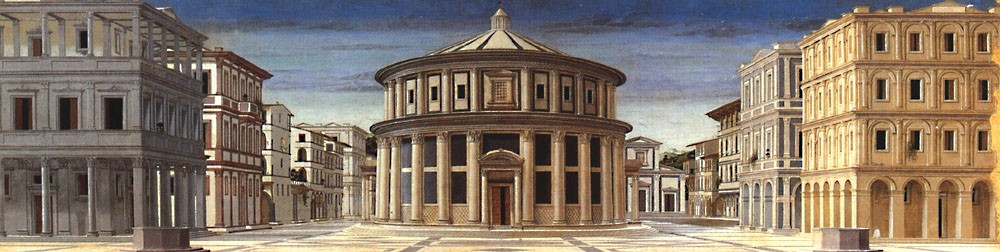
Paul Rumsey is a British artist working in the tradition of the fantastique.
Yearly Archives: 2008
Icons of erotic art #19

Venus (1532) by Lucas Cranach the Elder
From March 8 until June 8, 2008, the London Royal Academy of Arts will hold a retrospective of Cranach’s work. This advertising poster for the Cranach expo (which displays the Venus painting) was recently considered offensive to the officials of the London Underground, who banned it and stated that
“Millions of people travel on the London Underground each day and they have no choice but to view whatever adverts are posted there. We have to take account of the full range of travellers and endeavour not to cause offence in the advertising we display.”
Lucas Cranach the Elder (Lucas Cranach der Ältere, 1472 – 1553) was a German painter and printmaker in woodcut and engraving of the school now known as Northern Renaissance. His influence is readily displayed in the work of 21st century American artist John Currin [1].
Previous entries in Icons of Erotic Art here, and in a Wiki format here.
Happy valentine everyone
Breton’s homophobia
I’ve mentioned surrealist leader André Breton’s homophobia before, so I decided to investigate.
Apparently most of what is known of Breton’s dislike of homosexuality stems from round table discussions that were held in the years 1928 – 1932, long before Kinsey or Masters and Johnson began their clinical surveys. Participants included many of surrealism’s best known figures: Andre Breton, Paul Eluard, Louis Aragon, Max Ernst, Man Ray, Antonin Artaud, Benjamin Peret, Jacques Prevert, Marcel Duhamel, Yves Tanguy, Pierre Unik, etc…. Their findings were partly published in the surrealist magazine La Révolution surréaliste. For those of us without access to those magazines (and that is 99.999% of us) there is an English translation available from Verso books with the title Investigating Sex: Surrealist Discussions 1928-1932, which publishes verbatim accounts of all of these round table discussions.

Quoting from both sides (pro and contra):
André Breton said:
- “I accuse homosexuals of confronting human tolerance with a mental and moral deficiency which tends to turn itself into a system and to paralyse every enterprise I respect.”
Pierre Unik states:
- “From a physical point of view, I find homosexuality as disgusting as excrement …”
André Breton concludes:
- “I am absolutely opposed to continuing the discussion of this subject. If this promotion of homosexuality carries on, I will leave this meeting forthwith.”
Some surrealists came to the defense of homosexuals, most notably Raymond Queneau who states:
- “It is evident to me that there is an extraordinary prejudice against homosexuality among the surrealists.
I’d like to investigate further who was pro and who contra, but I am running out of time here.
Icons of erotic art #18

![[1]](http://www.coldbacon.com/art/pics/currin/johncurrin-thepinktree.jpg)
Via the newly discovered blog aileron comes the film The Lost Secret of Catherine the Great by Peter Woditsch and Sophie Schoukens.
I had first heard about the erotic furniture of Catherine the Great a couple of years ago and even traced the existence of the documentary by Woditsch, but had never actually seen the pieces of furniture that presumedly belonged to Catherine before the collection was destroyed during WWII. Catherine was a strong and independent woman (it helped that she was an empress) who throughout her long reign, took many lovers, often elevating them to high positions for as long as they held her interest, and then pensioning them off with large estates and gifts of serfs. She also cultivated Voltaire, Diderot and D’Alembert — all French philosophes encyclopedists who later cemented her reputation in their writings.
Note: In the erotic furniture category belong art works such as Chair, Table and Hat Stand by Allen Jones and Les Krims‘s Heavy Feminist with Wedding Cake [1] (1970).
![[1]](http://blog3.nadjavilenne.com/krims2.jpg)
Previous entries in Icons of Erotic Art here, and in a Wiki format here.

Introducing Praxis

It’s actually strange that I’ve never actively come across this band besides of having heard of them. I am a big fan of Bill Laswell and all P-Funkiana, both are canonical to my encyclopedic work. Praxis introduces a whole collective of adventurous culture, from cutting edge music to exciting graphics, rebellious texts and tetsuoesque performances (is the life-size doll by Rammellzee?).
[Youtube=http://www.youtube.com/watch?v=KUL_gcHv0EA]
“Animal Behavior” (1992) from the Transmutation (Mutatis Mutandis) album.
Praxis is the name of an ever-changing Bill Laswell musical project. Praxis combines elements of different musical genres such as funk, jazz, hip-hop and heavy metal into highly improvised music. First appearing in 1992 with the critically acclaimed Transmutation (Mutatis Mutandis), Buckethead, Bill Laswell, Bernie Worrell and Brain have defined the direction of the band over the last 15 years.
Transmutation (Mutatis Mutandis) is the first album by Bill Laswell‘s everchanging “supergroup” Praxis. This first album features Buckethead on guitar, Bootsy Collins on bass and vocals, Brain on drums, Bernie Worrell on keyboards and DJ AF Next Man Flip on turntables and mixer.
Transmutation features a wide range of musical styles, all mixed together to make a very diverse and unique album. Styles such as heavy metal, funk, hip hop, ambient, jazz and blues are blended together to form a strange style of avant-garde, with extended guitar and keyboard solos, and highly improvised passages.
The artwork is by James Koehnline, photography by Thi-Linh Le and liner notes by Hakim Bey.
Icons of erotic art #17

Sensuality (1891) – Franz von Stuck
Although a mediocre painter at best and deservedly one of the minor figures in European fin de siècle Symbolism, there are two paintings by Franz Von Stuck that I like: Salome, which I “exhibited” here, and Sensuality (pictured above) . In Sensuality, the image of the serpent as phallus is left in little doubt and shows an enormous python-like creature passing between the legs of a nude woman. The serpent’s head rests on the woman’s right shoulder; both the serpent and the woman gaze at the viewer. There are obvious connections to the tentacle eroticism trope.
Previous entries in Icons of Erotic Art here, and in a Wiki format here.
Horticultural horror
Following my recent post on an ugly plant, which was actually a very beautiful plant as suburbanlife remarked, I stumbled upon a photograph of a Tetrameles nudiflora tree at the Ta Prohm temple in Cambodia. This is a very frightening plant, the roots of which cover this entire temple in Cambodia and like the “ugly plant”, it seems to be dripping like a fluid over the structure.
I first came across horticultural horror in the stories of Stephen King but a quick search on “horticultural horror” at Google turns up many more examples. For example, “The Garden of Adompha”, a 1938 story by Clark Ashton Smith, tells of a king who maintains a gruesome garden sown with human limbs grafted onto plants.
- “A bare, leafless creeper was flowered with the ears of a delinquent guardsman…. Some of the salver-like blossoms bore palpitating hearts, and certain smaller blossoms were centered with eyes…”
Previously at Jahsonic:
A reappraisal of Amélie
I had seen Le Fabuleux Destin d’Amélie Poulain in the winter of 2001 when it came out in theatres in Belgium and had not taken to it because of its faux happiness and its European hollywoodity. I’ve seen it again today and I think it is time for a reappraisal. This clever film shows a unique understanding of visual and auditory culture. It is told by an omniscient narrator* in an extremely writerly and accomplished style.**
The visuals and the score from Yann Tiersen are virtually symbiotic. One peep show scene features music from French house musician Alex Gopher‘s “The Child” (1999) (“them that’s got, shall get”). I wanted to give you the Kenny Dope remix (the one actually featured in Amélie). In stead, here Youtube is a slower version with many intrusive voices but interesting visuals (animation made out of typography by Antoine Bardou-Jacquet). If you badly need the Kenny Dope remix, buy Beats & Pieces vol. 2 on the highly recommended series out on BBE Records.
*On the omniscient narrator, see scenes in the recent film Stranger Than Fiction in which Dustin Hoffman teaches a whole seminar on the omniscient narrator phrase par excellence “little did he know”, illustrating the excesses of literary theory.
** Films such as Reconstruction (which I liked immensely) owe a lot to the Ameliesque aesthetic.
Gratuitous nudity #6

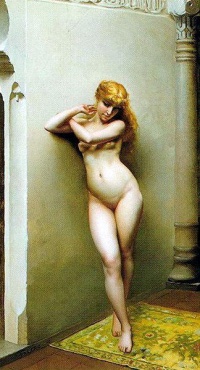
La Favorite () by Luis Riccardo Faléro
There is something about this pose, legs crossed, one foot put forward, that I find particularly attractive. Mabe it’s the fact that standing like this makes the rear foot tiptoe and raise the buttocks.
If anyone can help me with the date on this painting, please drop me a line.
Previous entries in this series.