Category Archives: Uncategorized

I finally hold a copy of ‘Short History of the Shadow’ in my hands

Photo (I accidentally mirrored it) of three books by Victor Stoichita. It shows (from left to right) The Pygmalion EffectVisionary Experience in the Golden Age of Spanish Art and Short History of the Shadow.

The photo was taken against the backdrop of the University of Antwerp library at the Prinsstraat.

I was surprised to find these books in the collection of the Ruusbroec Institute of all places. Not so surprising it would appear the following day after doing my homework, as on February 6th 2014 Stoichita gave a lecture at the UCSIA, on the visionary experience in art. John of Ruysbroeck (after which the Ruusbroec Institute was named) was a Flemish mystic and Stoichita has written on the visionary experience.

A pity I missed that lecture.

Victor Stoichita’s oeuvre very obliquely reminds me of David Toop‘s and especially his last work Sinister Resonance: The Mediumship of the Listener (which I have still to read, or better said, “hold in my hands”, as I’ve researched it already online), in particular the chapter Art of silence. As I’ve noted in a previous post[1], in that book Toop references Stoichita. Three times[2], to be exact, I just checked.

I started reading Short History of the Shadow and in the introduction I found Plato’s cavePliny’s shadow and Hegel on lightness and darkness.
World cinema classic #178

http://www.youtube.com/watch?v=1vrkjbmUPF0

closing credits sequence of Dogville

Yesterday, I watched Dogville (2003) on DVD with my daughter, who had to watch it for her final year in high school. Her assignment: searching for Brechtian alienation elements. That wasn’t hard: the whole film is an attack on the suspension of disbelief.

I’d previously seen the von Trier film in the cinema and that time I had missed the importance of the closing credits sequence [above] with images of poverty-stricken Americans taken from Jacob Holdt’s social documentary photography book American Pictures (1977) and accompanied by David Bowie’s song “Young Americans.”

The film is an indictment of the hypocrisy of small town morality. Its most dislikable character is Tom Edison Jr., the wannabe writer, would be philosopher and cowardly lover who abuses Grace’s trust time after time.

Von Trier’s tale reminded me both of Thomas Hardy and the misery of Jude the Obscure and of the festering perversion in the small town of Samuel Fuller’s The Naked Kiss.

The film is a masterpiece. But bleak.

I’ve added it to my film canon: the World Cinema Classics list where it sits next to District 9 and Dr. Pyckle and Mr. Pryde.

I finished reading Mikhail Bakhtin’s ‘Rabelais and His World’

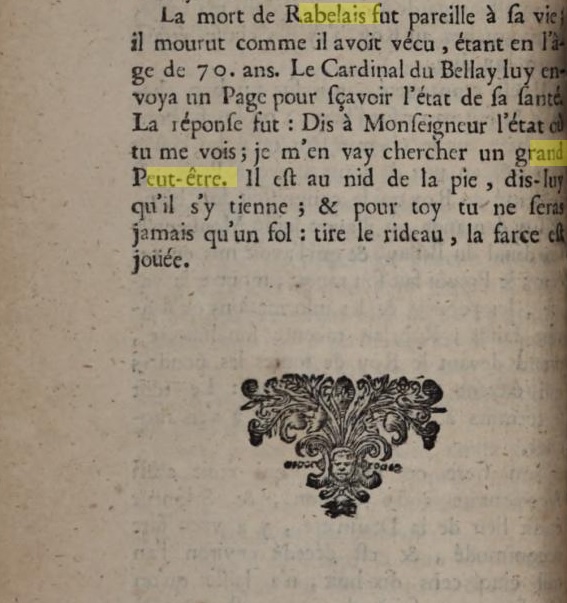
"I go to seek a Great Perhaps", supposed last words of Rabelais

I go to seek a Great Perhaps“, supposed last words of Rabelais

I finished reading Mikhail Bakhtin’s Rabelais and His World (1965) and took notes here.

“Our study is only a first step in the vast task of examining ancient folk humor” says Bakhtin on the last page of his monumental work. To me, this was not a first step, but a pretty comprehensive overview of Rabelais, his language and his time. Sometimes I even felt there was just a bit too much repetition.

What I will most likely remember best of Bakhtin’s analysis is the metaphor of the pregnant death: symbol for a number of processes characterized by the prefix re-: renewal, rebirth, regeneration, reconstruction, revitalization and ultimately Renaissance.

I find myself smiling and nodding in admiration simultaneously when reading Rabelais.

Spain had Cervantes, England had Shakespeare, but the Frenchmen Rabelais was the father of them all.

When he died, he said “I go to seek a Great Perhaps“.

Did he?

Nobody knows, actually.

More and more I am confronted with the spuriousness of attributions.

Finding Nemo

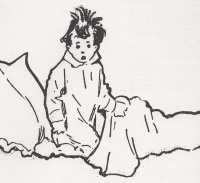
This page May 29, 2014 is part of the comics series. Illustration: Little Nemo sitting upright in bed

Illustration: Little Nemo sitting upright in bed

When we were children, there was a joke about three boys sitting in a boat. One was called biteme, another one pinchme and a third hitme.

Hitme fell out of the boat. Who remained in the boat?

You can guess what happened next.

In Rabelais and His WorldBakhtin describes a somewhat similar word game.

A 13th century medieval monk searched all biblical and patristic texts for sentences containing the word nemo, Latin for nobody.

He then interpreted phrases such as “nemo deum vidit” (“Nobody has seen God”), along with many other references to nobody, to mean that Nemo referred to a proper noun and thus was a certain person and that the phrase actually meant “Saint Nobody has seen God”.

That text, known as the “History of Nemo“, is now lost, but its story is not and it is easy to see why it so fascinated medieval everyman.

Bakhtin remarks: “everything impossible, inadmissible, inaccessible is, on the contrary, permitted for Nemo. Thanks to this transposition, Nemo acquires the majestic aspect of a being almost equal to God, endowed with unique, exceptional powers, knowledge (he knows that which no one else knows), and extraordinary freedom (he is allowed that which nobody is permitted.)”

I am reminded of another childhood memory. I have younger brother who is called Joost. There is a Dutch expression which says “Joost mag het weten,” (literally “Joost is allowed to know [it]”) meaning “heaven knows” or “God knows” (nobody knows).

When we were children, many people used to say jokingly to my brother “Joost mag het weten.”

One day — apparently fearing that some big secret was being kept from me — I asked my mother. “Mother, when am I allowed to know it?”

PS 1. If you like these word games, I recently posted on the medieval nonsense word blituri[1].

PS 2. Nobody is also a subcategory of the void and a sister category of nothing. I recently mentioned the void [2].

On the originary date of ‘Mona Lisa Smoking a Pipe’

Mona Lisa Smoking a Pipe by Eugène Bataille (Sapeck) (page from the book Le rire, source Gallica.bnf.fr)

I’ve been fascinated by the Incoherents since I first stumbled upon them in 2007[1][2].

After becoming a member of the Royal Museum of Fine Arts Antwerp library some weeks ago, I have been able to consult two seminal books on that movement’s history: the Arts incoherents, academie du derisoire exhibition catalog (1992) by Luce Abélès/Catherine Charpin and The Spirit of Montmartre: Cabarets, Humor and the Avant-Garde, 1875-1905 (1996) by Phillip Dennis Cate.

Object of my research was to check the dates of works I consider canonical to the proto-avant-garde, dates which I previous held to be the neat series of 1882, 1883 and 1884.

It’s a pity, but I’ve had to adjust that series to 1882, 1883 and 1887: Negroes Fighting in a Tunnel at Night (1882), Funeral March for the Obsequies of a Deaf Man (1884) and Mona Lisa Smoking a Pipe (1887).

According to my research, Mona Lisa Smoking a Pipe by Sapeck, which is still listed over at Wikipedia as originating in 1883 and erroneously titled as Le rire, in fact first saw the light of day in 1887, in the book Le Rire by Coquelin cadet.

Wikipedia is not the only reference work in error. The Oxford Critical and Cultural History of Modernist Magazines erroneously states that this Mona Lisa was first shown in 1883 at the second “Incohérents” exhibition.

What is the importance of this augmented Mona Lisa?

Simple.

Perhaps the invention of high art with capital ‘A’ coincided with the first blows of its ridicule. This augmented Mona Lisa was a desecration, a violation, a rape of its masterpiece: the Mona Lisa proper by da Vinci.

Think about it.

Erratum

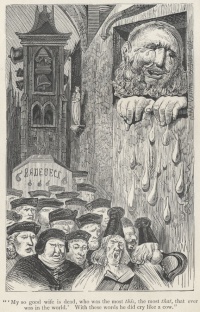
Pantagruel by Gustave Doré (prologue)

While[1] I’m on the subject of Metamorphic Genitalia and Fantastical Sexual Images, I recently found out that I’d previously misinterpreted the famous “How Panurge showed a very new way to build the walls of Paris” episode in Gargantua and Pantagruel by French writer Rabelais.

I thought that Panurge wanted to build the walls with women’s bodies while in fact he wanted to build them with women’s vulvae, these being cheaper than stones. My mistake was due to the fact that the Urquhart and Motteux translation I based my research on, speaks of “kallibistris” (“callibistrys” in the French original), probably one of the neologisms of Rabelais (although Rabelais scholar Lazar Saineanu (1859-1934), remarks that the word callibistrys was used in the valley of the Yères, so it could actually be an obscure loan-word).

In Rabelais and His World (which uses the 1936 Jacques LeClercq translation of Gargantua and Pantagruel), kallibistris has been replaced by the much more straightforward “pleasure-twats”:

“I have observed that the pleasure-twats of women in this part of the world are much cheaper than stones, therefore the walls of the city should be built of twats.”

Everyone knows what a twat is.

I can’t help but imagine what Yoshifumi Hayashi (the greatest living artist when it comes to grotesque genitalia, you should google him) would make of a wall of twats, a fortification of disembodied vulvae.

Eureka

I’m happy to report that I have identified ‘vulvic face, phallic head‘, the informal title to three (actually two unique ones, 2 and 3 are the same image) [1] [2][3] grotesque shunga of an amorous couple; her head is a vulva, his head is a phallus, her vulva is a face, his phallus is a face.

These images are featured in Shunshoku hatsune no ume(1842), written by Tamenaga Shunsui and illustrated by Utagawa Kunisada.

I’ve previously written about these prints here.

They are part of the Metamorphic Genitalia and Fantastical Sexual Images project, in the category “Substitution, displacement or replacement”.

The gaping mouths of Goya

Los Chinchillas from Los Caprichos by Francisco de Goya

Los Chinchillas from Los Caprichos by Francisco de Goya

I’m reading Rabelais and His World and I’m taking notes as I go along.

There is much repetition of the tropes of Rabelais in Bakhtin’s book. For example, the term dismemberment is mentioned about twenty times and gaping about ten times. The grotesque body and what it stands for is explained over and over again.

It suddenly occurred to me that Francisco Goya is the specialist of the gaping mouth.The mouth which is wide open. Incidentally, gaping means yawning in my language (Dutch).

 This morning I looked up the combination Goya/gaping/mouth.

British art critic David Sylvester came to the same conclusion:

“The mouth plays a role in Goya‘s art more prominent than in that of any other major artist. Mouths leer, grin, gape, gasp, moan, shriek, belch. A hanged man’s mouth lies open and a woman reaches up to filch his teeth. Grown men stick fingers in their mouths like sucking infants. Mouths vomit, the sick gushing out of them, and a great furry beast sicks up a pile of human bodies. Mouths guzzle: they guzzle avidly, ferociously, living flesh as well as dead. Saturn grips one of his children in his fists and with his mouth tears him limb from limb.”

One can add to this the Lazarillo painting and the Caprichos There Is Plenty to SuckYa es horaEstan calientes and the force-fed Chinchillas. And from the Desastres: the vomiting man in Para eso habeis nacido and the vomiting monster of Fiero Monstruo!

Tortured artists and beautiful losers

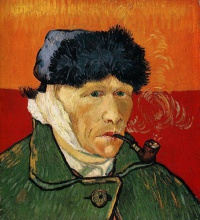
Self-Portrait with Bandaged Ear and Pipe (1889) by Vincent van Gogh

Self-Portrait with Bandaged Ear and Pipe, the purest version of the two ‘bandaged’ portraits.

Vincent van Gogh‘s two Self—Portraits with Bandaged Ear are the most perfect visual expression of the concept of the tortured artist, an artist who in this particular case literally in an act of self-torture cut off his own ear.

Van Gogh was a beautiful loser unacknowledged during his lifetime and posthumously rewarded with success.

One other painting in the category ‘existential angst’ comes to mind, the far more famous The Scream, depicting an artist tortured by existential angst.