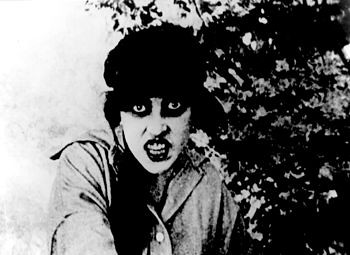
Musidora @120

Musidora by you.

Musidora in Les Vampires (1915)

[Youtube=http://www.youtube.com/watch?v=q_fdUROaJYo&]

Musidora in Les Vampires (1915)

Musidora (February 23, 1889December 11, 1957) was the stage name of a popular French silent film actress of the early 20th century. She is best-remembered for her vamp persona in the roles of Irma Vep and Diana Monti in the early motion picture crime serials Les Vampires (1915) and Judex (1916), respectively.

Poster for Les Vampires

Adopting the moniker of Musidora (Greek for “gift of the muses“) and affecting a unique vamp persona that would later be popularized in the United States of America by actress Theda Bara, Musidora soon found a foothold in the nascent medium of moving pictures. With her heavily kohled dark eyes, somewhat sinister make-up, pale skin (see the heroin chic aesthetic) and exotic wardrobes, Musidora quickly became a highly popular and instantly recognizable presence of European cinema.

Beginning in 1915, Musidora began appearing in the hugely successful Feuillade-directed serials Les Vampires as Irma Vep (an anagram of “vampire”), a cabaret singer, opposite Edouard Mathé as crusading journalist, Philippe Guerande. Contrary to the title, the Les Vampires were not actually about vampires, but about a criminal gang cum secret society inspired by the exploits of the real-life Bonnot Gang. The somewhat surreal series was an immediate success with French cinema-goers and ran in ten installments until 1916. After the Les Vampires serial, Musidora starred as ‘Diana Monti’ in another popular Feuillade serial, Judex, filmed in 1916 but delayed for release until 1917 because of the outbreak of World War I. Though not intended to be “avant-garde,” Les Vampires and Judex have been lauded by critics as the birth of avant-garde cinema and cited by such renowned filmmakers as Fritz Lang and Luis Buñuel as being extremely influential in their desire to become directors.

I’ve previously mentioned Les Vampires[1].

RIP Oreste Lionello (1927 – 2009)

Michaela Miti in Biancaneve & Co (1982) – Mario Bianchi

Oreste Lionello (Rodi, April 18, 1927 – Rome, February 19, 2009) was an Italian actor, cabaretier and dubber. He famously dubbed Woody Allen‘s voice and was involved in the Italian exploitation film Biancaneve & Co. based on the adult comic Biancaneve, directed by Mario Bianchi and featuring starlet Michela Miti with Oreste Lionello, Gianfranco d’Angelo and Aldo Sambrell. It was released in English as Snow White and 7 Wise Men.

Futurism @100

Futurism @100

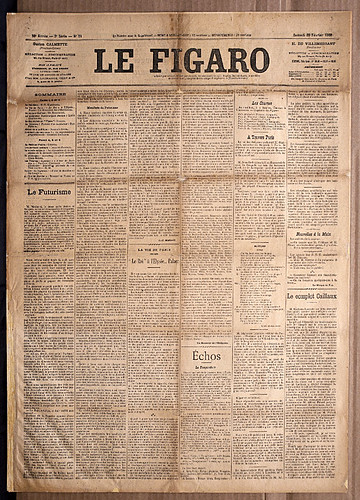
Futurist Manfisto in the Figaro of February 20, 1909 by you.

Tomorrow, February 20, 1909, it will have been 100 years since the Futurist Manifesto was published in the French conservative newspaper Le Figaro.

Futurism is now known as a early 20th century avant-garde art movement focused on speed, the mechanical, and the modern, which took a deeply antagonistic attitude to traditional artistic conventions.

Centrale elettrica (1914) – Antonio Sant’Elia

The Futurists explored every medium of art, including painting, sculpture, poetry, theatre, music, architecture and even gastronomy. The Italian poet Filippo Tommaso Marinetti was the first among them to produce a manifesto of their artistic philosophy in his Manifesto of Futurism (1909), first released in Milan and published in the French paper Le Figaro (February 20). Marinetti summed up the major principles of the Futurists, including a passionate loathing of ideas from the past, especially political and artistic traditions. He and others also espoused a love of speed, technology and violence. The car, the plane, the industrial town were all legendary for the Futurists, because they represented the technological triumph of man over nature.

Photograph of intonarumori: “intoners” or “noise machines”, built by Russolo, mostly percussion, to create “noises” for performances. Unfortunately, none of his original intonarumori survived World War II.

Marinetti’s impassioned polemic immediately attracted the support of the young Milanese paintersBoccioni, Carrà, and Russolo—who wanted to extend Marinetti’s ideas to the visual arts (Russolo was also a composer, and introduced Futurist ideas into his compositions). The painters Balla and Severini met Marinetti in 1910 and together these artists represented Futurism’s first phase.

Mina Loy (1909), photo by Stephen Haweis

Futurism’s misogyny is illustrated by article 9 (below): we will glorify scorn of woman

It was one of the few art movements to be initiated by a manifesto.

In fact, manifestos were introduced with the Futurists (not entirely true, there were the Symbolists and the Decadents with their manifestos) and later taken up by the Vorticists, Dadaists and the Surrealists: the period up to World War II created what are still the best known manifestos. Although they never stopped being issued, other media such as the growth of broadcasting tended to sideline such declarations.

Full text of the manifesto

  1. We intend to sing the love of danger, the habit of energy and fearlessness.
  2. Courage, audacity, and revolt will be essential elements of our poetry.
  3. Up to now literature has exalted a pensive immobility, ecstasy, and sleep. We intend to exalt aggressive action, a feverish insomnia, the racer’s stride, the mortal leap, the punch and the slap.
  4. We affirm that the world’s magnificence has been enriched by a new beauty: the beauty of speed. A racing car whose hood is adorned with great pipes, like serpents of explosive breath—a roaring car that seems to ride on grapeshot is more beautiful than the Victory of Samothrace.
  5. We want to hymn the man at the wheel, who hurls the lance of his spirit across the Earth, along the circle of its orbit.
  6. The poet must spend himself with ardor, splendor, and generosity, to swell the enthusiastic fervor of the primordial elements.
  7. Except in struggle, there is no more beauty. No work without an aggressive character can be a masterpiece. Poetry must be conceived as a violent attack on unknown forces, to reduce and prostrate them before man.
  8. We stand on the last promontory of the centuries!… Why should we look back, when what we want is to break down the mysterious doors of the Impossible? Time and Space died yesterday. We already live in the absolute, because we have created eternal, omnipresent speed.
  9. We will glorify war—the world’s only hygiene—militarism, patriotism, the destructive gesture of freedom-bringers, beautiful ideas worth dying for, and scorn for woman.
  10. We will destroy the museums, libraries, academies of every kind, will fight moralism, feminism, every opportunistic or utilitarian cowardice.
  11. We will sing of great crowds excited by work, by pleasure, and by riot; we will sing of the multicolored, polyphonic tides of revolution in the modern capitals; we will sing of the vibrant nightly fervor of arsenals and shipyards blazing with violent electric moons; greedy railway stations that devour smoke-plumed serpents; factories hung on clouds by the crooked lines of their smoke; bridges that stride the rivers like giant gymnasts, flashing in the sun with a glitter of knives; adventurous steamers that sniff the horizon; deep-chested locomotives whose wheels paw the tracks like the hooves of enormous steel horses bridled by tubing; and the sleek flight of planes whose propellers chatter in the wind like banners and seem to cheer like an enthusiastic crowd.
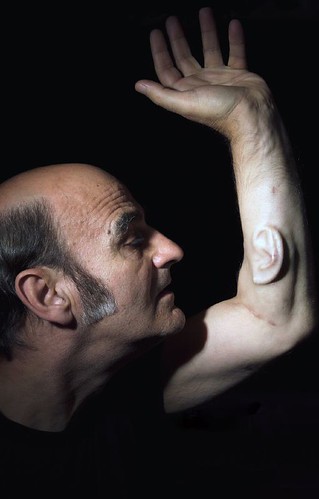
Stelarc’s third ear

Stelarc's Ear PORTRAIT taken by nina sellars by k0re.

Stelarc’s third ear, photo by Nina Sellars from the Flickr stream of  k0re

Stelarc’s third ear[1] is performance by Australian body artist Stelarc consisting of a subdermal implant of a cell-cultivated ear in his left arm, thus becoming a living example of transhumanism.

A barrage of images

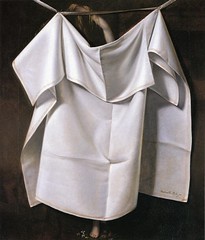
Venus Rising from the Sea,  A Deception c. 1822

Venus Rising from the Sea — A Deception[1] (c. 1822) Raphaelle Peale

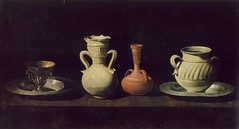
Zurbaran_-_Bodegon

Francisco Zurbarán

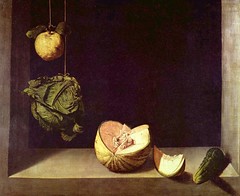
Juan Sánchez Cotán 2

The still lifes of Juan Sánchez Cotán

One hint from Femme Femme Femme brings up a barrage of images.

Venus Rising from the Sea — A Deception[1] (c. 1822) Raphaelle Peale, reminiscent of Magritte[2] .

The still lifes of Juan Sánchez Cotán[3][4], reminiscent of de Chirico[5] .

Francisco Zurbarán[6] and Pieter Claesz[7] are contemporaries

Jack Palance @90

Jack Palance would have turned 90 had he not died 3 years ago.

Like so many American actors — some of them had fallen on hard times, though I do not know if this is the case for Palance — they had a second life in European cinema, see for example the recently featured European career of American sex kitten Carroll Baker[1].

My father was nuts for Shane, and I’m sure he alerted me and my brother of that movie and had us see it, but my first conscious experience of Palance was in the cinematic fable Bagdad Café.

Back to the European career of Palance.

Palance starred in Godard‘s Contempt and Breathless, Jess Franco‘s Marquis de Sade: Justine, as well as in the poliziottesco Mister Scarface.

[Youtube=http://www.youtube.com/watch?v=wHFK2mTDd3M]

I leave you with a scene from Bagdad Café, I loved that film when it came out, not in the least because of the brilliant loungy Jevetta Steele track, “Calling You.”

[Youtube=http://www.youtube.com/watch?v=MyU1R50_Nc8]

Introducing Alva Bernadine and icon of erotic art #39

Introducing Alva Bernadine and icon of erotic art[1] #39

Back in the day, when I was still editing Jahsonic.com, I had amassed a list of erotic photographers I thought were important. The list consisted of Alva Bernadine, Gilles Berquet, Guy Bourdin, Steve Diet Goedde, Nan Goldin, David Hamilton, Irina Ionesco, Richard Kern, Doris Kloster, Eric Kroll, David LaChapelle, Sally Mann, Robert Mapplethorpe, Steven Meisel, Carlo Mollino, Helmut Newton, Man Ray , Bettina Rheims, Paolo Roversi, Thomas Ruff, Jan Saudek, Jeanloup Sieff, Romain Slocombe, Roy Stuart, Jock Sturges, Ellen Von Unwerth, Trevor Watson and Theodore Zichy.

Today is the day to introduce Alva Bernadine, a man whose work is a fusion of the erotic and the surreal.

Alva Bernadine (born June 17, 1961) is a British photographer born in Grenada, West Indies, and brought to London at the age of six. He is self-trained and has photographed for Vogue, GQ, Elle and others. Winner of the Vogue/Sotheby’s Cecil Beaton Award, he was also twice nominated English “Erotic Photographer of the Year.” His book Bernadinism: How to Dominate Men and Subjugate Women was published by Stemmle in 2001 with text by Nerve cofounder Genevieve Field. His work is self-admittedly inspired by Guy Bourdin, shows influences of the Distortions series [2] by Hungarian photographer André Kertész. Bernadine describes himself as an anti-portrait photographer, since he rarely shows faces, which gives his work that distinct forniphilia/sexual objectification* look. A recurring theme in his work is the mirroring of a female from the waist up/down[3][4].

The Philosopher Illumined by Candlelight – Alva Bernadine (image used with permission of author)

I’ve chosen his work The Philosopher Illumined by Candlelight as the current icon of erotic art. The photo depicts a man in a suit sitting in a darkened bedroom reading by candlelight. The lighted candle is protruding from a woman’s vagina. The picture has elicited comments of sexual objectification and misogyny. Objecters find more “proof” of Bernadine’s “misogyny” over here[5].

On the accusations of misogyny he says:

“I don’t really think about that [accusations of misogyny],” he declares. “Normally, I get an idea for a picture and if I can’t think of a good reason not, I take it. I can’t censor my own stuff.”

“That doesn’t bother me much, … you bring your own experiences to a picture. Sometimes I am surprised at the way they’re interpreted, but every opinion is as valid as mine because I haven’t usually formed an opinion before I’ve taken the shot. It’s only later that I work out the ramification. My work isn’t about subtlety. I need a reaction. It’s better to be a bad influence than no influence at all.”

On his inspiration for Illumined Bernadine commented:

“I once listened to a late night BBC Radio 4 programme called Sex in the Head where people described their sexual fantasies and on it a woman described how she enjoyed her partner reading his newspaper by the light of a candle placed in her vagina.

The image stayed in my head and 2 or 3 years later I was able to find a couple who agreed to model for the picture.”

You can find more by Bernadine at:

*In the forniphilia/sexual objectification/erotic furniture category belong artworks such as Chair, Table and Hat Stand[1] (1969) by Allen Jones and Les Krims‘s Heavy Feminist with Wedding Cake [2] (1970).

RIP Joe Cuba (1931 – 2009)

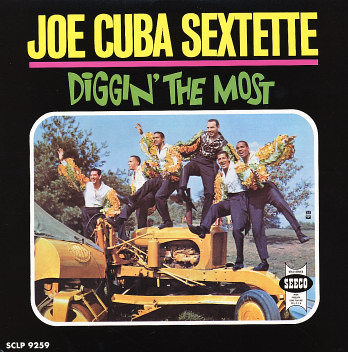
RIP Joe Cuba

RIP Joe Cuba by you.

I discovered Cuba’s work via the Nu Yorica and Nova Classics 01 compilations. Tracks from those compilations that have acquired cult status include “Do You Feel It?[1]” (most likely his interpretation of the Latin traditional “El Ratón[2]), and “El Pito (I’ll Never Go Back to Georgia)[3].”

[Youtube=http://www.youtube.com/watch?v=9-xIxdwpqY8&]

Do You Feel It?

His biggest hit was the 1966 “Bang! Bang![4],” which achieved unprecedented success for Latin music in the United States.

Joe Cuba (1931 – February 15, 2009), was a Puerto Rican musician who was considered to be the “Father of Latin Boogaloo“. The lyrics to Cuba’s music used Spanglish, a mixture of Spanish and English, becoming an important part of the Nuyorican Movement, somewhat the Latin version of the Harlem Renaissance.

Jahsonic’s canon

Surreal Documents writes[1]:

Genealogically, one can link the Medieval coq-à-l’âne to the Renaissance works of Rabelais, to Paul Scheerbart, Christian Morgenstern, Lewis Carroll, Pétrus Borel, Molière, Quirinus Kuhlmann, the Russian and Italian Futurists, and the Dadaists – and from there to ‘Les Légions Noires‘.

Surprisingly, Jahsonic hasn’t posted yet about Mikhail Bakhtin‘s Rabelais and His World

As I’ve commented on Surreal Documents’ blog, I did “blog” on Rabelais and Bakthin back in 2004, but that was before I started the WordPress blog.

Of course it is impermissible that querying Rabelais on this blog brings up naught. Rabelais is canonical to me and my anthology which celebrates laughter and its rhizomatic proxies (theory of laughter, A History of Derision, laughter in literature, history of laughter; (too much overlap there, I will have to sort it out))

To set the omission straight, here is the list of Jahsonic’s canon. A list of individuals who have been formative and continue to be formative. They comprise of 173 people.

A

B

C

D

E

F

G

G cont.

H

J

K

L

M

N

O

P

R

S

T

U

V

W

X

Y

É

For those of you wondering how I arrived at the canon, here is the list of themes and sensibilities that engendered it quite naturally:

A

B

C

D

E

E cont.

F

G

H

I

K

L

M

N

O

O cont.

Q

R

S

T

U