RIP Henri Pachard and World Cinema Classic #64

Henri Pachard died. Henri who? Don’t worry, I hadn’t heard of him either. He was a porn film director, but judging by way of this clip of the 1984 Great Sexpectations[1], one with a sense of humor and an understanding of the film medium, which is rare in the genre,  but successfully displayed in John Byrum‘s Inserts, which to tell you the truth, wasn’t a sex film at all.

[Youtube=http://www.youtube.com/watch?v=V0m42FFeyDY&]

I am quite surprised by this clip of Great Sexpectations. I thought that scripted pornography was a thing of the past after the home video revolution, making way for boring wall to wall sex and killing the softcore and porno chic film industry.

Common wisdom has it that:

“by 1982, most pornographic films were being shot on the cheaper and more convenient medium of video tape. Many film directors resisted this shift at first because of the different image quality that video tape produced, however those who did change soon were collecting most of the industry’s profits since consumers overwhelmingly preferred the new format. The technology change happened quickly and completely when directors realised that continuing to shoot on film was no longer a profitable option. This change moved the films out of the theatres and into people’s private homes. This was the end of the age of big budget productions and the mainstreaming of pornography. It soon went back to its earthy roots and expanded to cover every fetish possible since filming was now so inexpensive. Instead of hundreds of pornographic films being made each year, thousands now were, including compilations of just the sex scenes from various videos.”

I haven’t been able whether Sexpectations was made for a theatrical release or was shot for video. Thanks to Joplinfantasy for uploading this.

Inserts (1975) – John Byrum

Inserts is World Cinema Classic #64. Moon in the Gutter did an article[2] on it.

Service your engine if you want it to function

Fritz Kahn @120

click the images for larger versions and credits

Der Mensch als Industriepalast (Man as Industrial Palace) by Marc Wathieu

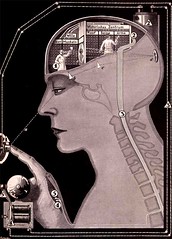
Fritz Kahn was a German writer and illustrator in the 1920s who specialized in illustrating the physical processes of human bodies as though they were machine powered.

Fritz-KahnNEW by raspberryteacup

This man machine trope can also be found in Lee Perry‘s “Throw Some Water In[1] with the lines “Service your engine if you want it to function” by Lee Perry, from his album Roast Fish Collie Weed & Corn Bread .

Der mensch gesund und krank by Marc Wathieu

Additionally Horace Silver and Andy Bey recorded “I Had a Little Talk,” in which the narrator has a little talk with each of his organs:

Das Leben des Menschen... (The Life of Man). Vol. 5 by Marc Wathieu

“I had a little talk with my lungs and I’ve decided to treat them right. We made a mutual agreement and I think, at last we both see the light. ” –Bey/Silver

Man as machine by densitydesign

The Andy Bey track can be found on the Blue Note kozmigroov compilation The United States of Mind.

I almost forgot The Man-Machine, the 1978 album by Kraftwerk, perhaps the ultimate cyborg manifesto.

Icon of Erotic Art #33

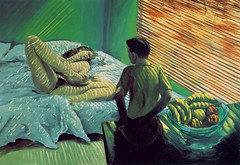
Fischl Eric bad_boy by m_orfeo0111

Bad Boy (1981) by Eric Fischl

Today is Icon of Erotic Art #33 day. Remember this series is handmade, I’m not pulling this out of a list. So it was with great pleasure that I was reminded Eric Fischl‘s Bad Boy painting[1].

Bad Boy (1981) depicts a young boy looking at and older woman shown in a provocative masturbatory (a beaver shot to be precise) pose on a bed, while the subject is surreptitiously slipping his hand into the woman’s purse and presumedly stealing its contents.

The painting unites eroticism and crime, between the two is a very strong link first explored by Sade and verbally juxtaposed by Jules Amédée Barbey d’Aurevilly in Happiness in Crime, a short story first published in the 1874 collection Les Diaboliques. I hope to explore this connection later.

Bad Boy is a painting which provokes the imagination, an equal amount of events seem to be in the painting as outside of it.

I imagine the neighborhood outside the room depicted suburbian. I imagine her husband (she is married and sexually neglected) watering the garden in a David Hockney painting manner. Maybe her husband is taking a A Bigger Splash[2] in their pool. Or the same husband is entertaining his gay lover in Portrait of an Artist (Pool with Two Figures)[3].

Since all figurative painting involving the human figure is narrative painting a number of questions can be raised:

What is the relationship between the older woman and the boy? Is he her son? Or is she barren? Is he a neighborhood boy who entered her house without her knowing? Is the woman aware that she is being stolen from and spied upon at the same time? Is it a game they play regularly and is the boy rewarded the money afterwards? Who is to tell?

What makes European erotic films of the seventies “euro chic” variety particularly interesting …

Giulio Romano 3

[Youtube=http://www.youtube.com/watch?v=EBTM-H74FjE]

Monamour, fresco footage at :10

“I had never heard of Tinto Brass until the late 1970s when I read an interview he gave to Gideon Bachmann in The London Times (Wednesday, 3 August 1977, p. 13). His remarks sufficiently intrigued me to begin a decades-long search, a search that for many years turned up almost nothing apart from tantalizing articles in trade papers. Since the autumn of 2000, though, thanks to friends in Italy, on-line overseas shopping, and eBay, I’ve been able to locate a fair number of Brass’s creations. I had been expecting at least a few of his earlier films to be excellent, but I wasn’t expecting them to be quite as good as they actually turned out to be. –RJBuffalo, a pseudonym of Ranjit Sandhu

This I read in the early 2000s when I discovered the site http://www.geocities.com/busterktn, a site hosted at Yahoo/Geocities, of which the author says it was “deleted without notice or explanation. They deleted all my email messages too.” I believe him. Yahoo did the same to my site in 2004.

Last week, I found the same site, back online, now hosted under its own domain name, http://www.rjbuffalo.com, a pleasure for the eye and the brain.

Brass is one of Jahsonic’s canonical filmmakers. Researching him today brought footage of Monamour, in which Marta visits a museum, I presume in Mantua and admires  scatological (see comment 1) frescoes by – again I presume – by Giulio Romano in – presuming further – the Palazzo del Te.

Giulio Romano

Palazzo del Te frescoes

Giulio Romano 2

Palazzo del Te fresco (detail)

As Sholem Stein has noted: “What makes European erotic films of the seventies “euro chic” variety particularly interesting is the fact that Europe has the scenery, and the best cinematic euro chic erotomaniacs (Tinto Brass, Just Jaeckin, etc…) have put it to use. There is a reason why Radley Metzger came to Europe in the seventies to film his softcore visual extravaganzas.”

Cinema of Obsession


[Amazon.com]
[FR] [DE] [UK]

Researching Dominique Mainon of the previous post brought up Cinema of Obsession: Erotic Obsession and Love Gone Wrong, which came out at Limelight Editions in 2007. An instance of thematic literary criticism studying l’amour fou and other cases of obsessive love.

Of the cover images I can only identify La dolce vita. The bottom right photo is of Barbara Steele, I’m sure, but which film? The man behind the camera is not Peeping Tom, I think. Anyone up for identifying the other films?

New @ Creation Books

Future Fiction is an imprint about to be launched by Creation Books.

Its earliest releases will include Hillary Raphael Ximena and Clarah Averbuck Cat Life.

Ximena

Unidentified cover photo to Hillary Raphael‘s Ximena

Regular Creation Books author Stephen Barber calls Ximena “a sensational new delicacy” and Dominique Mainon says it’s, “a sublime journey”. Clarah Averbuck‘s Cat Life will be the Brazilian author’s first translation into English.

Romy Schneider @ 70 and spiked fences

Spiked fence on the Herbouvillekaai

Spiked fence on the Herbouvillekaai

DSC01219

Spiked fence on the Herbouvillekaai

Spiked fence on the Herbouvillekaai

Spiked fence on the Herbouvillekaai

A tribute to Romy Schneider.
Music by Eric Satie, “Gnossienne No. 5,” played by Pascal Rogé

You are very young and it is a Sunday afternoon. Your parents pass off one of the films in the Sissi trilogy to you as a guilty pleasure.

The “spiked fence” scene is at 4:27

You’re older now. You see a spiked fence in the Hitchcock/Dali film Spellbound. You are – of course – unaware of the Dali connection.

You’re seventeen. Your mother tells you the sad story of Romy Schneider who killed herself after her son David-Christopher had accidentally been killed by trying to climb over a spiked fence.

The”spiked fence” scene is at 2:38

Still older. The spiked fence again. This time in The Virgin Suicides.

Romy Schneider would have been 70 today. Her son 41. Click the images to see the YouTube footage.

One of the most hateful and disagreeable female characters in fiction

[Youtube=http://www.youtube.com/watch?v=V5v0spjsk1Y]

Bette Davis is Mildred Rogers

As noted in a previous post[1] I’ve been reading Of Human Bondage last week. I was particularly piqued by the female protagonist Mildred Rogers, a thoroughly unsympathetic character. One contemporary critic described her as one of the “most hateful and disagreeable female characters in fiction.” After finishing reading (I cried big tears towards the end) I wanted to find out if Mildred was inspired by a real-life love of Maugham, which is only fair given that the novel is auto-billed as semi-autobiographical.

Darragh O’Donoghue over at Senses of Cinema has provided me with a clue on how Maugham achieved such accuracy in describing the bleakness of the human condition in Of Human Bondage, pointing to Maugham’s homosexuality.

“The character of Mildred, according to Maugham’s intimates, was an amalgam of rent boys and lovers: she is often described in masculine terms, while descriptions of female sexuality are coloured with disgust; the narrative of cross-class, unconsummated, elusive desire can be read as a story of thwarted gay love. Some of this is retained in the film, such as the contrast between “abnormal” (because physically maimed), “sensitive” Philip and the raucous sexuality of his friend Griffiths (Reginald Denny), to whom he effectively pimps Mildred, unable to bed either of them.” —Darragh O’Donoghue [2]

Why is it, and I believe I asked this before, that gay men and to a lesser extent women, are so proficient in painting the human condition. Is it because their lenses aren’t “pinked” by images of “knights in shining armor” and parenthood. For examples see for example films like Ozon‘s Water Drops on Burning Rocks and Fassbinder‘s The Bitter Tears of Petra von Kant.

The Human Bondage wikipedia article provides another clue:

“Maugham’s homosexual leanings also shaped his fiction, in two ways. Since, in life, he tended to see attractive women as sexual rivals, he often gave the women of his fiction sexual needs and appetites, in a way quite unusual for authors of his time. Liza of Lambeth, Cakes and Ale and The Razor’s Edge all featured women determined to service their strong sexual appetites, heedless of the result. Also, the fact that Maugham’s own sexual appetites were highly disapproved of, or even criminal, in nearly all of the countries in which he travelled, made Maugham unusually tolerant of the vices of others. Readers and critics often complained that Maugham did not clearly enough condemn what was bad in the villains of his fiction and plays. Maugham replied in 1938: “It must be a fault in me that I am not gravely shocked at the sins of others unless they personally affect me.”

Aside from these attempts at analyses, I cannot recommend Maugham’s writing (my first exposure was the filmed version of The Razor’s Edge by Jahsonic fave John Byrum when I was in Portugal in the mid eighties) highly enough. Maugham missed critical acclaim by his contemporaries because he wrote in a time when experimental modernist literature such as that of William Faulkner, Thomas Mann, James Joyce and Virginia Woolf was gaining increasing popularity and winning critical acclaim. In this context, his plain prose style was criticized as “such a tissue of clichés that one’s wonder is finally aroused at the writer’s ability to assemble so many and at his unfailing inability to put anything in an individual way” (Edmund Wilson, quoted in Vidal, 1990). Another author who equally suffered (but not at the box office), was George Gissing, the hero of The Intellectuals and the Masses.