Sitting on a bench in Antwerp

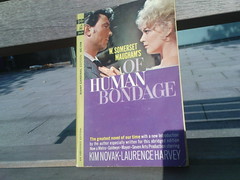
My copy of Of Human Bondage, sitting on a bench in Antwerp

My copy of “Of Human Bondage,” sitting on a bench in Antwerp.

I was recently very irked by a series of posts[1] over at the Anglophone blog Gatochy (known for its excellent image juxtapositions). The posts were about sexual masochism and she painted a ridiculously malinformed picture of the sexual masochist as a person suffering from a mental disorder. When I reacted by guiding her gently towards Zizek‘s Enjoy Your Symptom! she graciously acknowledged to never having heard of him. After an exchange of about 3 comments she proposed to never speak to me again, to which I proposed to oblige, but first pointing her to and quoting from the relevant Wikipedia article which shows that masochism, just like homosexuality is no longer considered a mental disorder.

The results of newer studies have led to calls to abolish sadism and masochism as disease categories completely, arguing that the truly pathological forms are adequately covered by other diagnoses. The sadomasochistic subculture added a political dimension to this drive with claims of discrimination and by pointing to the precedent of removing of homosexuality from the list of mental disorders.

In response, the American Psychiatric Association modified the criteria for sadism and masochism in the Diagnostic and Statistical Manual of Mental Disorders (DSM IV) in 1994 so that consensual sadomasochistic behavior alone is not considered a sexual disorder anymore. In the DSM-IV TR, published in 2000, sadomasochistic behavior can be diagnosed if the patient “has acted on these urges with a non-consenting person” or “the urges, sexual fantasies, or behaviors cause marked distress or interpersonal difficulty,” so consensual sadomasochism can no longer be considered a disease unless it causes severe discomfort. In 1995, Denmark became the first country to completely remove sadomasochism from its classification of diseases.

Our entire conversation – and the comment above – was promptly erased by the author Marianna and I was doubly annoyed. I thought I had done her a favor by showing her the errors of her ways. I dedicate the photograph above to her. May she soon awaken from her obstinate ignorance.


[Amazon.com]
[FR] [DE] [UK]

RIPs

Jamaican reggae singer and producer Bertram Brown died. So did American writer David Foster Wallace. Suicide by hanging for the latter.

[Youtube=http://www.youtube.com/watch?v=O7CbVugPWWM]

The dub of Lot’s wife by King Tubby & Soul Syndicate

Bertram Brown (1950 – September 8th 2008 ) ran Freedom Sounds and worked with Prince Alla, Earl Zero, Rod Taylor, and Philip Frazer. Some of his best work was compiled on Steve Barrow‘s  “Freedom Sounds In Dub” on Blood & Fire.

On a happier note, it’s Amy Winehouse 35th birthday today.

World Music Classics: the first 100

World Music Classic is a series I started on this blog in 2007. Below are the first 100 entries in a project that will eventually include 1001 postmodern world music classics. Most of the entries have YouTube links at the top of the page. Feel free to add missing YouTube connections. The series’ future entries will mainly be posted to my FaceBook account and on my wiki. So it’s a goodbye here as far as regular WordPress/WMC entries go, WordPress/WMC will be reserved for longer articles on particular musical compositions. Hope to see you on FaceBook, for all of you who have yet resisted, I can assure you that FaceBook is an amazingly elegant platform and very suitable to quick and responsive writing.

9

A

B

C

D

E

F

G

H

I

I cont.

J

K

L

M

N

O

P

R

S

S cont.

T

W

Y

Z

The 50th anniversary of the integrated circuit: a love song to the computer

In search of computer love.

“In 1959, Texas Instruments’ Jack Kilby files the first patent for an integrated circuit. (Texas racists later run him out of town, crying “segregation forever!”)”

Today, 2008 September 2, is the 50th anniversary of the integrated circuit, and invention that lead to electronic music, Japanese music machines, personal computers, the internet, bitpop and YouTube, to name but a disparate yet connected few.

Much of what we now call the origins of postmodernity coincides with the “microchip revolution or digital revolution,” aptly described by techno-utopian writer Alvin Toffler in Future Shock (1970) and The Third Wave (1980) .

With “Computer Love” (1981), Kraftwerk became the first German musical ensemble to hit No. 1 on the U.K. music charts and the first band to reach an audience with a love song to the computer.

Zapp and Roger also professed their love for man’s best friend in “Computer Love”[3] (1985).

Computer love can lead to computer addiction. By the mid eighties most traditional orchestration was replaced by “Japanese music machines” in Western music. Marvin Gaye’s single “Sexual Healing” lead the way.

An outright celebration of the electronic aesthetic came with electronic disco (“I Feel Love,” “Do You Wanna Funk”), electro funk (“Planet Rock”), techno (“Techno City”) and house music(“Your Love”); while previously non-electronic genres such as reggae also took up the aesthetic (Sleng Teng), but nowhere was this man/machine love affair so strong as in acid house (“I Got a Big Dick”).

Several of these compositions are WMCs.

See also: The Electronic Revolution.

I wasn’t going to write about this

A moment of silence…

I wasn’t going to write about this, but then John from Uncertain Times posted the picture shown to the left, possibly the most haunting photo since this one. It is so easy to get caught up in the rhetorics of the Situationist spectacle when discussing 9/11, that one tends to forget these “little” tragedies, such as the man jumping on the photo, whose last two seconds of life are worth a novel in itself. 9/11, that titanical and hyperreal event, has shaped us all and I really feel sorry for all concerned. But we will never be forgiven if – at the same time – we do not think about thousands dying every day of famine.

See also:

9/11: The Falling Man

Cult fiction item #10; unabashed male opinions

DSC01048

My edition of Cocaine (in a 1982 translation by Frédérique Van Der Velde for the Dutch-language imprint Goossens, which also published translations of Thérèse philosophe, Villon, and Aretino)

“Not since Of Human Bondage have I read a more poignant rendition of the human condition,” and “after The End Of The World Filmed By An Angel possibly the second surrealist novel” wrote American literary critic Sholem Stein in a rare review of Cocaina in 1922.

Cocaina is a 1921 Italian novel written by Pitigrilli, a pseudonym of Italian journalist and author Dino Segre.

The novel, set in Paris and dedicated to cocaine use, was banned when it was published due to its liberal use of explicit sex and drugs.

The protagonist is Tito Arnaudi, a young Dostoevskian nihilist who travels from his home town Turin to Paris after a failed love story. There he discovers the joys of cocaine, takes a job as a journalist and meets two women: the exotic and orgiastic Kalantan Ter-Gregorianz and the tawdry cocotte Maud Fabrège. Maud, who later in the story is renamed to Cocaina (she is the personification of the effects of cocaine, at first lively and spirited, later jaded and blunt) is his femme fatale. Tito falls in love with her despite her apparent infidelity and despite of her sterilization which he knows is bound to make her ugly and less feminine.

The novel is full of unabashed male opinions on women and love and ends with an original “Russian roulette” twist.

I read in three days, and never felt the urge to quit reading. I laughed out loud at least three times. An underrated masterpiece. See also drugs in literature and cocaine in literature.

More covers:

Cocaine (1921) – Pitigrilli [Amazon.com] [FR] [DE] [UK]

Hector Zazou (1948 – 2008)


[Amazon.com]
[FR] [DE] [UK]

Uncertain Times reports the death of Hector Zazou (1948 – 2008).

http://www.youtube.com/watch?v=1y-40ENc9n4

Strong Currents by Hector Zazou was released in 2003 and featured an all-female vocal cast which included Laurie Anderson, Melanie Gabriel, Lori Carson, Lisa Germano, Irene Grandi, Jane Birkin, and Caroline Lavelle. Musicians included Ryuichi Sakamoto, Dennis Rea, Bill Rieflin and Archaea Strings. The album took six years to complete.

In 2003 DJ Martian recommended “M’Pasi Ya M’Pamba”, “a weird afro-electro Fela Kuti meets Kraftwerk track produced by Hector Zazou.”–DJ Martian[1]