It is my fashion to view people’s careers in terms of their controversies and their influences outside of their own fields.
Darwin’s claim to fame in this context is that he said we are of common descent with “apes.”
Charles Robert Darwin (February 12, 1809 – April 19, 1882) was an eminent English naturalist who achieved lasting fame with his 1859 book On the Origin of Species which established evolution by common descent as the dominant scientific explanation of diversification in nature.
Influence on Naturalism
Writers who belong to the 19th century literary school of Naturalism were influenced by the evolution theory of Charles Darwin. They believed that one’s heredity and social environment decide one’s character. Naturalism attempts to determine “scientifically” the underlying forces (i.e. the environment or heredity) influencing these subjects’ actions. In fact, Zola wrote a long essay in which he mentioned Darwin in relation to contemporary literature. The essay was called The Experimental Novel and described the process of writing a novel as an experiment, in which the writer introduces “characters”, and the outcome is determined by heredity and mileu.
He wrote:
Sans me risquer à formuler des lois, j’estime que la question d’hérédité a une grande influence dans les manifestations intellectuelles et passionnelles de l’homme. Je donne aussi une importance considérable au milieu. Il faudrait sur la méthode aborder les théories de Darwin; mais ceci n’est qu’une étude générale expérimentale appliquée au roman, et je me perdrais, si je voulais entrer dans les détails.
If I remember correctly, Naturalism in literature shares its etymological roots with the Natural Sciences, of which Darwin was a practitioner.
Henri Bergson was highly influenced by biology, particularly Charles Darwin‘s On the Origin of Species, which was released the year of Bergson’s birth. This leads Bergson to discuss the ‘Body’ and ‘Self’ in detail, arguably prompting the fundamental ontological and epistemological questions to be raised later in the twentieth-century French philosophy.
British cultural critic John Ruskin (1819 – 1900), who I’ve mentioned here[1] would have turned 190 today if such a thing were possible.
By the same token, German cultural critic Siegfried Kracauer (1889 – 1966), would have celebrated his 120th birthday. I’ve mentioned him here[2] and here[3].
John and Siegfried were both cultural critics. Ruskin largely dealt with pre-industrial society, Kracauer with modern mass culture.
John Ruskin is best known for his work as an art critic and social critic, but is remembered as an author, poet and artist as well. Ruskin’s essays on art and architecture were extremely influential. He is perhaps best-remembered for the books Modern Painters, The Stones of Venice; the speculations surrounding his sexuality; and the art controversy with James Whistler on Nocturne in Black and Gold, the Falling Rocket.
Siegfried Kracauer was a German-American writer, journalist, sociologist, and cultural critic, particularly of media such as film, as well as the urban form. His best-known work is From Caligari to Hitler (1947), which traces the birth of National Socialism via the cinema of the Weimar Republic.
Kracauer analyzed and critiqued the phenomena of modernism’s mass culture. He built up a general theories based upon dozens of smaller examples. His attention to detail lends itself to an inductive method. He was one of the first to treat the cinema seriously; in it he saw a mirror of social conditions and desires.
He applied his methods in such works as The Detective Novel, The Mass Ornament, The Salaried Masses, From Caligari to Hitler: A Psychological History of the German Film and Theory of Film: The Redemption of Physical Reality.
German edition of From Caligari to Hitler
I like to imagine that From Caligari to Hitler sheds light on the process of desiring-production by Deleuze and Guattari on the one hand and Wilhelm Reich’s fundamental question — why did the masses desire fascism? on the other.
Desiring-production is a term coined by the French thinkers Gilles Deleuze and Félix Guattari in their book Anti-Œdipus (1972). They oppose the Freudian conception of unconsciousness as a “theater”, instead favoring a “factory” model: desire is not an imaginary force based on lack, but a real, productive force. They describe the mechanistic nature of desire as a kind of “Desiring-Machine” that functions as a circuit breaker in a larger “circuit” of various other machines to which it is connected.
Butler wants you to know that the works he pointed to are for reference only and may not correspond to the works at the exhibition. He also wants you to know that some of the links may be NSFW.
The first film was The Wicker Man. To my knowledge, the transcripts of the introductions by Cox were not published. I do suggest that any serious film student would “read” them from start to finish. I wish I could.
Update:
Maybe there is a way to find the missing texts. Cox has just published an autobiography so it seems.
Aristotle, had I known him, would have answered me:
Objects which in themselves we view with pain, we delight to contemplate when reproduced with minute fidelity: such as the forms of the most ignoble animals and of dead bodies. —Aristotle via the Poetics.
Googling for “indescribability” brings up this interview regarding the sublime, indescribability and mountain literature and mountain art.
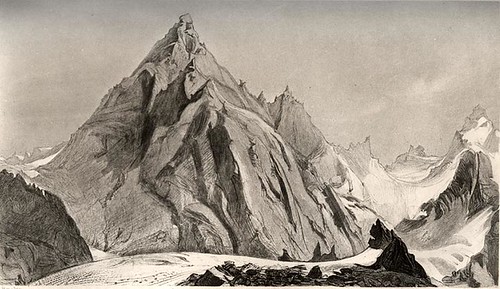
The trope of unrepresentability is probably the commonest of all in mountain literature and art: the throwing up of the hands, the confession of the inadequacy of representation to catch the phenomena of the mountain world. I remember reading the journal of an Edinburgh bishop from the 1760s who’d gone on a mini-Caledonian tour. He writes: “I looked north and saw rank on rank of unspeakably beautiful…” He crosses out “unspeakably”—he’s obviously unhappy with it—and writes instead “mountains so beautiful I could not describe them.” Then he crosses that out, and we get four synonyms for “indescribable,” the first three crossed out. What’s exciting about Ruskin is that instead of acquiescing to indescribability, he tries to enact it, to let his art or prose take the forms of their subjects. In his drawing of the Glacier du Bois, near Chamonix, for example, the whole image is vortical; everything is being tugged by some centripetal force which has no apparent center but which is clearly at work. It’s hard to say what that force is, but it has something to do with time, a kind of deep time that is at work in that viewing moment. The glacier looks like a river in flood, in spate; the sun looks to have been absorbed by it, and there’s an inexplicably detached tree bole and root in the foreground. Even his curving signature seems to be vulnerable to the vortex. –Brian Dillon interviewing Macfarlane [2]




![[1]](http://www.toutfait.com/issues/issue_2/Art_&_Literature/images/EtantDonnes.jpg)
![[2]](http://remue.net/IMG/jpg/image_Baquie.jpg)
![[3]](http://www.zwirnerandwirth.com/exhibitions/2001/112001ProperMeaning/images/doll.jpg)
![[4]](http://images.artnet.com/artwork_images_424149003_242768_robert-mapplethorpe.jpg)
![[5]](http://www.19thc-artworldwide.org/autumn_02/reviews/gr/hack_1b.jpg)
![[6]](http://c.paulve.free.fr/contenu/polad-hardouin/images_intranquilleamour/FINDAMgd.JPG)
![[7]](http://koninkrijksprookjes.web-log.nl/photos/uncategorized/extasis.jpg)
![[8]](http://blogs.warwick.ac.uk/images/michaelwalford/2006/11/23/erich_heckel_man_and_woman_1909.jpg)
![[9]](http://www.paleothea.com/Pictures/PhryneAreopagusGerome.jpg)
![[10]](http://i3.photobucket.com/albums/y89/gordoncupcake/artblog5/Berlinde_de_Bruyckere_horses_klein.jpg)
![[11]](http://www.hyperrealism.net/photos/roland%20delcol.jpg)
![[12]](http://www.hueppi.de/titel.jpg)
![[13]](http://www.crywalt.com/blog/images/20061221/john_currin.grab.png)
![[14]](http://www.tinyways.com/media/img/lisa_yuskavage/lisa_yuskavage_01.jpg)