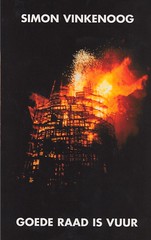
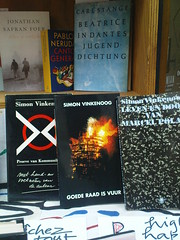
Goede Raad is Vuur is a Dutch language poetry anthology and at the same time a theory of poetry, first published by Simon Vinkenoog in 2004.
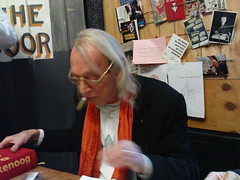
Simon Vinkenoog is the Dutch Timothy Leary, just as Jean-Jacques Lebel was the French Timothy Leary, see counterparts.
The book is the definitive guide to cult poetry and begs for a English translation.
In this collection for example: “The Right Mask” by Brian Patten in a Dutch translation more powerful than its English original:
One night a poem came up to a poet.
From now on, it said, you must wear a mask.
What kind of mask? asked the poet.
A rose mask, said the poem.
I’ve used it already, said the poet,
I’ve exhausted it.
Then wear the mask that’s made out of
a nightingale’s song, use that mask.
Oh, it’s an old mask, said the poet,
it’s all used up.
Nonsense, said the poem, it’s the perfect mask,
still, try on the god mask,
now that mask illuminates heaven.
It’s a tight mask, said the poet,
and the stars crawl about in it like ants.
Then try on the troubador’s mask, or the singer’s mask,
try on all the popular masks.
I have, said the poet, but they fit so easily.
There are many things to be said about Wim T. Schippers, but since I write this blog in English and most of my readers are from all over the globe, these things will be of interest to few. Suffice it to start by saying that Schippers belongs to the Dutch Dada tradition.
Digression #1
I say Dada because Surrealism is to weak a word; and it can be agreed upon that surrealism was not but an insipiddecoction of Dada; Dada having the chronological benefit of course. On the other hand, I realize there is no use bemoaning the insipidness of Surrealism, since Surrealism was its best possible replacement. Nevertheless, Surrealism to my liking has always been too formalistic and dogmatic.
In discussing Schippers, a number of comparisons are called for. In the Dutch language geographical area, we have Doctorandus P. whom I celebrated here[1] and [2] and who is most certainly a precursor of Schippers. Internationally, one can compare Schippers to Monty Python.
[Youtube=http://www.youtube.com/watch?v=_azDvJdRC2Y]
Famous banana clip (I can’t hear you, I have a banana in my ear!)
Now the force of Schippers resides in his mainstream influence, most Dutch-speakers know him without knowing him, he is voice actor of a number of voices of the local version of Sesame Street, most famously Ernie. In The Netherlands he is also known by face as the presenter of a popular science quiz show.
Outside of some dim recollections of his 1970s TV shows, he crossed my personal path each Wednesday afternoon when I listened to his radio show on VPRO (Schippers in the persona of Jacques Plafond (Eng: Jacques Ceiling) [3]. These shows were hilariously irreverent. It was love at first sight.
Shit, I forgot my car, from a Sjef Van Oekel comic
Later still, there were the comics of Sjef Van Oekel, the brain of which was again Schippers.
In Belgium, the Dutch-speaking part where I live, there are two soul brothers of Schippers: Kamagurka and Herr Seele. And perhaps Hugo Matthysen.
Bathing in an almost infantile innocence, Domai’s content[3] is a welcome interruption to the more explicit and sometimes abjectstroke material most of us find on our internet travels.
Their editors are have a sense of humor and a level of sophistication:
“Last Sunday I was up early for once. (To quote Robert Heinlein: “Progress isn’t made by early risers. It’s made by lazy men trying to find easier ways to do something.”) I went for a walk in the quiet town.”–Eolake Stobblehouse via [4]
The pre-internet world was literally a terra incognita. If one found a record by Fela Kuti, one had to find good sources to discover the rest of his releases. Today we’ve moved to a terra cognita. One glance at Discogs is enough to discover the oeuvre of Fela.
What we still need though, in spite of the terra cognita situation, are tastemakers. Biased tastemakers.
Simon Reynolds has blamed the terra cognita thing for the supposed death of the underground, he will be hosting a conference on this soon[2].
He stated on this before:
“The web has extinguished the idea of a trueunderground. It’s too easy for anybody to find out anything now, especially as scene custodians tend to be curatorial, archivist types. And with all the mp3 and whole album blogs, it’s totally easy to hear anything you want to hear, in this risk-less, desultory way that has no cost, either financially or emotionally.”Simon Reynolds via woebot.
One more word on Fela. Woebot once said – I paraphrase – “I’ll take King Sunny Adé over Fela Kuti any day. Too much redundancy in Fela.”I disagree. I like long pieces and love Fela’s trance. Which reminds me, I miss Woebot.
“Sunny Ade gets my vote over Fela Kuti anyday. There’s too much redundancy in Fela’s music, saxophones and organs meandering all over the place. Shaggy ain’t my thing. While the political ire and philosophical stance of something like “Kalakuta Republic” are rousing, in preference I’ll take the sheer sonic thrill of Tony Allen‘s edge-of-climax drum pans on the more “superficial” dance craze record “Open and Close“. That record retains the JB‘s hyper-tense instrumental dynamics and one-mind co-operation, without degenerating into marijuanamiasma.”[3]
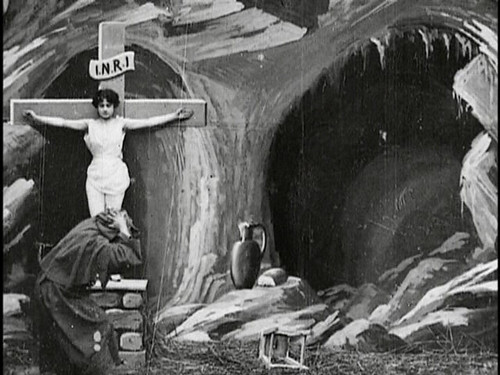
Saint Anthony has not been popular among writers nor filmmakers but has been very influential to painters, the dream visions lend themselves perfectly to exploring taboo subject matter.
Although Max Ernst‘s rendition (here[5] in a better scan) was the winning work, Salvador Dalí‘s contribution[6] (featuring a parade of spider-legged elephants tormenting the saint) went on the become better-known.
The Divine Comedy exemplifies the conventions of dream-vision literature, though Dante specifically says that his Comedy is not a dream vision.
I guess what this post comes down to is the boring but somehow unavoidably attractive “literature vs. cinema” debate I’ve been engaging in.
The debate is boring when you limit it to either/or, but of interest if you view it from its technical angle, with fiction at the center, and medium-specificity at its perifery.
Notions such as unfilmability provide the best entry point.
“Romantic authors such as Novalis or Jean Paul, while anticipating the Expressionist notions of visualdelirium and of a continual state of effervescence, also seem almost to have foreseen the cinema’s consecutive sequences of images. In the eyes of Schlegel in Lucinde, the loved one’s features become indistinct: ‘very rapidly the outlines changed, returned to their original form, then metamorphosed anew until they disappeared entirely from my exalted eyes.’ And the Jean Paul of the Flegeljahre says: ‘The invisible world wished, like chaos, to give birth to all things together; the flowers became trees, then changed into columns of cloud; and at the tops of the columns flowers and faces grew. In Novalis‘s novel Heinrich von Ofterdingen there are even superimpositions.”
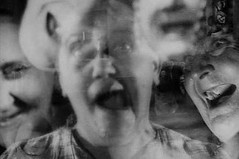
Example of a superimposition in The Last Laugh (1924) – Murnau
She concludes:
“It is reasonable to argue that the German cinema is a development of German Romanticism, and that modern technique [cinematography] merely lends visible form to Romantic fancies.”







![[1]](http://mandyssexlife.blogspot.com/Domai%20nudes11.jpg)
![[2]](http://bountifulcurves.com/domai_full_figure_nude_women_images/domai_gigi_full_figure_nude_women_001.jpg)
![[3]](http://claudet.club.fr/Milhaud/MilhaudParMilhaud/PrivateAffairsOfBelAmi.jpg)
![[5]](http://bp0.blogger.com/_FupxBtRPAbY/R-l_F0LmtkI/AAAAAAAAA9U/cAk0dfGh6BU/s1600-h/max_ernst_anthony.jpg)